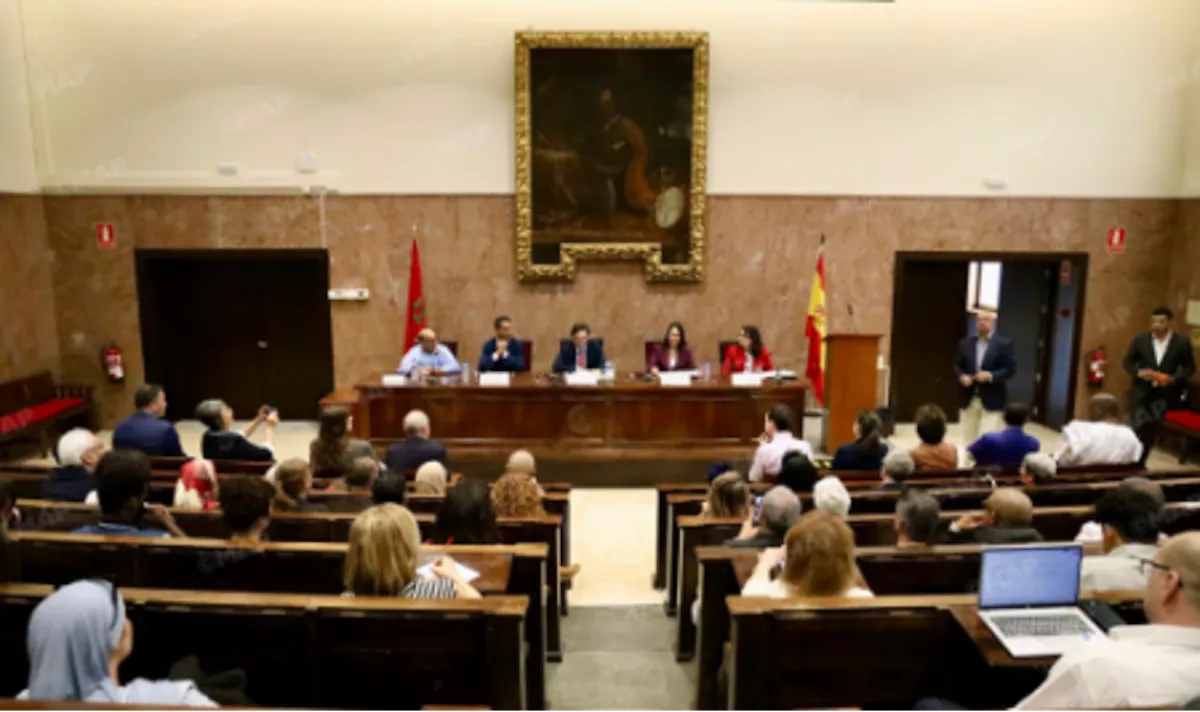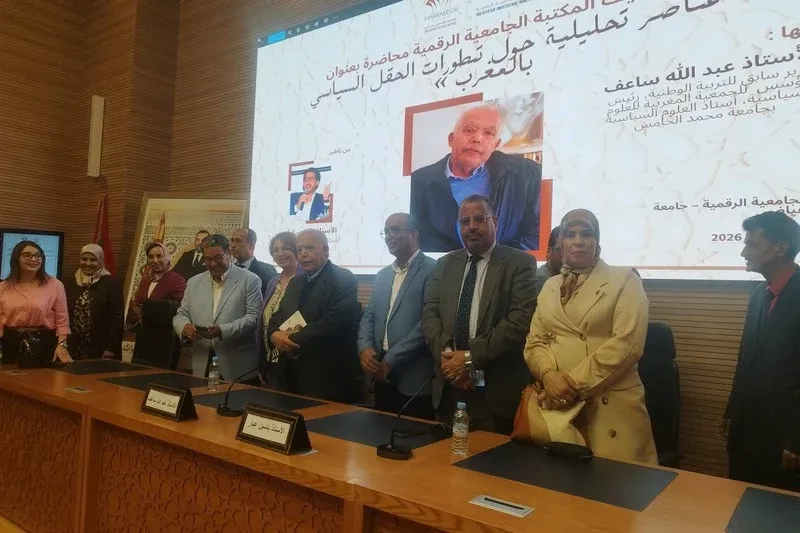
The University of Cadi Ayyad's digital library recently hosted Moroccan thinker and academic Abdullah Saaf for a lecture centered on the transformations in the Moroccan political landscape. The event attracted a diverse audience, including academics, researchers, and journalists, highlighting the significance of such discussions in the academic realm.
During his presentation, Saaf emphasized the crucial role that university spaces play in fostering intellectual discourse and linking culture with societal changes. This is particularly relevant in the context of rapid digital transformations and their impact on contemporary modes of thinking. He raised a critical question regarding the relationship between change and continuity, arguing that political transformations do not necessarily result in a complete break from the past. Instead, they may lead to the reproduction of existing structures in new forms. Saaf pointed out that the concept of "political transition" is a more accurate descriptor of the Moroccan situation than that of "democratic transition."
In his discourse, Saaf addressed various transformations tied to the social structure, including demographic changes and the emergence of new family models. He noted the persistence of state centrality, alongside a decline in the traditional mediation roles previously held by elites, which is being replaced by new forms of expression emerging within society. Furthermore, he highlighted the evolution of power dynamics, suggesting a shift towards negotiating and governance mechanisms rather than relying solely on rigid approaches, especially in a context characterized by an increasing overlap between political and economic spheres.
The lecture also touched upon what Saaf termed the "administrative state," where technical approaches take precedence over ideological ones, coinciding with the rise of new actors, particularly within the digital space. The event concluded with an interactive discussion that focused on the prospects for political reform and the limitations of change, as society continues to balance the demands of modernization with the continuity of existing structures.
As reported by hespress.com.