Morocco's Accelerated Military and Economic Modernization
In recent years, Morocco has embarked on an ambitious journey to modernize its military and economy, significantly aided by the United States. This modernization drive is set to grant Morocco access to advanced technologies, including the highly sought-after F-35 fighter jets and NATO systems, over the next decade. As a result, the military capabilities gap between Morocco and Spain is narrowing, although Spain still maintains its dominance, particularly in naval and technological realms.
In 2025, Morocco's defense budget is projected to reach unprecedented levels, constituting nearly 10% of its GDP. This expenditure is anticipated to stabilize around 6% by 2036, with substantial investments earmarked for artillery, armored vehicles, and aviation. Despite Morocco's military buildup, experts remain skeptical about the prospect of direct conflict, highlighting instead the rising concern over hybrid warfare tactics and the increasing technological sophistication in the region.
A Shift in Regional Dynamics
While Spain retains its strategic superiority in the southern flank, the equilibrium in the Mediterranean is no longer firmly established. Morocco's forward momentum in military and economic modernization towards 2036 is gradually bridging the capabilities gap. Although Spain still holds an advantage, Morocco's advancements present a scenario of growing convergence, where both quantitative and qualitative asymmetries are steadily diminishing.
The recent cooperation agreement signed between Rabat and Washington for the next decade will enable Morocco to acquire numerous weapons systems previously beyond its reach, including the coveted F-35 jets and advanced command and control systems. By 2025, Morocco's economy is projected to grow to $155.43 billion, with a growth rate of 3.8%, as reported by the World Bank, solidifying its position as one of the most dynamic economies in the Maghreb. Nevertheless, the structural gap with Spain remains significant, with the Spanish economy expected to close 2025 at approximately $1.9 trillion, reflecting a 2.8% increase.
The current snapshot, however, conceals a clear trend. Projections for 2036 indicate converging trajectories: Spain is expected to evolve into a mature economy of $2.45 trillion, albeit with deceleration, while Morocco could nearly double its economy to $315 billion. This convergence is particularly evident in defense, with Morocco planning an unprecedented military investment of 157 billion dirhams (approximately 14.5 billion euros) for 2026, aimed at multi-year commitments for weapons acquisition and maintenance.
Strategically, Morocco's modernization efforts are designed to enhance its weapon systems, close the technological gap, and gain leverage in a region characterized by rivalry with Algeria, instability in the Sahel, and persistent pressure regarding Ceuta and Melilla. The significant increase in Morocco's 2025 defense budget—up by 17.8%—positions its military expenditure around 10% of its GDP, a level typically associated with countries undergoing intensive rearmament cycles. Although this spending is likely to decrease slightly in subsequent years after solidifying its military modernization plan, the implications for regional security dynamics are profound.
Meanwhile, Spain has initiated its own shift in defense strategy. In 2025, defense investment will reach 33.589 billion euros, aligning with NATO's commitment to allocate 2% of GDP for defense, with potential for growth reflecting new strategic demands from the EU and the Atlantic Alliance. However, this level remains distant from the 5% of GDP that former President Donald Trump suggested as a benchmark for NATO allies by 2035, amid increasing pressures over burden-sharing within the Western bloc, particularly as Trump has consistently criticized Spain for its perceived lack of commitment to this goal.
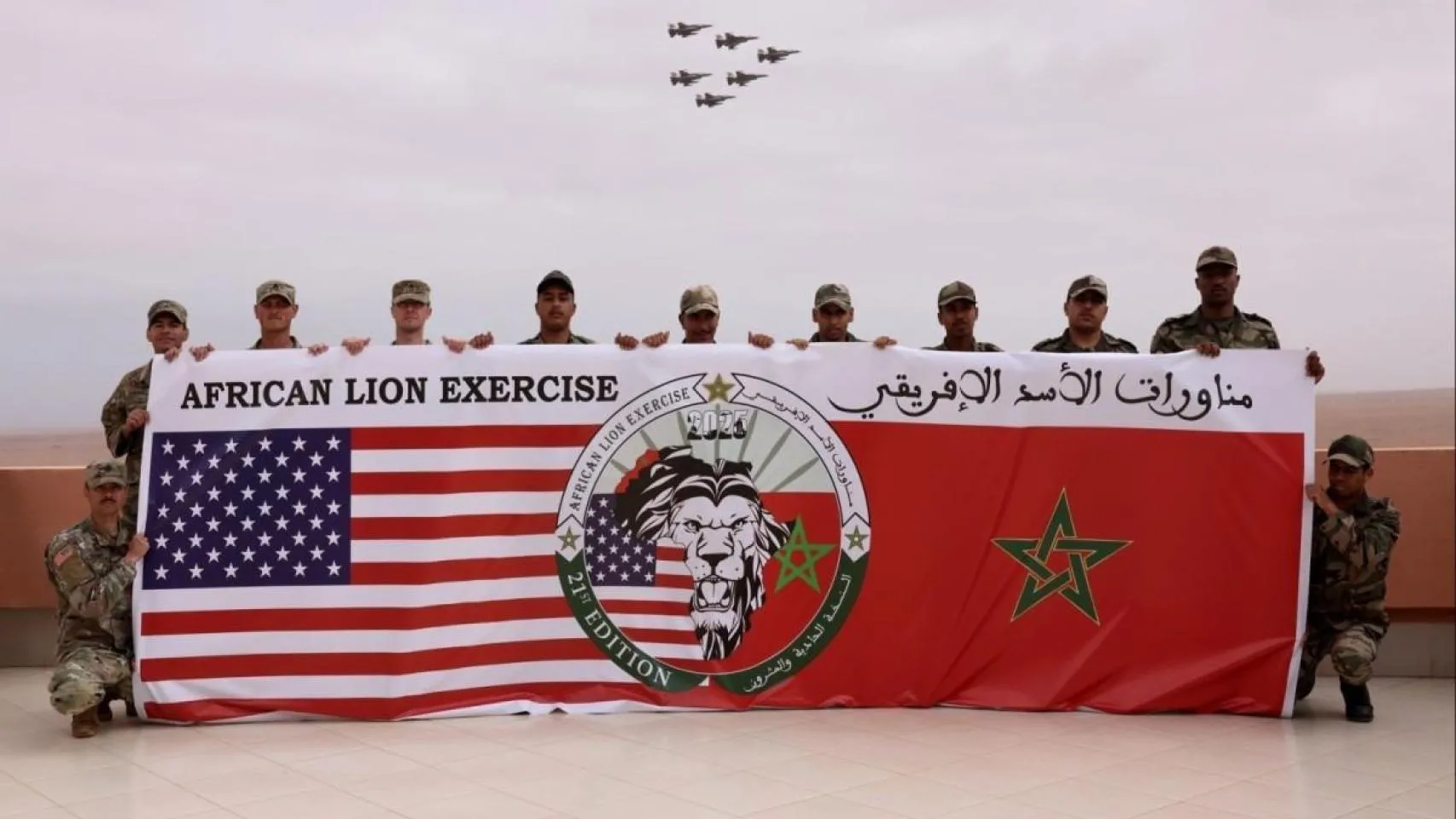
In this evolving landscape, Rabat is also enhancing its international positioning: the ten-year agreement allows Morocco to acquire equipment under NATO standards. Signed on April 16 in Washington, this agreement outlines a defense cooperation roadmap for the period from 2026 to 2036, expanding the framework initiated in 2020 and solidifying access to technology, industry, and advanced systems. General Francisco José Dacoba, a retired brigade general and former director of the Spanish Institute for Strategic Studies, emphasizes that while Spain retains military superiority over Morocco, the margin is no longer as pronounced. He notes, "We still have an acceptable gap in our favor, but it is true that it is closing because Morocco's recent acquisitions are quite substantial."
Despite the prevailing perception that a direct confrontation is unlikely, experts like Dacoba express concern over the narrowing operational distance between the two nations: "As a Spaniard, the fact that this gap is closing does not reassure me." As Morocco continues to modernize its military capabilities—projecting a GDP of $315 billion by 2036 and stabilizing its defense spending at 6%—the nation is expected to consolidate military investments nearing 18.9 billion annually. While this figure gradually reduces the distance with Spain, achieving total budgetary parity would still require several decades. Nevertheless, Morocco's financial muscle will not only translate into the acquisition of cutting-edge platforms—such as fighter jets, missiles, and armored vehicles—but also grant access to critical technologies like the Link-16 tactical communication system, previously restricted to NATO partners, and the long-negotiated F-35 jets.
Thus, Rabat is not merely seeking firepower; it aims to establish strategic influence in a region where economic and security dimensions are increasingly interlinked. Despite Morocco's recent dynamism, international indicators continue to affirm Spain's military hegemony. The Global Firepower Index, which audits the military potential of 145 nations, ranks Spain 17th while placing Morocco at 59th.
General Dacoba succinctly summarizes this historical evolution on the southern flank: "Traditionally, we have always had more capabilities in general terms than they do." However, he nuances the current scenario by recognizing the contemporary arms race in the region: "It is true that lately they are rearming considerably. We also want to do so with the new increases in military spending." He adds, "Morocco has acquired many weapons systems such as Apache helicopters, missiles, and F-35s, and many other capabilities that have yet to arrive and will take years to materialize." Moreover, various military sources consulted agree that Spain's superiority is less about quantitative factors and more rooted in structural elements. "Spain still maintains a tremendous military advantage over Morocco," they assert decisively.
The key to this disparity lies in autonomy and technical development, areas where Spain operates on a different level: "We have an industrial base that they will never have; we possess extraordinary technological power." Regarding the contentious issues of Ceuta and Melilla, military experts consulted by EL ESPAÑOL exercise caution. Despite the accumulation of military resources on both sides of the Strait, the primary concern of Spanish intelligence is not a frontal clash. Instead, the focus is on hybrid warfare actions: from instrumentalized migration and disinformation to sabotage and cyberattacks. General Dacoba and other defense experts consulted for this article dismiss the likelihood of a direct conflict, stating, "There is no sense in a military conflict, in principle, between Spain and Morocco," while also considering the deterrent cost: "A military operation would raise numerous doubts, significant inconveniences, and probably an unbearable international condemnation."
No one can predict with certainty how the military balance between Spain and Morocco will evolve over the next decade, but current trends allow for a plausible scenario to be drawn. As of now, Morocco surpasses Spain in active military personnel, with nearly 200,000 active military and 150,000 reservists, compared to Spain's 133,000 soldiers and 15,000 civilians in reserve. In contrast, Spain maintains a quantitative advantage in aerial vectors, operating 461 aircraft compared to Morocco's 260, although Rabat is steadily modernizing its capabilities, potentially reducing this gap. In the air domain, the Spanish Air and Space Force sustains its projection capabilities with Eurofighter Typhoon and F/A-18 Hornet fighters.
However, the replacement of the latter is already underway: Spain plans to incorporate 45 new Eurofighters (Hawk Programs), which will further consolidate a more homogeneous fleet. Concurrently, strategic transport capabilities are being reinforced with the Airbus A400M and the conversion of Airbus A330 MRTT aircraft for aerial refueling, a critical force multiplier. Meanwhile, Morocco has opted for selective modernization. Its fleet of F-16 Fighting Falcons will be bolstered by 25 additional Block 70/72 (Viper) aircraft. In the medium term, Rabat may complement this capability with attack UAVs like the MQ-9 Reaper and MIM-104 Patriot air defense systems.
The potential acquisition of the F-35 Lightning II remains on the table, which would signify a significant qualitative leap, although military experts caution that "these will not arrive before 2040." They also warn of the dependency on the supplier: "Those F-35s will fly as long as the United States wants... if they stop providing updates or block the system, you won't be flying anymore." Additionally, they could come with limitations preventing strikes against allied nations or incorporating many restrictive clauses. In the rotorcraft segment, Spain will modernize its 18 Tiger helicopters to the MKIII standard, while Morocco takes the regional lead with the receipt of 24 AH-64E Apaches.
In the armored domain, the Royal Moroccan Army is solidifying its position as one of Africa's strongest forces by operating the American M1A2 Abrams. Although the opacity of Rabat complicates the exact balance, it is estimated that 200 units are in service, with an additional 150 on order. Since 2018, Morocco has sought to elevate these armored vehicles to the SEPv3 standard (improved armor and combat system), relegating its Chinese VT-1A units and obsolete Soviet T-72 tanks to a secondary role. Spain counters with a force of 220 Leopard 2E tanks (based on the Leopard 2A6) and around fifty 2A4 tanks. The Army plans to initiate this year the upgrade of its platforms to the 2A8 standard, the current reference in Europe.
The most pronounced asymmetry arises in long-range artillery. While Spain operates fewer than one hundred M109 howitzers and plans their future replacement, Morocco already exceeds that number with more modern versions. Furthermore, Rabat has gained an advantage in rocket artillery with Chinese systems (WS-2D and PHL-03), the Israeli PULS system—already operational—and the future incorporation of the American HIMARS, equipping Morocco with a saturation and precision capability that Spain currently lacks (awaiting the SILAM program). In the maritime domain, Spanish superiority remains clear and, for the time being, absolute. The backbone of the Spanish Navy is supported by its five F-100 'Álvaro de Bazán' class frigates, units focused on air warfare, considered among the best platforms of their kind globally.
In contrast, Morocco's flagship is a single FREMM multipurpose frigate, whose surface and anti-submarine warfare capabilities are more comparable to Spain's F-80 frigates (Santa María class), whose operational life the Navy is currently evaluating for extension. In lower ship categories, Morocco has high-seas patrol boats and smaller corvettes, even retaining units purchased from Spain in the early 1980s. However, the disparity becomes vast when analyzing strategic projection and submarine capabilities. Beyond the F-100s and future F-110s, Spain possesses an ambitious program for domestically developed submarines, with the S-81 'Isaac Peral' and the S-71 'Galerna' currently active; a capability that represents one of the historical shortcomings of the Alaouite kingdom. Additionally, the Navy operates the LHD 'Juan Carlos I', fulfilling aircraft carrier functions, along with two amphibious assault ships of the 'Galicia' class.
Given the technical complexity and extended development cycle of naval systems, which can exceed ten years, Spanish hegemony in this domain is assured for the foreseeable future. While Rabat explores the incorporation of its first submarines or new surface units over the next decade, Spain's structural advantage is poised to remain unchanged for a significant period. Overall, the horizon for the next ten years points towards partial convergence: Morocco will continue to close distances through the acquisition of advanced systems—particularly in air and artillery—while Spain will maintain its structural advantage in naval capabilities, strategic projection, and integrated systems. The outcome will not be a complete equilibrium, but rather a gradual narrowing of the gap, fostering a more competitive and technologically sophisticated environment along the European southern flank.
As reported by elespanol.com.