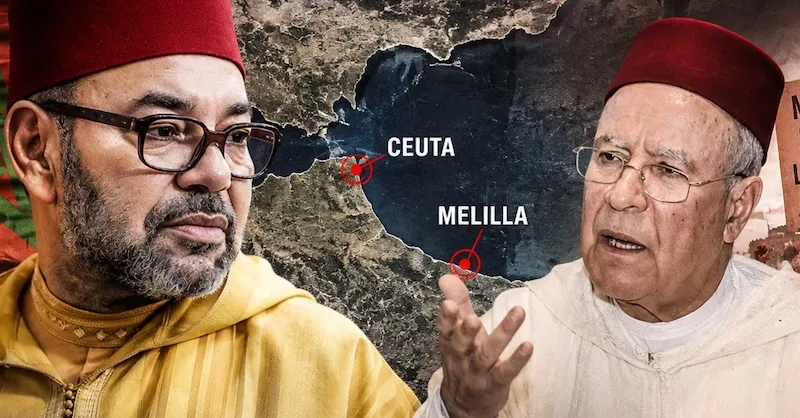

Morocco has once again placed Ceuta and Melilla at the forefront of its territorial discourse. During a religious ceremony held in Rabat by King Mohammed VI to commemorate the Al Mawlid festival, Minister of Islamic Affairs Ahmed Toufiq made a new reference to the two Spanish cities and Morocco's historical claims over them. Although Toufiq did not formally demand annexation in the manner recently expressed by other Moroccan government officials, his speech openly revived the language of "liberation of occupied cities." He referenced several ulemas and scholars born in Ceuta prior to Spanish sovereignty, presenting their works as inspiration for the "sacred struggle" aimed at liberating territories that Morocco considers occupied.
This intervention comes mere days after Moroccan Justice Minister Abdellatif Ouahbi explicitly asserted Morocco's alleged "historical and geographical right" over Ceuta and Melilla, calling for a dialogue mechanism with Spain to address their future and achieve their "return to the homeland." In response, the Spanish government reiterated that both cities are an integral part of Spain's sovereignty and territorial integrity, firmly rejecting any alternative proposals.
Religious Factors Gain New Dimensions
Toufiq's remarks hold particular significance due to the role of the Ministry of Habous and Islamic Affairs in Morocco's religious structure and the sustained influence this department has maintained over a significant portion of the mosques and Muslim religious personnel in Ceuta. Recent data indicates that Morocco finances 34 mosques in Ceuta and the salaries of 95 imams and religious guides, demonstrating a substantial economic and religious presence in a Spanish city where the Muslim community constitutes a significant part of the population. Furthermore, in 2018, the Moroccan government acknowledged that it financed nearly all mosques and imams leading Muslim worship in Ceuta and Melilla, although religious communities in Ceuta have since clarified the extent of that funding.
The situation now takes on an especially sensitive dimension. The same Moroccan institutional structure that intervenes in organizing and financing part of the Muslim religious activity in Ceuta is led by a minister who, in the presence of the Alaouite monarch, has revived a discourse linking the city to a purported historical struggle for "liberation." This raises critical questions about the current relationship between Spain and, particularly, Spanish authorities (Madrid and Ceuta) with respect to their economic and religious dependence on the Moroccan Ministry of Habous and the Muslim associations established in Ceuta.
Calls for Revisiting Religious Dependence
Amid this context, voices advocating for Spain to reassess its existing economic and religious dependency on Morocco are gaining traction. The discussion is not centered around questioning religious freedom or the right of the Ceuta Muslim community to organize its worship; rather, it seeks to determine to what extent it is compatible with Spanish sovereignty for a foreign ministry, part of the institutional structure of a state that lays claim to Ceuta, to finance mosques and religious personnel within Spanish territory. This issue becomes even more pressing when the head of that department uses an official event presided over by Mohammed VI to resurrect the rhetoric of "occupied cities." Can a state that claims sovereignty over Ceuta simultaneously maintain direct influence over a substantial portion of the Muslim religious structure in the city?
The crux of the problem lies not in the practice of Islam in Ceuta, but in who finances, organizes, and exerts influence over specific religious structures. The Ministry of Habous is a body of the Moroccan state, and Moroccan religious policy is closely linked to the king's role as Amir al-Mu'minin, Commander of the Faithful. Additionally, many of the associations funded with public funds from the Autonomous City maintain a relationship of religious subordination to the 'Habbous' of Rincón.
Thus, the reiteration of territorial claims by members of the Moroccan government resurfaces the necessity of analyzing this presence through strictly Spanish and European criteria. Ceuta is not only facing a country that publicly asserts its territorial claims but is also confronted with a religious structure partially financed by that same country. This is particularly significant following the border crisis at the end of July and the successive statements from Moroccan officials questioning Spanish sovereignty. In this context, territorial claims are not only appearing in political discourse but are also being reintroduced into official religious ceremonies, in the presence of Mohammed VI. While the Spanish Foreign Ministry has made it clear that Ceuta and Melilla are Spanish cities and that any contrary proposals will be rejected, a new debate is emerging in Ceuta: if sovereignty is Spanish, then Spain should also fully possess the capacity to guarantee the autonomy of its religious structures against the institutional influence of a foreign state that lays claim to those same cities.
As reported by ceutaahora.com.