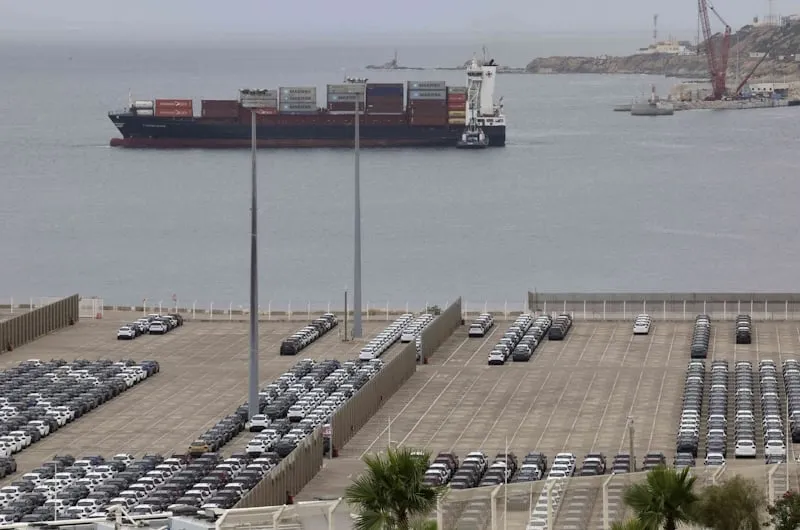
The European Union is increasingly alarmed by the prospect of billions of dollars that Chinese companies plan to invest in Morocco, as these investments could transform the North African nation into a launchpad for heavily subsidized goods, potentially inundating European industries. According to a report by the British newspaper Financial Times, the latest manifestation of China's strength in the automotive sector is evident in the suburbs of Tangier, where a 500-hectare area has been carved out of agricultural land to establish "Mohammed VI Tangier Tech City." This emerging hub for Chinese auto parts manufacturers, ranging from brake components to battery supplies, aims to contribute significantly to the electric vehicle revolution in Europe.
The European Union's Trade Commissioner, Valdis Dombrovskis, noted that investment in Morocco reflects China's efforts to address its domestic industrial overcapacity by "recharging" exports through alternative trading partners to Europe. This issue is particularly critical for the European economy, highlighting the EU's growing concerns over trade dynamics amid rising tensions with China.
Trade Defense Measures and Challenges
In light of escalating trade tensions, Brussels is bolstering its trade defense measures against China and its alleged alternative trading partners. Last year, the European Commission determined that aluminum wheels exported from Morocco were "unfairly subsidized" by both Rabat and Beijing. EU officials have expressed concerns about distinguishing between genuine Chinese industrial cooperation with Morocco and attempts to circumvent the EU's import tariffs. The EU has imposed tariffs of up to 45% on Chinese electric vehicles, with estimates from the Organization for Economic Cooperation and Development suggesting that affiliated Chinese companies produce between three to eight times the output of firms in EU member states, often relying on hard-to-detect subsidized loans.
According to the Financial Times, John Gi Kai, a project manager at Chinese brake manufacturing company APG, which is set to open a $70 million facility in Tangier Tech City this year, stated that the factory will integrate local labor, materials, and supplies with Chinese technology. He emphasized that European, Moroccan, and Chinese companies could all benefit from this collaboration, providing competitively priced supplies close to European manufacturing plants. The European Automobile Manufacturers Association, an EU industrial lobby group, has refrained from commenting on the potential challenges posed by Morocco.
Chinese Investments and Economic Implications
The APG factory will house approximately twelve Chinese companies within Tangier Tech City, with BTR New Materials, the largest supplier of battery poles in the world, also planning to construct a new facility. Moreover, the British newspaper reported that Chinese investments will extend to other regions in Morocco, including a massive $1.3 billion factory being built by Chinese battery manufacturer Gotion High-tech, in which Volkswagen holds a 25% stake. This factory is under construction in Kenitra, located 200 kilometers along the Atlantic coast from Tangier.
Morocco offers various incentives for foreign investors, such as a five-year tax exemption, a young workforce, clean energy inputs to help reduce the EU's carbon tax obligations, and access to 2.5 billion consumers through nearly 50 free trade agreements, including those with the EU and the United States. These free trade agreements are a major draw for Chinese companies, as relocating production to closer regions is viewed as a strategy to mitigate tariff risks. Moroccan Trade Minister Ryad Mezzour stated that the country anticipates establishing an "integrated value chain" capable of meeting the needs of up to 500,000 electric vehicles annually by the end of 2026.
Moroccan officials reject allegations that their economic zones will become backdoors for exporting excess Chinese production to the EU, which could exacerbate the industrial decline in major manufacturing hubs like Germany. Yassine Lahyani, head of emerging industries at the Moroccan Agency for Investment and Export Development, remarked, "We understand that the EU is discussing industrial policy, but we believe that Morocco can be one of the best partners in this field," emphasizing the mutually beneficial nature of this collaboration.
However, analysts caution that the massive scale of planned Chinese investments in Morocco, which has reached approximately $6 billion since the onset of the COVID-19 pandemic, poses a challenge for European policymakers. Ahmed Aboudouh, from the North Africa program at Chatham House, noted that rising instability in the Middle East has increased the attractiveness of Southern Mediterranean countries for Chinese investors. He pointed out that China has the potential to control the entire supply chain, starting from processing phosphate used in battery production, of which Morocco has significant reserves, to battery factories, roads, railways, and even ports. This comprehensive control is what concerns the EU.
In conclusion, the Financial Times highlights that Rabat cannot ignore Brussels' concerns, as the EU stands as Morocco's largest trading partner, accounting for one-third of its exports, valued at over €26 billion in 2025. More than half of these exports originate from the machinery and transport sectors.
As reported by alquds.co.uk.