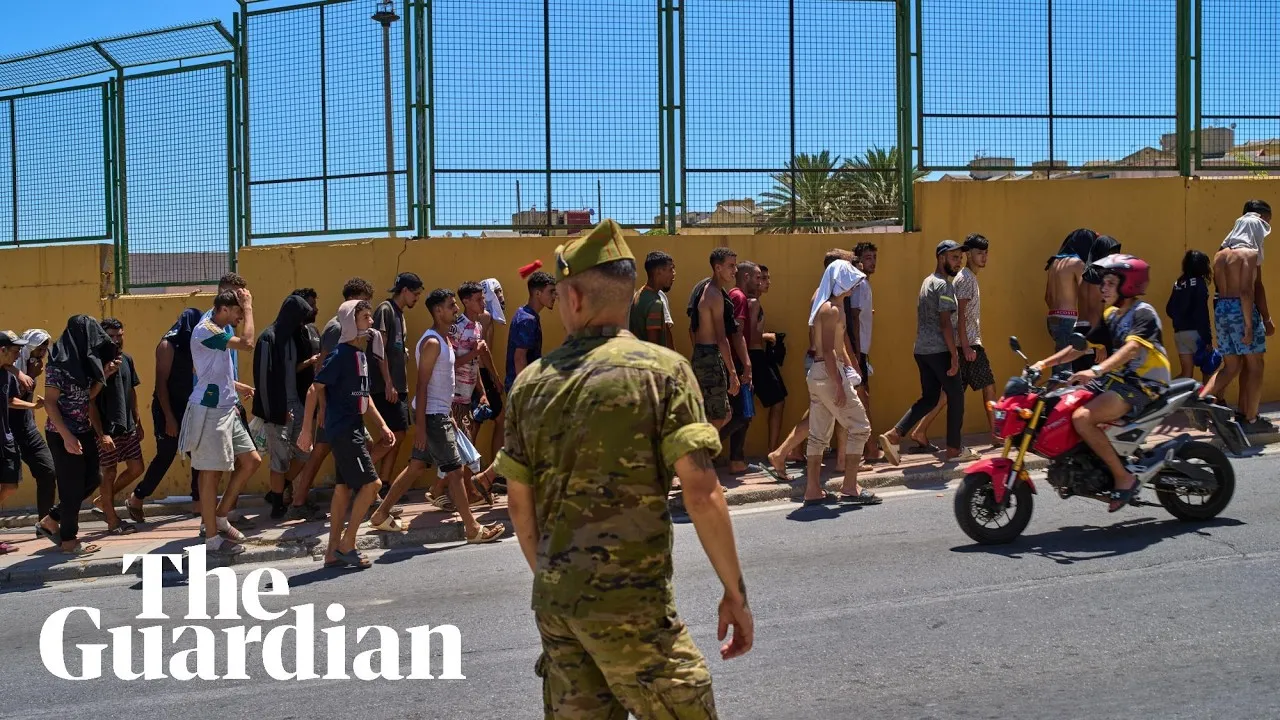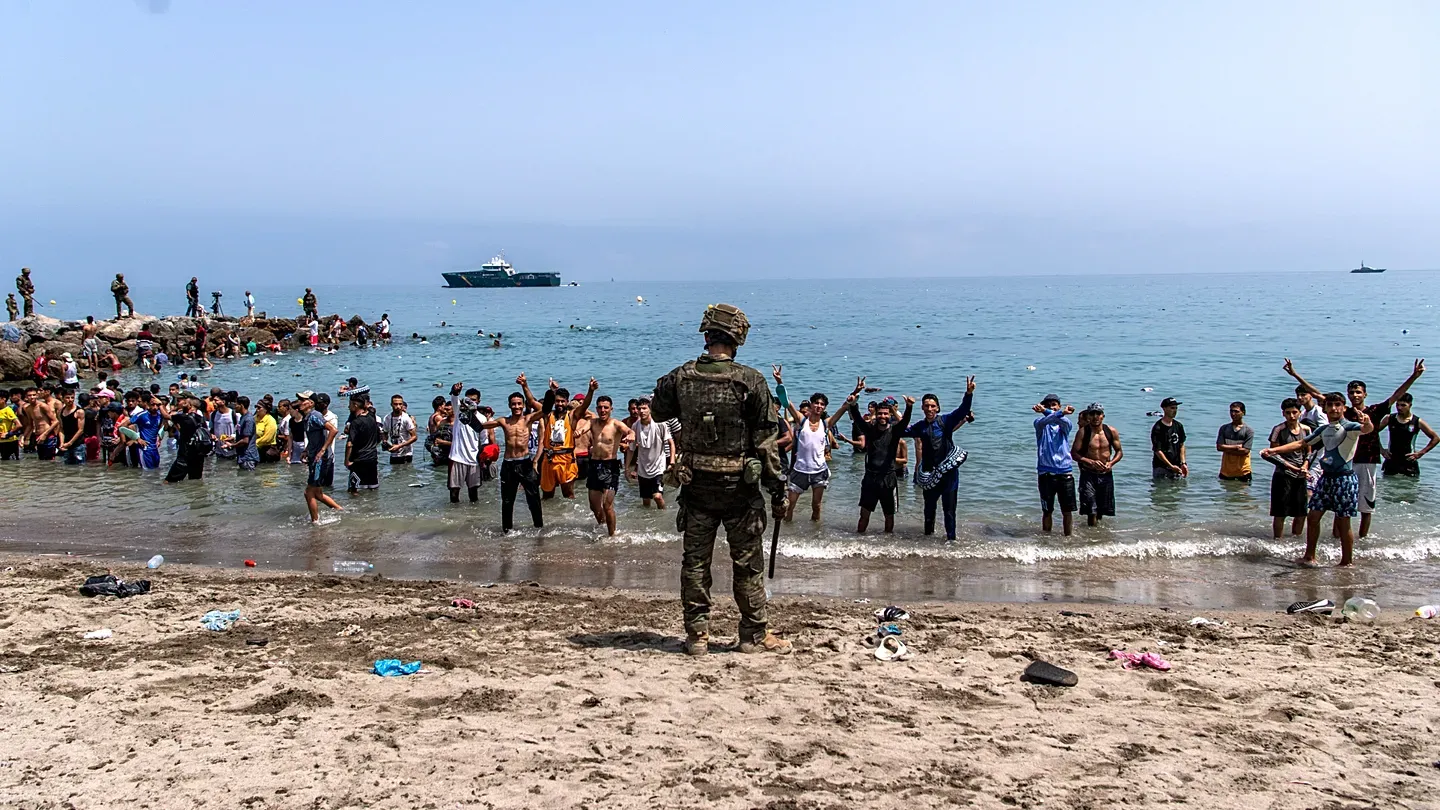

The migration crisis in Ceuta has escalated significantly over recent days, with alarming reports indicating that tens of thousands of individuals have crossed the border into the Spanish exclave from Morocco. This unprecedented mass influx, which has seen over 70,000 people enter Ceuta, marks the largest recorded surge of migrants onto Spanish territory. Visual evidence reveals chaotic scenes, as numerous individuals swim to the autonomous city, scramble along breakwaters, or traverse steep terrain in their desperate bid for entry.
In response to the situation, the Spanish government swiftly mobilized military forces, while police and humanitarian organizations scrambled to manage the overwhelming influx. Reports indicate that many of those who crossed into Ceuta returned to Morocco within a few hours due to a lack of available shelter and basic provisions. Nevertheless, local residents report that hundreds of individuals continue to linger in the city, raising further concerns about the ongoing humanitarian crisis.
Juan Jesús Vivas, the President of Ceuta, has voiced strong criticism of the current immigration laws, advocating for reforms that would allow for expedited returns of individuals who cross the border illegally. In a remarkable turn of events, Spain and Morocco reached a rapid agreement aimed at facilitating the swift repatriation of migrants amidst the crisis, in a city with a population of barely 80,000 residents.
The Spanish and Moroccan authorities have attributed the sudden influx to rumors circulating on social media, which claimed that a recent ruling by the Supreme Court prohibited immediate deportations. Both governments have also pointed to the activities of smuggling gangs as a contributing factor. However, questions remain regarding why Moroccan security forces initially allowed large groups to approach the border without intervention, as well as how thousands managed to travel from Casablanca, Rabat, Tangier, and Marrakech without any roadblocks. The initial passive response from Moroccan officials, who only acted to stop the influx hours later following a political decision, has fueled suspicions of a coordinated operation.
The mass movement began on July 30, coinciding with the Moroccan National Day and the anniversary of King Mohammed VI's ascension to the throne. The _New York Times_ cited young Moroccans who claimed that authorities had explicitly encouraged them to cross into the Spanish exclave. One individual recounted how their group was directed towards the border by Moroccan police officers, who repeatedly instructed them to proceed in that direction.
Intelligence Agents in the Crowd
Beyond official narratives, an analysis of thermal imaging and high-performance cameras installed at Ceuta's breakwaters and border fence reveals crucial insights. Reports from _El Español_ indicate that agents from the Moroccan intelligence service infiltrated the crowds that breached the border controls. Civil Guard analysts identified several undercover intelligence operatives who blended in with the masses, guiding them, gathering information, and visually coordinating the border crossing.
This evidence contradicts the notion that the crisis was a purely spontaneous phenomenon driven solely by social media rumors. Instead, it suggests that state intelligence agencies may have played a role in orchestrating the events. Notably, Spanish intelligence had already warned the government days prior about an impending crisis in Ceuta, coinciding with the Moroccan royal celebrations. Despite these warnings, Interior Minister Fernando Grande-Marlaska has maintained that Morocco is a "reliable partner," rejecting calls for a reassessment of the situation.
According to reports by the Spanish newspaper _The Objective_, which cites Moroccan sources familiar with the kingdom's power structures, Fouad Ali El Himma is seen as a potential orchestrator behind the crisis. Known in certain circles as Morocco's "viceroy," El Himma has been a close advisor to King Mohammed VI since their time at the Royal College. He previously served as a high-ranking official in the Interior Ministry and founded the Authenticity and Modernity Party (PAM) in 2008. This analysis posits that El Himma may have exploited the migration crisis to weaken the government of Aziz Akhannouch, who is not seeking re-election in September, while simultaneously bolstering PAM's position ahead of the upcoming elections.
Geopolitical Implications and Future Considerations
Spain has been grappling with tensions at its southern border for years, but the Ceuta crisis must be understood within the broader context of fluctuating concessions and conflicts between Madrid and Rabat, as well as the disputes concerning migration policy with European partners. In 2022, Spanish Prime Minister Pedro Sánchez recognized Morocco's autonomy plan for Western Sahara, a move supported by the United States. This marked a significant shift in Spain's historically neutral stance, celebrated in Rabat but sharply criticized within Spain, particularly by the Polisario Front and segments of the government coalition.
Spain's government has also pursued extensive legalization measures for migrants, sparking open conflict with 22 EU member states, whose leaders penned a letter linking these policies to the so-called pull factor and the crisis in Ceuta. Italy, for instance, recently tightened Schengen controls for non-EU citizens entering from Spain. Notably, despite the dramatic situation, the Spanish government declined the EU's offer to deploy the European Border and Coast Guard Frontex to Ceuta. Meanwhile, tensions with Brussels persist, as Sánchez criticized the "lack of solidarity" from certain EU partners without mentioning Morocco's role in the crisis.
In the backdrop of this unfolding situation, the role of the United States cannot be overlooked. Just days before the crisis, former President Donald Trump reaffirmed U.S. recognition of Moroccan sovereignty over Western Sahara in a message to King Mohammed VI. This acknowledgment coincided with Moroccan initiatives to strengthen ties with Washington, including military cooperation and infrastructure projects.
As the situation continues to evolve, it is essential to recognize the complex interplay of migration, geopolitics, and regional power dynamics at play in Ceuta. The ramifications of this crisis will not only impact the immediate region but also reverberate throughout Europe and beyond, highlighting the intricate web of relationships that define contemporary global politics.
As reported by de.euronews.com.