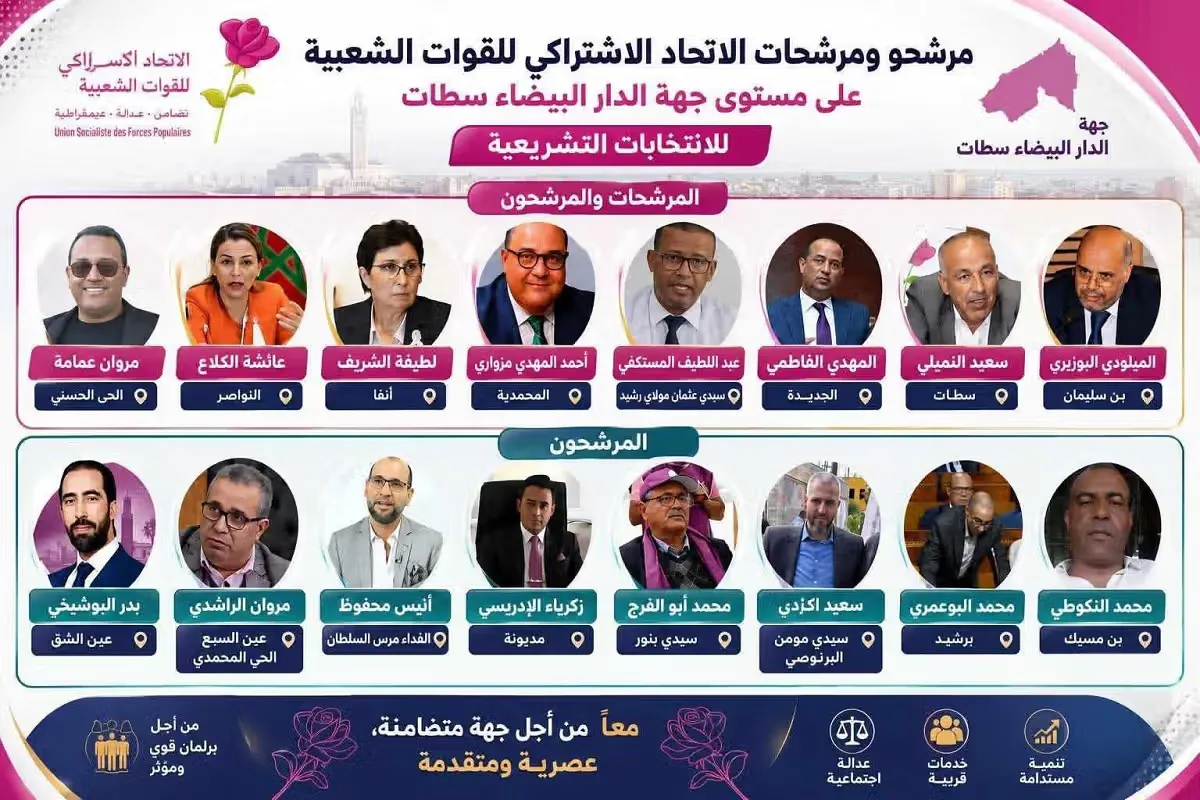
As the Socialist Union of Popular Forces (USFP) gears up for the upcoming elections, a significant transformation is evident in its candidate selection process, particularly highlighted by the appointment of around 80% new candidates across the sixteen electoral districts of Casablanca. Latéfa Cherif, a member of the USFP political bureau and a candidate in the Anfa district, articulates that this strategic overhaul is not merely an effort to enhance electoral performance. Instead, it is a calculated move aimed at rejuvenating the party's leadership and setting the stage for future electoral contests, including the critical legislative elections in 2026.
In stark contrast to the Justice and Development Party (PJD), which is striving to reclaim its footing in the national political arena after a significant decline in 2021, the USFP appears to be pursuing a fundamentally different approach. While the Islamists are fighting for their survival, the socialists are focused on rebuilding their political machinery and nurturing a new generation of leaders ready to take on future challenges.
Transforming Political Dynamics with New Faces
Analysis of the candidate list unveiled by the USFP reveals a comprehensive strategy for political renewal, as emphasized by Cherif. Out of the sixteen candidates nominated by the party in Casablanca, only three individuals from the previous electoral cycle in 2021 have been permitted to run again for parliamentary seats. Cherif points out that this significant turnover, with nearly 80% of the candidates being new faces, symbolizes a decisive effort to move past previous electoral outcomes and strategically reposition the party for a more enduring political cycle.
When asked whether Casablanca will serve as a testing ground for the party's electoral recovery strategy, Cherif confidently notes that the USFP has a robust presence in several rural constituencies outside of Casablanca, such as Oujda, Nador, and Tangier, where the party is well-established and holds assured seats. She expresses optimism about the upcoming elections, indicating that the USFP is poised to regain prominence in several districts it lost in 2021, which are now showing signs of revitalization.
Inclusive Candidate Selection Process
Addressing concerns about the party leadership's influence over candidate nominations, Cherif refutes any notion of centralized control within the USFP. She emphasizes that, unlike many other political organizations, the candidate selection process for the sixteen nominees in Casablanca was largely open and inclusive. Any party member wishing to run for the legislative elections in September was encouraged to submit an official application to local coordinations, which underwent a thorough evaluation by regional and then national party structures to determine candidate eligibility.
In constituencies with multiple contenders, the decision-making process included comprehensive interviews or internal auditions akin to primary elections, ensuring that the final choices were not solely dictated by the party's first secretary. Cherif asserts that there was no significant opposition between local and central party bodies, reinforcing the democratic nature of the candidate selection process.
While acknowledging the need for generational renewal, Cherif states that candidate nominations were based not only on their profiles and on-the-ground presence but also on their competencies. She highlights that there was a conscious effort to avoid parachuting candidates from other regions into these positions, aiming instead for a locally grounded leadership that can effectively represent their constituencies.
Despite the commendable efforts towards renewal, Cherif admits that the representation of women remains markedly low, with only two women among the sixteen candidates in her Casablanca-Settat list. She recognizes the ongoing challenges in achieving gender parity within the party and the parliament, blaming a persistent sexist political culture that discourages women's electoral engagement. She notes that while the USFP has historically championed gender equality, the current list fails to meet even the legal quota of 30% female representation, achieving only 12.5%. Cherif argues that the true challenge lies not merely in reserving seats for women but in fostering the necessary political, cultural, and organizational conditions that would empower women to pursue electoral mandates.
Looking ahead, Cherif conveys that beyond the immediate elections, the USFP's strategy is designed for long-term political reconstruction, extending beyond the upcoming legislative elections to future municipal and regional elections in 2027. She confirms that the new candidates are intended to eventually lead the party, suggesting that the USFP is laying the groundwork for a generational shift in leadership.
Finally, when asked about the potential for reassessing leadership positions in light of disappointing electoral outcomes, Cherif does not dismiss the possibility of a leadership transition from Driss Lachgar, who has held the party's top position since 2012. She acknowledges that following the elections, the political bureau will conduct a comprehensive review, and perhaps even Lachgar himself will advocate for refreshing the party leadership. Despite the challenges, she believes that the newly presented candidate lists are not merely about securing additional seats but instead represent the initiation of a new political cycle aimed at re-establishing the USFP's territorial network, renewing its leadership, and preparing for future generational succession.
As reported by medias24.com.