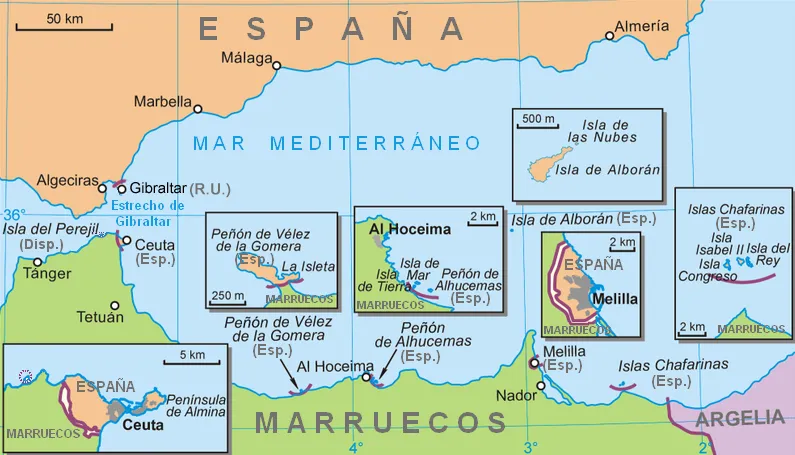

The recent surge in migration to Ceuta marks a significant moment in the region's history, resembling a modern-day Green March orchestrated by Morocco. However, this event is anything but spontaneous; it is a calculated maneuver by the Moroccan government under King Mohammed VI, aimed at sending a clear message to the Spanish government led by Pedro Sánchez. This implies that Morocco possesses the ability to destabilize its southern neighbor while simultaneously promoting its narrative regarding the Moroccan identity of Ceuta and Melilla. This complex geopolitical game demonstrates Morocco's confidence, bolstered by perceived support from the United States and Israel, which challenges Spain's longstanding assurances stemming from its membership in the EU and NATO. Notably, the situation has evolved to a point where the sovereignty of these Spanish enclaves is being debated in forums outside of Morocco, notably within U.S. congressional discussions.
A recent report from the House Appropriations Committee indicates a shift in American discourse surrounding Ceuta and Melilla, recognizing them as territories administered by Spain but fundamentally located within Moroccan land. This represents a significant breakthrough for Rabat, which has struggled for decades to shift the narrative around these cities. The report, introduced through an amendment by Republican Congressman Mario Díaz-Balart, emphasizes the historical alliance between the United States and Morocco, dating back to the Treaty of Peace and Friendship in 1786, and encourages dialogue regarding the future of these cities. This marks a pivotal moment, as it is the first time an official U.S. congressional body has explicitly mentioned the Moroccan claim to Ceuta and Melilla.
In response to this developing situation, Spain's Foreign Minister, José Manuel Albares, attempted to downplay the significance of the report, reiterating the undeniable Spanish identity of Ceuta and Melilla. Yet this dismissal does little to mitigate the growing intellectual machinery behind the Moroccan claim. Influential figures, such as Michael Rubin of the American Enterprise Institute, have publicly advocated for the recognition of Ceuta and Melilla as occupied Moroccan territories, framing their status as incompatible with the United Nations' decolonization doctrine. Such perspectives are not without consequence, as they feed into a broader narrative that questions Spain's colonial legacy in Africa while positioning Morocco as a strategic partner for Israel and the U.S.
The Abraham Accords, established in December 2020, further complicate the issue. In exchange for U.S. recognition of Moroccan sovereignty over Western Sahara, Morocco normalized relations with Israel. This alliance has led to military cooperation, with Morocco now operating Israeli systems, which strategically positions the country as a key player in North Africa. The deepening ties between these nations come at a time when Spain's relationship with the Trump administration has soured, particularly regarding military bases and NATO commitments, leaving Spain vulnerable to external pressures regarding its territorial claims.
As the geopolitical landscape evolves, the question remains whether Spain can effectively respond to these challenges beyond mere rhetoric. With the dynamics surrounding the sovereignty of Ceuta and Melilla shifting towards a more complex, multilateral context, Spain finds itself at a critical juncture. The enduring belief that these territories would remain unquestioned is increasingly being challenged, highlighting the need for a robust strategic response from the Spanish government.
As reported by elindependiente.com.