
The Congress of Deputies has transformed into a near-monographic forum for the third consecutive week, focusing on the exceptional situation in the autonomous city of Ceuta. It has been 48 days since at least 72,000 irregular immigrants entered Spanish territory, and between 10,000 and 13,000 of them remain in the enclave with no clear prospects for their return to Morocco. The political exchange has become predictable: Alberto Núñez Feijóo poses questions, while Pedro Sánchez remains silent. This has become the pattern of the control session, which extended to queries directed at other ministers by various representatives.
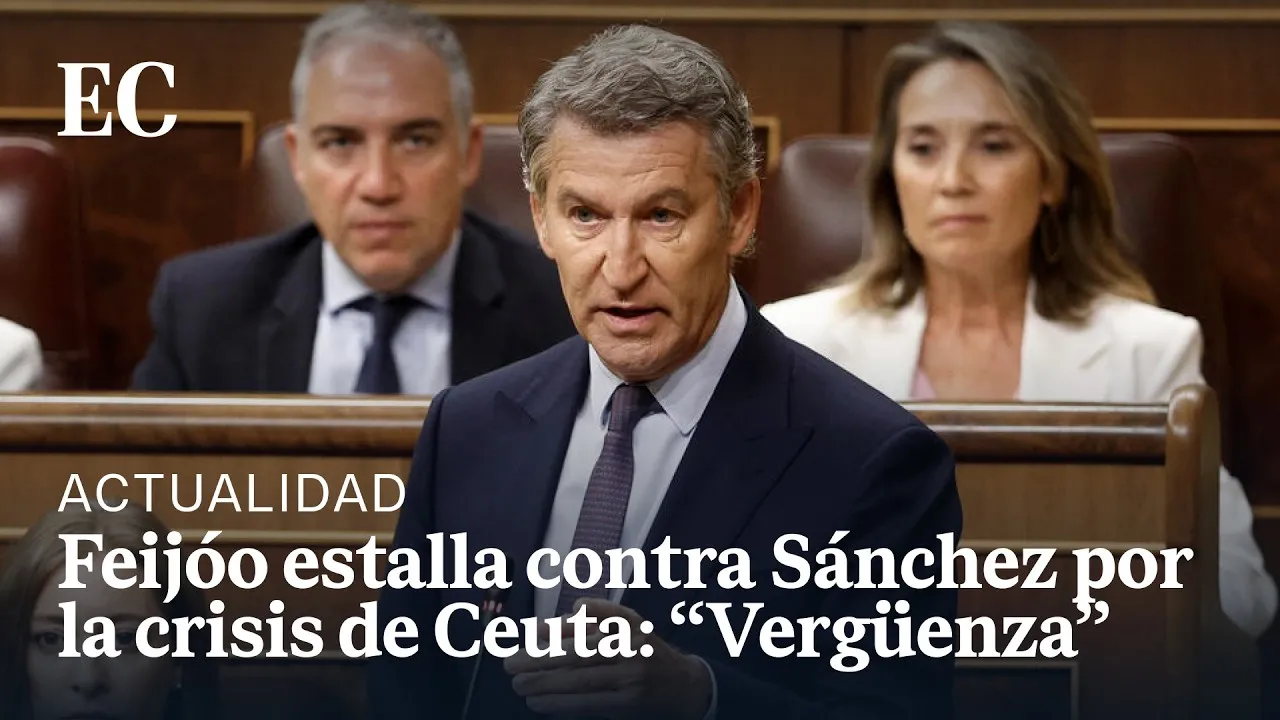
Feijóo, fully aware of the elusive nature of the Prime Minister, began his critique with four pointed questions: "When was the last time you spoke with Moroccan authorities? How many times have you done so since July 30? What did you ask, and what responses did you receive?" Morocco, whose inaction allowed the massive influx of immigrants into Ceuta between July 30 and 31, has repeatedly stated its readiness to accept all individuals on its territory, most recently in the European Parliament this week. "Either he is incompetent, or someone is lying," Feijóo declared, accusing Sánchez of damaging the country's image abroad.
In his initial response, the Socialist leader sidestepped Feijóo's inquiries, glossing over the Ceuta crisis and instead critiquing the PP for allegedly obstructing solutions by making requests in the European Parliament, such as suspending the association agreement with Morocco. "Are you trying to chronically prolong the problem or resolve it?" Sánchez sarcastically asked, drawing applause from the Socialist benches. This was the extent of his remarks before he shifted to boasting about macroeconomic figures, claiming that Spain is the leading investment destination in Europe and that national credit ratings have improved, according to the Elcano Institute.
"My questions were crystal clear, and your silence is a disgrace. It is shameful that you dare to discuss other topics while insulting the people of Ceuta and undermining our territorial integrity," Feijóo exclaimed, receiving accolades from his party members. Although Sánchez had one last chance to respond, he took advantage of Feijóo's lack of right to reply and pivoted to the 'grandchildren's law'. Following the Supreme Court's decision to temporarily suspend the voting rights of those naturalized under the Democratic Memory Law to verify their links with exiles from the Franco regime, the Prime Minister described the opposition's hostility toward this measure as "shameful," asserting, "There is no need to fear voting, but those who want to take it away, which is you and the far-right Vox party."
The First Vice President, Carlos Cuerpo, faced criticism from popular representatives Ester Muñoz and Juan Bravo, who questioned the government's delay in returning the irregular immigrants to Morocco and why there was no response to the warnings from the National Intelligence Center (CNI) about the impending crisis. Cuerpo, calm yet resolute, challenged the PP deputies to support the royal decree law containing economic measures to assist the people of Ceuta, which is set to be debated in the Lower House on Wednesday. After addressing Cuerpo's inquiries, Sánchez hurried out of the hemicycle, with journalists asking about the minors still on the streets of the autonomous city. He briefly referred them to the local president, the popular Juan Jesús Vivas, according to **Carlos Mullor**.
The next ministers to face scrutiny were those most involved in the crisis: Foreign Minister José Manuel Albares and Interior Minister Fernando Grande-Marlaska. Unless rescued by government partners, Marlaska faces a sixth reprimand before the Cortes since assuming office over eight years ago. The third minister, Defense Minister Margarita Robles, was absent that Wednesday and is at odds with Marlaska following a war of narratives regarding the assault on Ceuta—Robles revealed a CNI alert, dependent on the Interior Ministry, a day prior, which Marlaska contradicted. "Do not confuse diplomacy with capitulation," pleaded the popular Cayetana Álvarez de Toledo, who shifted her usual target from Félix Bolaños to the head of Spanish diplomacy, accusing him of "surrendering Ceuta to please Rabat" and boasting about it. "Yes, I immediately called Morocco and told them, 'those who enter must exit,' this must be stopped and cannot happen again. They dislike that the Foreign Minister of Spain speaks the truth... but they will not silence me," Albares defended himself.
Anyone who heard Marlaska during his appearance in the second control session of the new term would have recalled his statements from early August, with the invasion of Ceuta still fresh in memory. The Interior Minister quickly corrected his earlier assertion that the city had returned to normal, replacing it with a commitment to ensure its restoration. Just as he did this Wednesday in Congress, where he once again defended that "none of the reports [from intelligence services] mentioned anything resembling what occurred in 2021," referring to the previous mass entry of irregular migrants following the humanitarian hosting of the leader of the Polisario Front, Brahim Gali, in Spain.
"Only your arrogance is greater than your incompetence. Subjectively and objectively, you are incompetent," declared the secretary-general of the PP, Miguel Tellado. His fellow party member, Elías Bendodo, directly asked the Interior Minister whether he believed he was serving Spain better by remaining in his position or resigning. "I believe I am doing well to remain in this government," Marlaska concluded. Bolaños also faced scrutiny, this time from a sharp Cuca Gamarra, who wished that Sánchez's government had reacted to the invasion of the autonomous city with the same vigor with which they attack the Supreme Court over its ruling on the 'grandchildren's law,' bringing it back into the center of the debate for a few moments. "They are pleased to deny voting rights to over 400,000 Spaniards like you and me. It is a massive cut to the most sacred right in democracy," the Minister of the Presidency, Justice, and Relations with the Cortes responded. "In a census, one enters because the law states so, not because the government opens a back door. With you, there is no law without trickery," added the PP representative.
"You have no intention of restoring normalcy. You call Supreme Court judges terrorists, but the lone wolves are those who have invaded Ceuta," stated Pepa Millán, the Vox spokesperson in Congress. Millán also questioned the management of the Spanish enclave in North Africa. "What are your plans for Ceuta?" she shot. "To continue working to restore normalcy as soon as possible," responded Bolaños, echoing the government's motto adopted since July 30, especially by Marlaska. This response did not convince the right-wing party. "You have no intention of restoring normality; you have told the people of Ceuta to get used to the current situation. You call Supreme Court judges terrorists, but the lone wolves are those who have invaded Ceuta, which reflects the image of the country you have constructed over the past eight years," Millán attacked, while the minister highlighted the still uncertain support from the right for the first aid decree, which is likely to be approved on Wednesday, attempting to put Vox in a difficult position. "While you proclaim that Ceuta is not for sale, you sell it the moment you refuse to support even a single cent for Ceuta," Bolaños retorted.
As reported by abc.es.