Righa: A Promising Archaeological Discovery
Situated just eight kilometers north of Sidi Slimane, nestled within the winding paths of the Oued Beht, Righa has emerged as a vital archaeological site in Morocco. Over the past two decades, a collaborative Franco-Moroccan mission has significantly enhanced the site's historical importance, unveiling Roman baths and previously uncharted wine presses. These findings bolster the theory that this sprawling ten-hectare city, long relegated to the shadows of Volubilis, may have once served as a capital of the Mauretanian kingdom.
Archaeology demands patience, a principle embodied by Dr. Mohamed Alaoui Kbiri, a professor at the National Institute of Archaeological Sciences and Heritage (INSAP). For twenty years, he has co-led an extensive international mission, merging efforts from INSAP in Rabat, under the Ministry of Youth, Culture and Communication, and Paul-Valéry University Montpellier 3, through the ASM laboratory focusing on Mediterranean societies. This initiative enjoys support from Morocco’s Directorate of Cultural Heritage and the French Ministry for Europe and Foreign Affairs, facilitated by the French Embassy in Rabat. Despite this robust backing, Dr. Kbiri emphasized in a recent interview with Médias24 that only a mere "3–4% of the site’s 10 hectares" has been excavated, highlighting the gradual nature of archaeological research.
A Methodical Approach to Excavation
To comprehend the deliberate pace of exploration at Righa, one must consider the historical context of Volubilis. Excavations there began in 1915 during the protectorate, where German prisoners conducted crude clearance work under French military oversight. Dr. Kbiri notes that this approach aimed primarily to expose the Roman pavement, serving as a means to ideologically justify the French occupation as a continuation of Roman heritage. This hurried excavation resulted in the loss of centuries of Islamic history, particularly from the Idrissid period, which was destroyed without any documentation. In contrast, the current mission at Righa adopts a meticulous methodology, thoroughly documenting, analyzing, and mapping each layer of occupation, whether from the Merinid (14th century) or Idrissid (9th century) eras, before proceeding to excavate deeper Roman and Mauretanian strata.
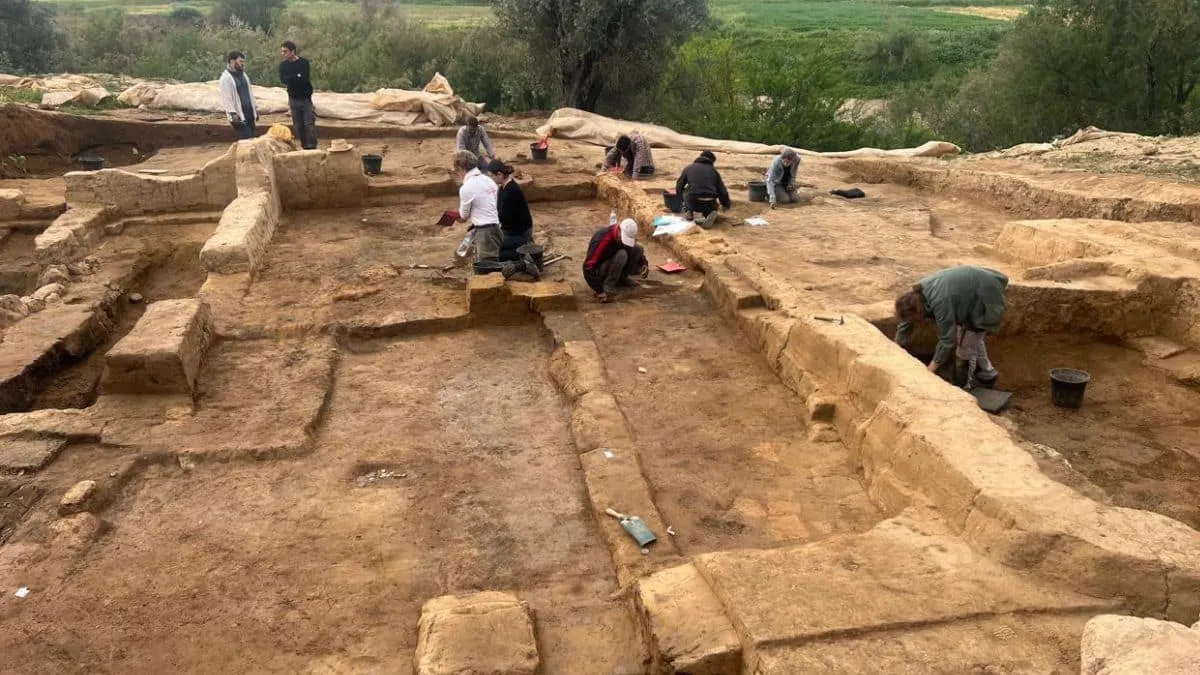
The research at Righa has evolved into a complex, multidisciplinary endeavor. The excavation team comprises not only archaeologists but also geomorphologists who investigate the interplay between the city and the river's meandering pathways, as well as specialists in flora and fauna examining even the tiniest organic remnants. The focus has primarily been on two distinct sectors of the site. In the western area, a Mauretanian quarter made entirely of mudbrick has been unearthed, dating from the 5th century BC to the early 1st century AD. The excavations here aim to establish a comprehensive "stratigraphy of habitation," shedding light on how local populations adapted their architectural forms and lifestyles over a span of 500 years, well before the advent of Roman standardization. The artefacts discovered within these layers now enable archaeologists to accurately date each phase of pre-Roman occupation.
The eastern section of the site reveals a more intricate narrative. Archaeologists have uncovered a large peristyle house, characterized by a courtyard encircled by columns, which dates back to the Roman era. However, the most remarkable discovery is the adjacent winemaking facility. Through thorough laboratory analyses and the identification of grape seed residues, the team has confirmed that these were presses utilized for red wine production. While their design resembles that of olive presses, this identification as a winemaking facility marks a significant first for Morocco. Unfortunately, evidence suggests that this industrial and residential quarter met a sudden end, as a major fire in the 3rd century AD led to the abrupt destruction of the structures, preserving them in a moment of time.
Since April 6, the current excavation campaign has entered a new and exciting phase. Guided by geophysical surveys for subsurface imaging, researchers have initiated a new trench in the site’s central area, adjacent to the Oued Beht. This trench has corrected a long-standing misinterpretation; earlier studies had suggested it was a water channel, but recent excavations have confirmed that it is, in fact, a Roman public bath complex. The discovery of these baths signifies that Righa was equipped with high-status urban infrastructure comparable to that of Banasa and Thamusida, two other prominent cities in the Gharb plain.
Righa is not merely an ancient site; it represents a
As reported by medias24.com.