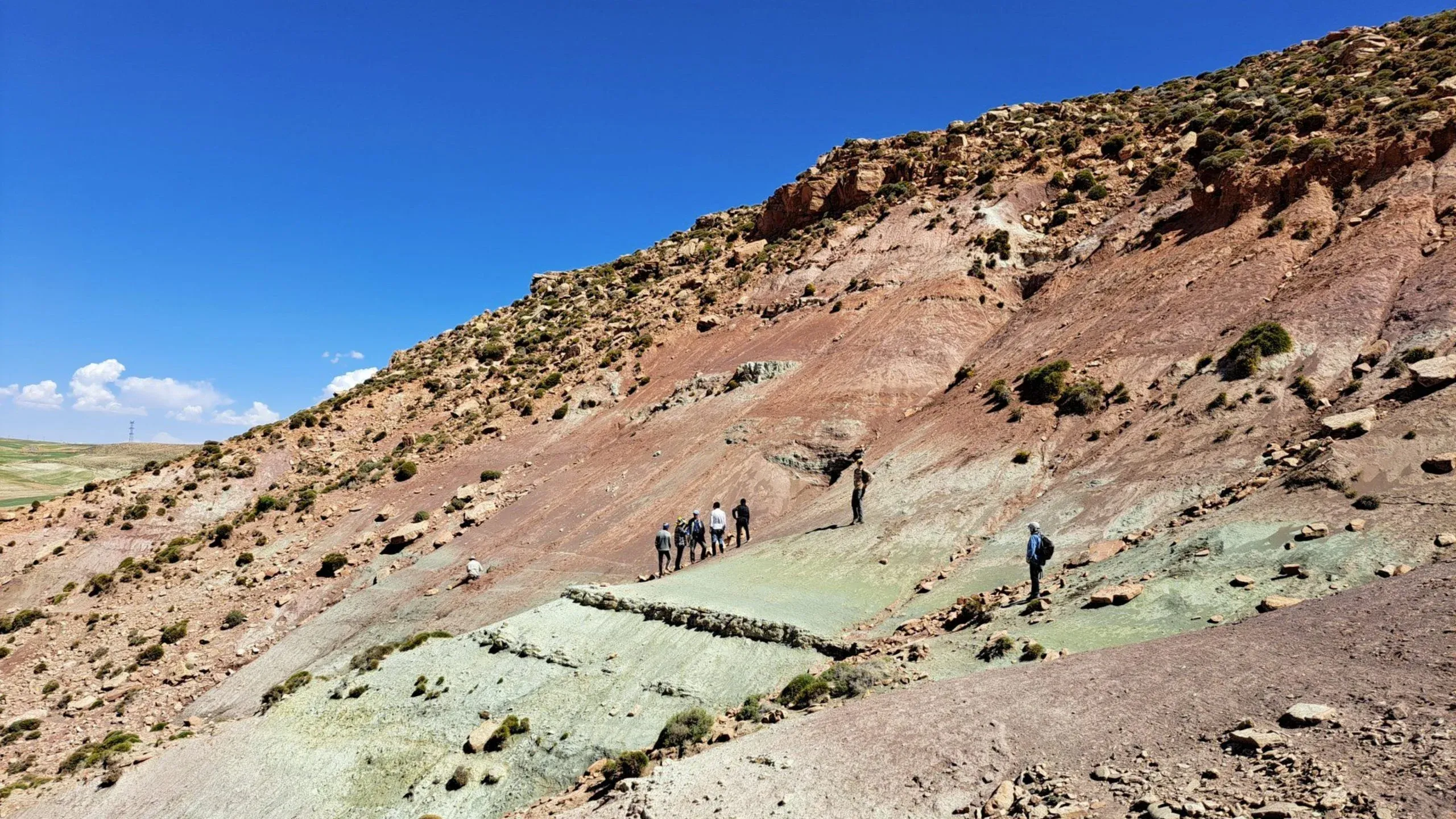
Remarkable Fossil Discovery in Morocco
A remarkable discovery of rare fossil footprints belonging to a lizard-like creature has been made in Morocco, dating back an impressive 160 to 170 million years. This find is particularly significant as it represents only the third instance of such footprints ever discovered globally and the first within the ancient landmass of Gondwana. This groundbreaking revelation not only underscores the scientific importance of the discovery but also highlights Morocco's rich fossil heritage and the urgent need for its preservation and promotion.
A dedicated group of Moroccan researchers has identified these fossilized tracks in Msemrir, located in the Tinghir Province. Their findings were published on April 20 in the peer-reviewed journal Historical Biology. The study delves into the characteristics of the footprints, which belong to a lacertoid species that is closely related to modern lizards. Abdelouahed Lagnaoui, a professor of paleontology at the Higher School of Education and Training in Berrechid, who is also part of the research team, emphasized the rarity and significance of this discovery, noting that it sheds new light on the historical distribution of these creatures.
According to Lagnaoui, the discovery was made by one of his PhD students, Omar Ait Haddou, from the Faculty of Sciences Dhar El Mahraz at Sidi Mohamed Ben Abdellah University in Fez, as part of his doctoral research project. The Msemrir site is particularly notable because it marks the first documentation of such fossilized tracks in Gondwana, a supercontinent that existed before it fragmented into what we now recognize as Africa, parts of Europe, and South America. Until this discovery, scientists believed that this type of lacertoid was primarily confined to Europe and South America, making the Moroccan find a pivotal addition to our understanding of the distribution of these ancient reptiles.
The Geological Significance of Morocco's Paleontological Heritage
Researchers identified a total of 12 fossilized footprints at the site, some of which exhibit the characteristic five digits, further confirming their lacertoid nature. Employing photogrammetry techniques, the team was able to reconstruct the shape and movement of the creature, estimating that it measured between 30 to 50 centimeters in length and exhibited a sprawling, crocodile-like posture.
This significant discovery fits into the broader context of Morocco's rich paleontological legacy, which has yielded numerous important finds over the years. The Msemrir site has previously revealed various fossilized remains, including traces of birds identified by an Italian researcher in 2006 and dinosaur footprints, including theropods, sauropods, and ornithopods, uncovered by Ait Haddou. Geologists often refer to Morocco as a "geological paradise" due to its remarkable diversity of geological formations that date back over two billion years, from the Precambrian era to the present. This diversity, coupled with Morocco's historical role as a migration corridor for animals, has resulted in an extraordinary fossil record that is key to understanding ancient ecosystems.
In ancient times, Morocco served as a crucial passageway for wildlife exchange, particularly during periods when other regions were dominated by mountainous terrains. The relatively flat landscapes of Morocco facilitated the movement of many species, some of which left behind fossils and footprints that contribute to the current richness of paleontological remains. Professor Lagnaoui points out several major fossil discoveries in Morocco, including Spinosaurus in the Kem Kem region, Ankylosaurus in the Middle Atlas, and Stegosaurus and Atlasaurus in the Beni Mellal area, emphasizing that sites like Kem Kem were once home to large lakes that supported diverse ecosystems.
Despite the significant findings, there remains a lack of awareness regarding the scientific and cultural value of fossils in some regions of Morocco. In southeastern areas, locals often sell fossils, overlooking their potential for scientific research or geotourism development. The discovery of the 588-million-year-old shark, Maghriboselach, serves as an example of the interest such finds can generate; following its announcement, around 120 international researchers visited Morocco in 2026 to explore the site.
To fully realize the potential of Morocco's fossil and geological heritage, Professor Lagnaoui stresses the importance of enhanced public awareness, starting with educational initiatives that incorporate local fossils into school curricula rather than relying solely on examples from abroad. Media coverage also plays a vital role in shaping public perception, as even a single article can significantly influence how the community values its heritage. Additionally, there is a pressing need for trained tourist guides and increased investment in local museums. A national museum dedicated to geology and archaeology is currently under construction in Rabat and is expected to open between late 2027 and early 2028. Similar initiatives at the regional level are essential to preserve this invaluable heritage while unlocking its scientific and economic potential.
As reported by en.yabiladi.com.