Exploring the Enchantment of Morocco
My long-awaited journey to Morocco was finally realized after a series of delays, primarily due to the Covid pandemic and the subsequent catastrophic Al Haouz earthquake in September 2023, which claimed nearly 3,000 lives in the Atlas Mountains. However, when the opportunity arose again in late 2023, I was determined not to let it slip away a second time. I chose to begin my adventure at La Mamounia, arguably the most iconic hotel in Marrakech and a symbol of luxury in Morocco since its establishment in 1923. After spending two nights in this historic palace, where rates begin at around $900 per night, I quickly understood why it has enchanted travelers for nearly a century.
La Mamounia is not just a hotel; it is a century-old palace nestled within the Hivernage district, surrounded by eight acres of aromatic gardens that even bottle their scent for sale in the lobby. This is the very place where Winston Churchill once painted from its balconies and where modern tales of extravagance, like those of Anna Delvey, have unfolded. But my quest was not to validate the lavishness of this palace; rather, I sought to uncover whether Morocco’s allure extended beyond the opulent marble and whether the other side of the Atlas Mountains could redefine my understanding of luxury.
Crossing the Atlas: A Tale of Two Moroccos
Part of my motivation for visiting Morocco was to experience both sides of its geographical divide. On one side lies Marrakech, where the medina envelops you in a whirlwind of sights and sounds, and on the other, the expansive landscapes beyond the High Atlas mountains, standing at an impressive 7,400 feet. The latter reveals vast valleys where the horizon stretches infinitely, and kasbahs rise dramatically from the earth, as if they were always meant to be there.
Traveling through the Tizi n’Tichka pass felt like navigating an adventurous Oregon Trail, filled with switchbacks that ultimately led to a mud fortress and refreshing mint tea. As we descended through Ouarzazate, known as Africa’s Hollywood, I marveled at the studios where epic films like Gladiator were shot. On my journey, I encountered fierce winds that rattled our vehicle and shattered a window behind us, but my seasoned driver remained composed, while I nervously researched whether my travel insurance covered natural disasters. The allure of Morocco's almond blossom season, despite the winter storms, spurred me on, and I was determined to witness the beauty that awaited.
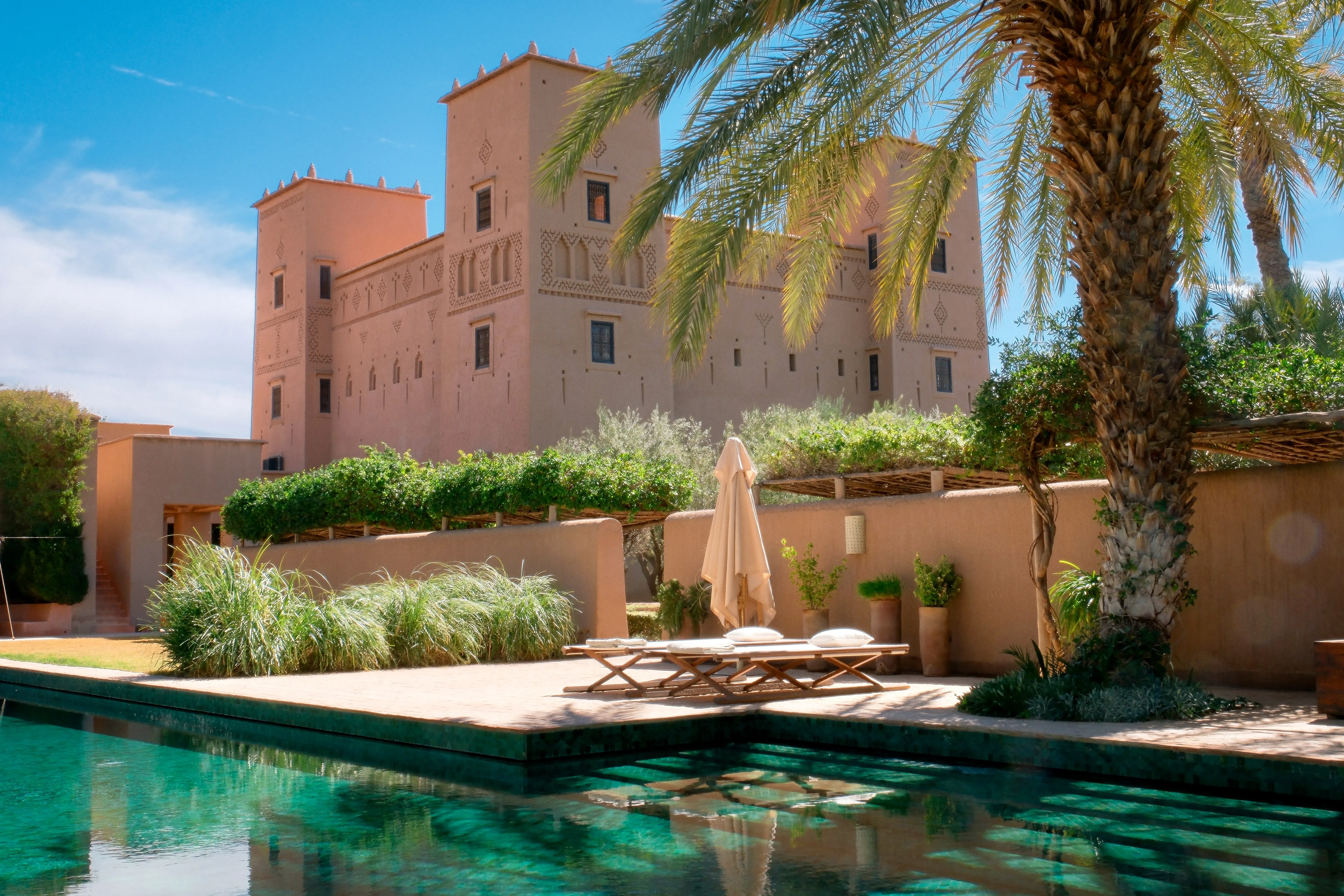
Upon arriving at the Skoura palm grove, the almond trees dazzled with their explosive white and pale pink blossoms against the rich earth, while ancient kasbahs with intricate Amazigh designs began to emerge along the route, each telling stories that predate modern maps. In Morocco, beauty often lies hidden behind walls—be it in riads, medina courtyards, or lush gardens—offering little to see from the street unless one dares to step through a door. Dar Ahlam was no exception; entering required passing through a heavy gate before being greeted by the stunning kasbah, its towers reflecting in a serene emerald pool. The absence of a traditional reception desk was refreshing; instead, Marcio, the general manager, welcomed me into a salon adorned with tadelakt walls and floor cushions, where decisions were made over tea at my leisure, allowing for an experience devoid of schedules or itineraries.
During my stay, I found a letter from Thierry Teyssier, the visionary founder of Dar Ahlam, inviting guests to embrace curiosity and explore the kasbah for hidden treasures. Teyssier, who transitioned from the Paris theater scene, transformed this kasbah by hand, utilizing adobe, bamboo, and olive wood, and curating a team of 120 to serve just 14 rooms. His philosophy, as he shared with me on his birthday, revolves around a unique approach to hospitality—creating moments that feel inevitable and nurturing a connection with the land and its people. Each interaction, from the gardener with a passion for birds to Hanan, the storyteller who captivates guests with the kasbah's rich history, illustrates the essence of community and belonging that permeates Dar Ahlam.
Throughout my stay, I engaged in various enriching activities, from hiking in the historic Mellah, Skoura's old Jewish quarter, to crafting cyanotype prints in the Food Lab alongside local farmers. I even donned a beekeeper's suit to learn from the region's only female beekeeper, who taught me about the interconnectedness of bees and their colonies—a metaphor for community and belonging that resonated deeply with the ethos of Dar Ahlam. As I explored the immersive art installation, La Maison du Ciel, created by sculptor Olivier Darné in a kasbah rebuilt after the earthquake, I experienced a sensory journey through fire, wax, and honey, each room revealing the intricate relationship between nature and art.
Each evening at Dar Ahlam unfolded like a beautifully orchestrated play, with dinner revealed in unexpected locations, from rooftops bathed in lantern light to intimate settings that felt entirely unique. The culinary experience, crafted by renowned chefs like Frédérick Grasser-Hermé, focused on locally sourced, predominantly vegetarian dishes that celebrated the flavors of the land. The Terre de Skoura spice blend, a house specialty, appeared at every meal, embodying the region's essence in each bite. The local lamb, sourced from nearby farms, exemplified the commitment to providing an authentic experience rooted in the geography and culture of the area.
As my time in Morocco came to an end, I returned to Marrakech, reflecting on the stark contrast between my experiences at Dar Ahlam and my next stop at the Mandarin Oriental, where luxury was defined by its sprawling villas and heated pools. Yet even amid such opulence, I found myself yearning for the simplicity and authenticity of the moments I had spent at Dar Ahlam. In his wisdom, Teyssier had reminded me that true beauty often lies hidden, requiring a willingness to step beyond the walls of convention and embrace the unstructured time that fosters genuine experiences. In a world increasingly dictated by schedules and reservations, my journey through Morocco revealed that the rarest form of luxury is not found in the grandeur of suites or Michelin-starred meals but in the freedom of time and the beauty that unfolds when one dares to explore.
As reported by observer.com.