The Transformation of Moroccan Football through Dual Nationals
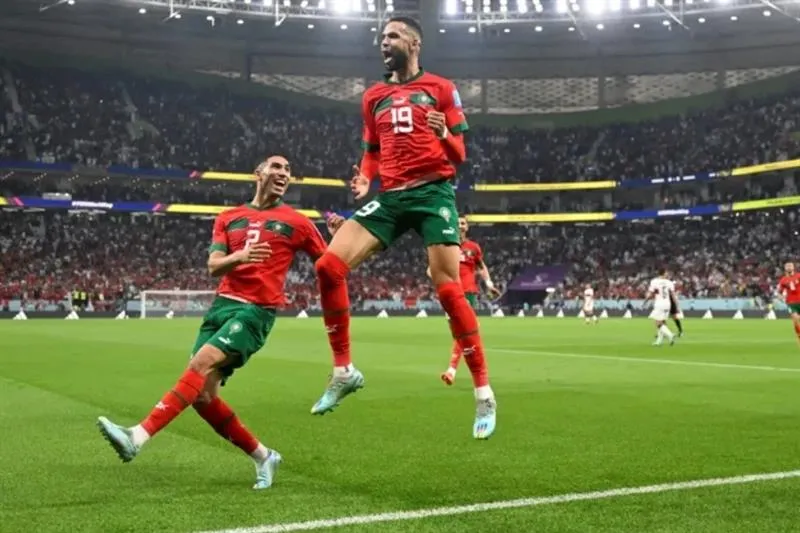
In recent years, the Moroccan national football team has undergone a remarkable transformation, with dual-national players now making up the majority of the squad across various age groups. This evolution has turned these talented individuals into a significant asset for the Atlas Lions, the national team of Morocco. In the past, the recruitment of dual nationals was seen as a backup plan, leading many players born abroad, such as Ibrahim Afellay from the Netherlands, Marouane Fellaini from Belgium, and Adil Rami from France, to represent their birth countries instead. However, the current strategy of the Moroccan football federation is centered around attracting these players, as the team seeks to build on its historic performance of reaching the semi-finals in the 2022 World Cup and competing with elite football nations worldwide.
Ryan Mmaee, a forward for Omonia Nicosia, reflects on his decision to represent Morocco, stating that the choice was straightforward. He noted the significant efforts made by the Moroccan football establishment to create optimal conditions for players. "Everything was well thought out -- a real project. That's what attracted me," he expressed. This commitment is evident in the federation’s extensive network of scouts throughout Europe, which plays a crucial role in identifying young talent. The connection between the Moroccan diaspora and their homeland, along with the influence of family, significantly impacts these players' decisions.
Strategic Vision and Future Aspirations
The Moroccan football federation’s technical director, Fathi Jamal, emphasized that the strategy involves a hybrid model. This model combines local development through national academies and club training centers with the identification of young dual nationals in Europe. Head coach Mohamed Ouahbi, who was appointed in March, corroborated this approach, revealing that the federation meticulously tracks potential dual-national players. Reports from scouts are pivotal in this process, as preliminary contacts are made based on positive evaluations, without any aggressive recruitment tactics. The aim is to present a comprehensive sporting project that outlines short, medium, and long-term goals to both players and their families.
The pivotal moment for Morocco's dual-national recruitment strategy came after the national team's failure to qualify for the 1998 World Cup. Since then, several high-profile players, including Hakim Ziyech, Achraf Hakimi, and Noussair Mazraoui, have emerged as key contributors to the national side. Young talents like Ayyoub Bouaddi have also opted to represent Morocco, highlighting the growing appeal of the national team. Hakimi, a defender for Paris Saint-Germain, described his decision to play for Morocco as a heartfelt choice, emphasizing the importance of personal comfort and familial support in such decisions. Similarly, Ziyech expressed that his allegiance to Morocco was unwavering, stemming from a deep-rooted identity despite being born in the Netherlands.
Nonetheless, some dual nationals continue to favor their countries of birth. For instance, Barcelona's Lamine Yamal, despite being approached by Morocco, ultimately decided to represent Spain. The investments made by Morocco in sports infrastructure and talent development have yielded significant results, including a semi-final appearance in the 2022 World Cup, a victory in the 2023 Under-23 Africa Cup of Nations, a bronze medal at the 2024 Olympic Games, and a runner-up finish in the 2025 Under-20 Africa Cup of Nations. Furthermore, Morocco was awarded the 2025 Africa Cup of Nations title, with the decision pending a ruling by the Court of Arbitration for Sport.
The increasing number of dual nationals representing Morocco has sparked criticism in some European nations, particularly Belgium and the Netherlands. Former Dutch international Rafael van der Vaart remarked that players who may not be good enough for the Netherlands often opt to play for Morocco. In contrast, Belgium's sporting director Vincent Mannaert acknowledged the right of these players to choose their national allegiance, despite their upbringing in Belgium, where they received significant support from local clubs.
As reported by english.ahram.org.eg.