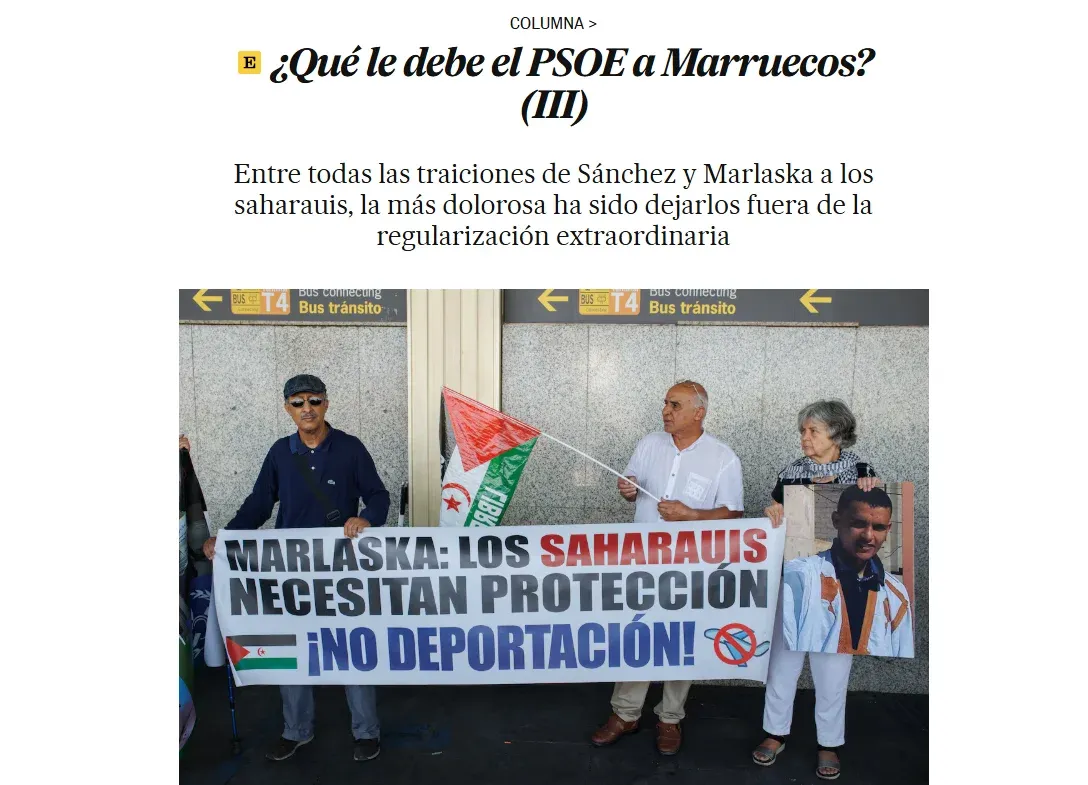
The opinion piece published in EL PAÍS by Ana Iris Simón, titled "What does PSOE owe Morocco? (III)", revisits a question that, despite its phrasing, has once again taken center stage in the political discourse in Spain. This third installment of a series began in 2023 delves into a critical analysis of the evolution of the Spanish government's position regarding Western Sahara, specifically highlighting the exclusion of Sahrawis from the recent extraordinary regularization process for migrants.
The discussion is timely, connecting with recent events that have reignited institutional debate. In the past few days, a legislative proposal aimed at facilitating Spanish nationality for Sahrawis born under Spanish administration has been revived in Congress after being stalled for over a year, particularly against the backdrop of this exclusion. This legislative initiative is seen by its proponents as a necessary step to rectify a historically discriminatory situation and is being processed concurrently with a controversy that has underscored the unique challenges faced by the Sahrawi community in accessing rights within Spain.
Simón's series of articles also reveals a continuity in the themes discussed. In her first piece, published in 2023, the focus was on PSOE's vote against granting nationality to Sahrawis born under Spanish sovereignty. The subsequent installment in 2024 shifted attention to the refusal to grant asylum to Sahrawis in particularly vulnerable situations, including minors. The latest article adds yet another layer to this narrative: the exclusion of Sahrawis from the regularization process. These three distinct episodes—nationality, asylum, and regularization—collectively illustrate a consistent thread in the discourse surrounding Spanish policy towards Western Sahara.
Currently, the parliamentary landscape is complex. While some factions advocate for advancing the nationality law as a means of reparation, divergent positions persist, as evidenced by the absence of several parties in recent discussions on this matter. Beyond varying interpretations, one common element is evident: the Sahrawi issue has once again gained significant traction in Spanish political debate. This is relevant not only in terms of foreign policy but also in areas closely related to rights, citizenship, and legal accountability.
In this context, the intersection of opinion and fact is particularly noteworthy. Simón's articles, while not introducing new data, resonate with the recent evolution of the political agenda, reflecting a sentiment that is increasingly palpable. They serve as a clear indication that the Western Sahara remains a pressing issue within the Spanish public sphere, deserving of attention and consideration.
As reported by noteolvidesdelsaharaoccidental.org.