Exclusion of the Sahrawi People from Regularization Efforts
The Sahrawi people have been explicitly excluded from the recent regularization initiatives put forth by the Spanish government, particularly affecting those seeking stateless status. This exclusion is yet another manifestation of Spain's continuous betrayal of the Sahrawi people, a trend that has persisted through successive administrations, each marked by shameful and dishonorable actions. The history of the Western Sahara, once a Spanish province, is fraught with betrayal. Under the Franco regime, Morocco seized control of the territory, a move further facilitated by the Spanish monarchy, which effectively sold out the Sahrawi people in one of the most cowardly and disgraceful acts imaginable.
Since then, every Spanish government has turned its back on the Sahrawis. Notably, Felipe González, who once assured the Sahrawi people that the PSOE would never abandon them, now enjoys a luxurious life in Morocco, advocating for the notion that Western Sahara rightfully belongs to Morocco. This betrayal continues under the current leadership of Pedro Sánchez, who recognized Moroccan sovereignty over Western Sahara, further deepening the shameful legacy of abandonment towards a people left to endure exile in the inhospitable Sahara desert of Algeria.
International Responsibility and the Call for Self-Determination
Under international law, Spain is still regarded as the administering power of Western Sahara until the decolonization process is fully realized through a self-determination referendum. Meanwhile, Morocco acts as the occupying force, administering the territory through oppressive measures, all while no United Nations member state has acknowledged its sovereignty over the area. The Spanish state bears responsibility for the circumstances in Western Sahara and should have prioritized the execution of the self-determination referendum long ago. Regrettably, all parties have surrendered to the interests of the Moroccan Kingdom, driven by economic and geostrategic motives that compel Spain and other nations to look the other way as Morocco blatantly ignores international resolutions and brutally represses the Sahrawi people.
The historical debt owed to the Sahrawi people has been consistently sidelined by various governments. Morocco’s strategy in occupied Sahara mirrors Israel’s tactics in Palestine, characterized by military occupation, the construction of a separation wall—dubbed the wall of shame—initiated in 1987 to restrict the Polisario Front's access to the sea, with the complicity of the European Union, which was simultaneously negotiating fishing agreements in Sahrawi waters. This wall not only divides occupied Sahara from the liberated territories controlled by the Polisario Front but also represents a blatant disregard for international mandates requiring a self-determination referendum.
Morocco continues to implement punitive policies against the Sahrawi people, aiming to displace them from their homeland while incentivizing Moroccan settlers to occupy the territory. This strategy seeks to alter the demographic composition of the region to ensure that, should a referendum occur, the majority of the population would be of Moroccan descent. Educational policies further reflect this denial of Sahrawi identity, where the history and language of the Sahrawis are actively suppressed, and there are no universities within Sahrawi-controlled territory, forcing those who wish to pursue higher education to do so in Morocco.
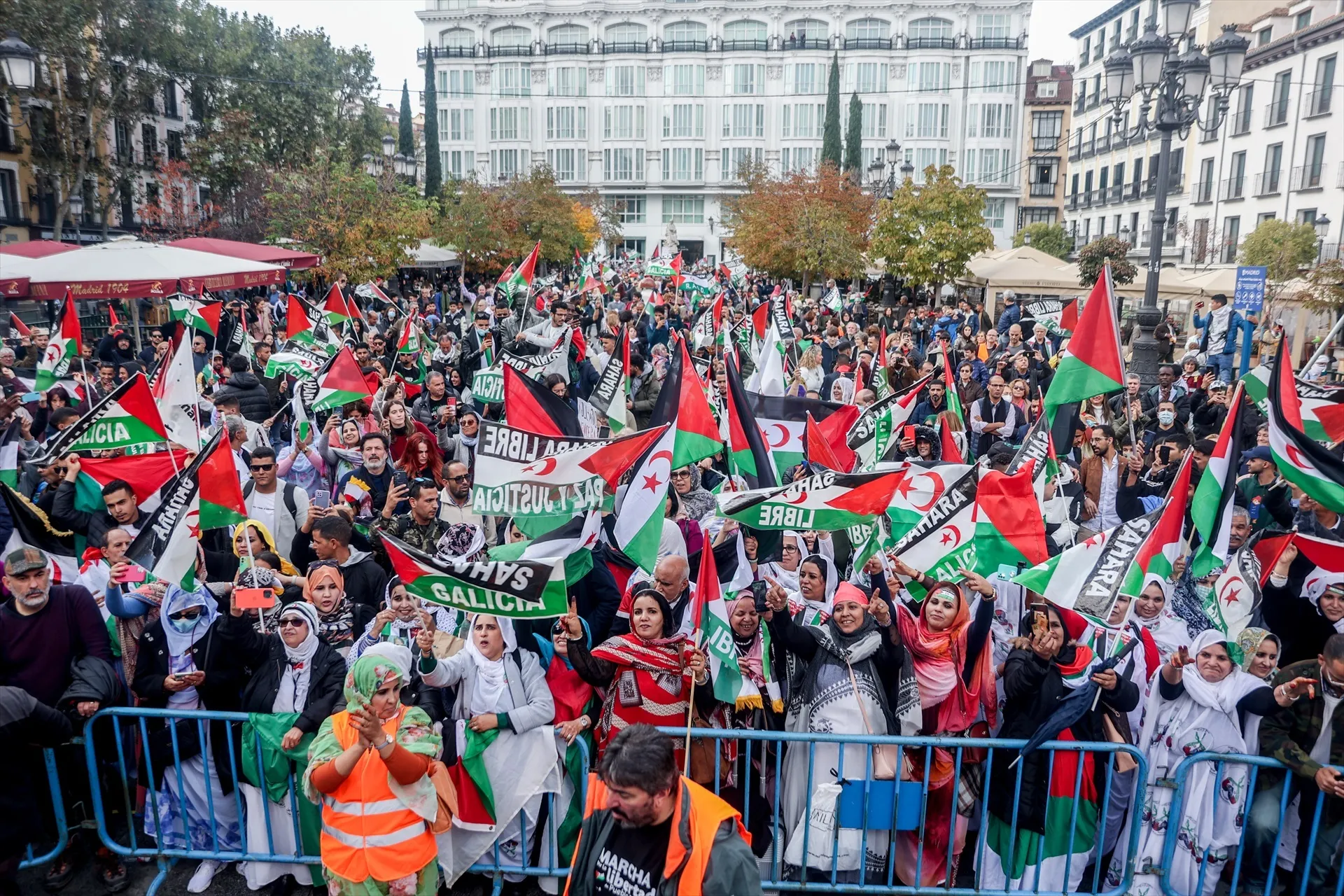
Since the ceasefire and the Peace Plan were established in 1991, the Sahrawi people have been effectively held captive in their own land or are exiled in the harsh deserts of Algeria, awaiting Morocco’s compliance with its obligation to facilitate a referendum that would allow the Sahrawi people to determine their future and independence. Today, the Sahrawi people find themselves in a state of limbo, fragmented and oppressed; some remain captives, tortured, and repressed by Moroccan occupying forces in Western Sahara, while others endure perpetual precarity in Algerian camps.
Despite enduring relentless hardships, the Sahrawi people have never surrendered and continue their struggle for sovereignty and reclaiming their land. They have successfully organized a government in exile, established an army, and built institutions capable of defending the sovereignty of liberated territories. The Polisario Front controls approximately 60,000 square kilometers, accounting for 25% of the Sahrawi territory, housing about 30,000 civilians. The failure to consider granting Spanish nationality to stateless Sahrawis occupied by Morocco, especially in light of Spain's historical obligations to Western Sahara, represents yet another act of betrayal that should evoke shame in us all.
As reported by argentina.indymedia.org.