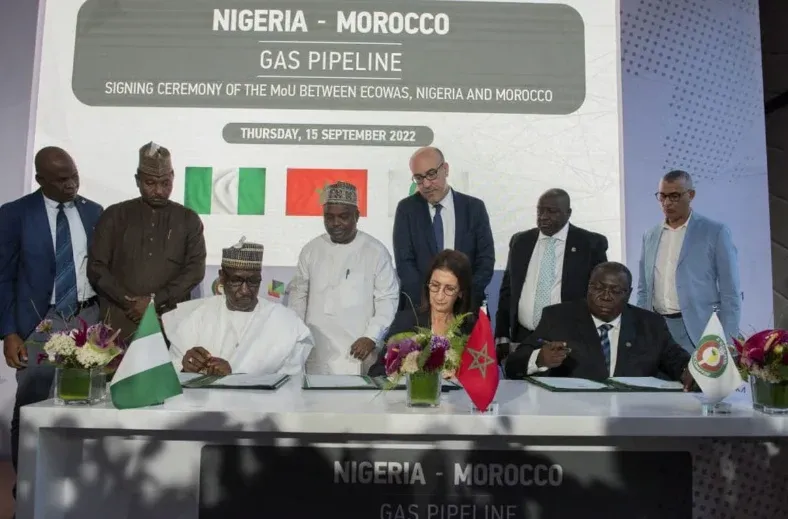
The ambitious Nigeria-Morocco Gas Pipeline (NMGP) is poised to revolutionize the energy landscape of West Africa by connecting its vast gasfields to regional markets and Europe. Spanning approximately 6,000 kilometers, this monumental pipeline will traverse 13 countries along the Atlantic coast of Africa, establishing a vital link for energy distribution. The heads of state of the Economic Community of West African States (ECOWAS) formalized their commitment to this project by signing an intergovernmental agreement during their ordinary summit in Freetown on July 19. This agreement is a significant milestone in the effort to transport billions of cubic meters of Nigerian gas to Morocco, where it will integrate with the existing Maghreb–Europe gas pipeline, thereby enhancing energy accessibility across the region.
Julius Maada Bio, the ECOWAS chair and President of Sierra Leone, emphasized the importance of this agreement in his address, stating, "We have signed the agreement on the West Africa–Morocco gas pipeline. Do not be surprised when the gas reaches you." The primary objectives of this pipeline are to connect West Africa’s gas resources to major consumption centers, foster the integration of African energy markets, and create a new development corridor that links West Africa, the Sahel states, Morocco, and Europe. This initiative aims to bolster the region’s energy security and promote sustainable development, as articulated in a joint statement from Morocco’s Office National des Hydrocarbures et des Mines (ONHYM) and the Nigerian National Petroleum Corporation (NNPC).
As the project progresses, the next steps involve the establishment of a project company in Casablanca and a Pipeline Higher Authority in Abuja, paving the way for potential investors to support this ambitious endeavor. Construction is anticipated to commence in 2028, with the first gas deliveries expected by 2031. Amina Benkhadra, the director general of ONHYM, highlighted the pipeline's potential, noting that it will significantly contribute to energy security, accelerate industrialization, and harness Africa’s natural resources for collective prosperity.
This €23 billion project has gained renewed urgency following Algeria’s termination of the contract for the Maghreb–Europe gas pipeline in 2022, a move that disrupted the previous flow of Algerian gas to Spain through Morocco after diplomatic relations between Algeria and Morocco deteriorated. Moreover, the geopolitical landscape has been further complicated by the rising hydrocarbon prices following Russia’s invasion of Ukraine. The NMGP represents not just a critical infrastructure project but a transformative opportunity for African energy independence and market integration.
As reported by theafricareport.com.