Centenary Celebrations and Historical Narratives
On July 16, a significant event unfolded as the centenary of the Grande Mosquée de Paris was celebrated, under the supervision of the current Dean, Shams al-Din Hafiz, and hosted by Moroccan journalist Abdel Rahim Hafidi, who presents the program on Islam for France’s second channel. The ceremony lasted nearly three hours and was intended to evoke the historical memory of this esteemed Islamic institution. However, the discussions raised during the event prompted critical reflection, as the celebration of institutions is incomplete without honoring their authentic histories.
My observations pertained not to the organization of the celebration or the number of attendees, but rather to the historical narrative presented regarding the mosque's inception. It became evident at various points that the foundational narrative had been restructured, marginalizing documented roles found in both French and Moroccan archives, and offering a version that conflicts with the official documents that established the mosque.
Revisiting Key Historical Figures and Contributions
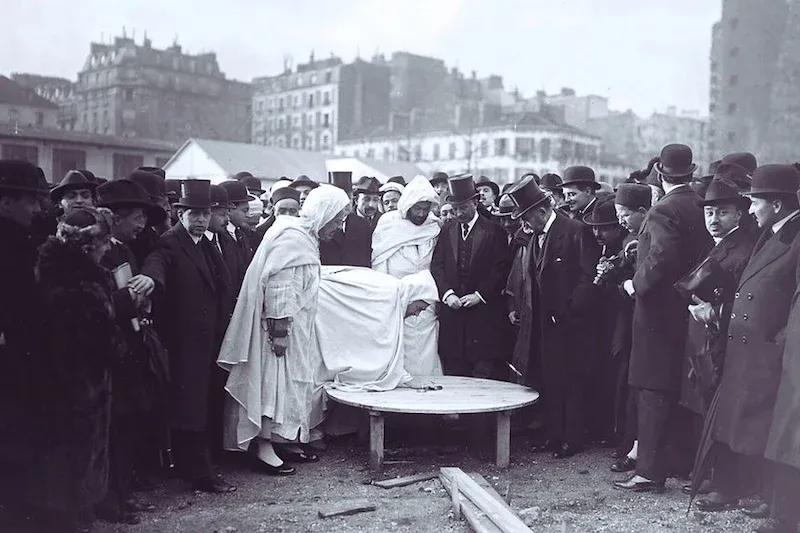
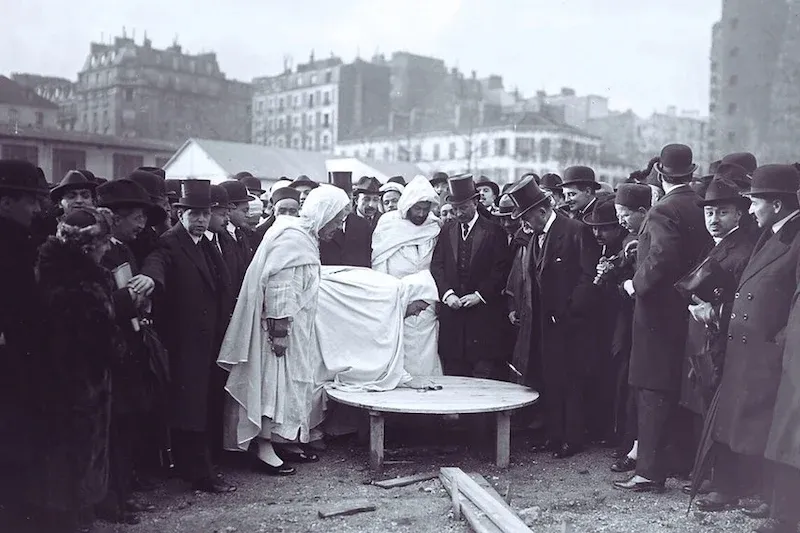
One glaring example was the portrayal of Moroccan Sultan Moulay Youssef as a guest at the inauguration alongside the President of France. In reality, the Sultan was not merely a guest but represented the spiritual authority linked to the mosque since its inception. In 1917, he issued a royal decree appointing Qaddour Ben Ghabrit, of Algerian descent and a naturalized Moroccan, to lead the endowment and sacred places, the institution responsible for overseeing the Grande Mosquée de Paris, as well as managing other charitable establishments, including hotels for Moroccan pilgrims in Mecca and Medina. Thus, the Sultan's relationship with the mosque was one of foundation and oversight, rather than mere ceremonial attendance.
Furthermore, the assertion regarding the contribution of “artisans from North Africa” to the mosque’s construction overlooks documented evidence preserved in the archives of the French Foreign Ministry in La Courneuve. This evidence confirms that the traditional craftsmen who executed the Moroccan decorations hailed specifically from Morocco, and that traditional construction materials, including Fassi tiles, intricately carved wood, and plaster, were transported via the Port of Casablanca to Paris expressly for the purpose of realizing the mosque in authentic Moroccan architectural style.
Documents also indicate that a committee of Moroccan temporaries was responsible for determining the direction of the qibla during the laying of the mosque's foundation stone, relying on Moroccan expertise in timekeeping and astronomy, a knowledge that the School of Fez and the House of the Muqati’ were renowned for, supported by a scholarly heritage accumulated by prominent scholars such as Ibn al-Banna al-Marrakshi.
Another significant figure deserving of recognition is Imam Muhammad Ben al-Arabi al-Sukairij, the mosque’s first imam and preacher. His inaugural sermon encompassed essential advice for Muslims residing in France, urging them to foster good neighborliness, respect the laws, show kindness to others, raise their children with strong morals, and maintain their faith while positively integrating into society. This foundational document merits inclusion among the reference texts of Islamic history in France.
During the celebration, a documentary was presented regarding the printing of the centennial Qur'an in Algeria and its distribution to mosques across France. This scene might suggest that the Grande Mosquée de Paris possesses religious authority over all French mosques, whereas the legal and organizational reality of Islam in France is far more complex and diverse. Additionally, it was emphasized that seven of the mosque's deans had Algerian roots without clarifying that Algeria, as an independent nation, had no role in their appointments, except for the current dean, and that the mosque’s history predates Algeria’s independence by many years.
The current administration of any institution does not grant it the right to rewrite its history; historical memory is shaped not by the current balance of power but by documents, archives, and established facts. In the case of the Grande Mosquée de Paris, the elements of its foundation are clear: the royal decree, the Moroccan endowment institution, Moroccan artisans, Moroccan architectural materials, Moroccan temporaries, the first imam and preacher, and the spiritual authority of the Moroccan Sultan.
In this context, the figure of General Hubert Lyautey stands out as one of the foremost supporters of the mosque project, believing that its success required a foundation based on the religious legitimacy represented by the Moroccan Sultan as the Commander of the Faithful, to gain the trust of Muslims and not be perceived merely as a colonial initiative. Correspondence from that period underscores the importance of this dimension in the French vision for establishing the mosque.
It is also noteworthy that the verses inscribed on the walls of the mosque were selected from a poem composed by Imam Muhammad Ben al-Arabi al-Sukairij to commemorate this occasion, highlighting the Moroccan presence in the symbolic identity of the mosque, alongside its architectural, scholarly, and spiritual identity.
In terms of attendance, it appeared that the celebration was limited to official French figures and a few close associates of the mosque's administration, while absent were diplomatic, cultural, and religious personalities whose presence would have genuinely represented the event, including the Moroccan ambassador and several ambassadors from Arab and African nations. Moreover, the majority of active Islamic elites in France were notably missing. The Moroccan role was only acknowledged in a speech by the French Interior Minister, who mentioned that the zellige adorning the mosque originated from the city of Fez.
As the centenary of the Grande Mosquée de Paris approaches, it is imperative to revisit its historical file in light of original documents, moving beyond fluctuating political narratives. Acknowledging the Moroccan role in the mosque’s foundation does not diminish anyone's standing; rather, it restores each party's rightful place in narrating the history of an institution that has become part of the history of Islam in Europe.
Today, an appropriate step would be to launch a French scientific and legal initiative, involving historians, archivists, and legal experts, to consolidate the foundational documents of the mosque and publish them in a critically established edition, ensuring that the history of this institution belongs to scientific inquiry rather than being subject to changing narratives. Major institutions are preserved not by political discourse but by archives, documents, and fidelity to historical truth.
As reported by hespress.com.