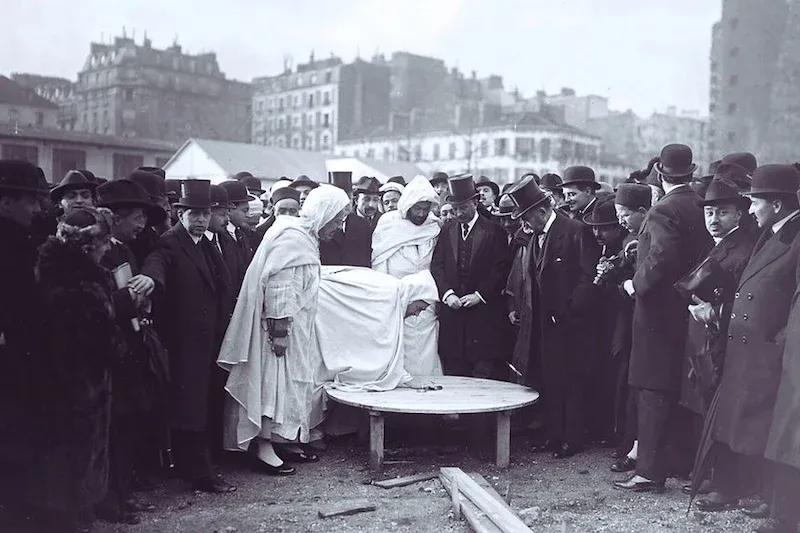
The celebration of the centenary of the Great Mosque of Paris took place on July 16, 2023, under the auspices of the current rector, Shams al-Din Hafiz. The event was co-presented by Moroccan journalist Abderrahim Hafidi, who hosts the Islam program on French Channel Two. Lasting nearly three hours, this gathering was intended to evoke the historical memory of this prestigious Islamic institution. However, the discussions raised significant concerns, as honoring such institutions requires a commitment to their authentic history.
My reflections were not focused on the organization of the event or the number of attendees, but rather on the historical narrative presented regarding the mosque's inception. It appeared, at various points, that the foundation's history was reinterpreted, sidelining well-documented roles found in both French and Moroccan archives, and offering a narrative inconsistent with the foundational documents of the mosque.
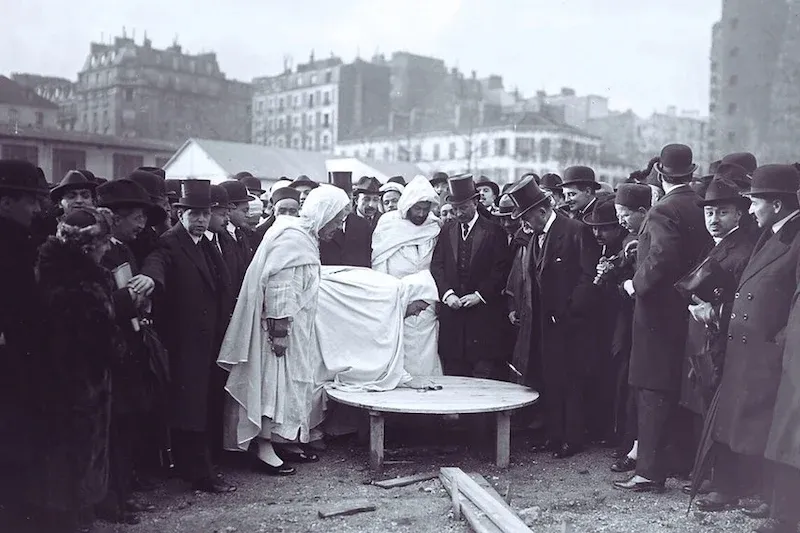
For instance, the portrayal of Sultan Moulay Yusuf as merely a guest at the opening ceremony alongside the French President misrepresents his crucial role. In reality, the Sultan was not just a ceremonial presence but a spiritual authority intrinsically linked to the mosque since its inception. In 1917, he issued a royal decree appointing Kaddour Ben Ghabrit, an Algerian by origin who naturalized as Moroccan, as the head of the charitable foundations responsible for overseeing the Great Mosque of Paris, along with other endowment institutions, such as hotels for Moroccan pilgrims in Mecca and Medina. Thus, the Sultan's relationship with the mosque was one of foundation and oversight, not merely a protocol-driven attendance.
Furthermore, the mention of "craftsmen from North Africa" contributing to the mosque's construction overlooks documented facts preserved in the archives of the French Foreign Ministry in La Courneuve. These documents confirm that the artisans who created the Moroccan decorations originated from Morocco, and that traditional building materials, including Fez tiles, intricately carved wood, and plaster, were transported via the port of Casablanca to Paris specifically for the mosque's construction in accordance with authentic Moroccan architecture.
Additional documents reveal that a committee of Moroccan timekeepers supervised the determination of the Qibla direction when laying the mosque's foundation, relying on Moroccan expertise in timekeeping and astronomy, a field renowned for its scholars from the Fes School and the Dar al-Muqit, drawing upon a scientific heritage accumulated by great scholars, including Ibn al-Banna al-Maraghini.
Moreover, it is essential to re-establish the significance of Imam Mohammed Ben Al-Arabi Al-Sukayrij, the first imam and preacher of the mosque. His inaugural sermon offered comprehensive advice to Muslims residing in France, urging them to uphold good neighborliness, respect laws, show kindness to others, instill morals in their children, and maintain their faith while integrating positively into society. This foundational document deserves inclusion among the reference texts of Islamic history in France.
During the celebration, a documentary was presented about the printing of the centenary Quran in Algeria, announced to be distributed to mosques across France. This scene could imply that the Great Mosque of Paris holds religious authority over all mosques in France, while the legal and organizational reality of Islam in France is far more complex and diverse. Additionally, it was emphasized that seven of the mosque's rectors were of Algerian descent, without clarifying that Algeria, as an independent state, had no role in their appointments, except for the current rector, and that the mosque's history predates Algeria's independence by many years.
The current administration of any institution does not grant it the right to rewrite its history; historical memory is not shaped by current power dynamics but is instead established through documents, archives, and verified facts. In the case of the Great Mosque of Paris, the elements of its foundation are evident: the royal decree, the Moroccan endowment institution, Moroccan artisans, Moroccan architectural materials, Moroccan timekeepers, the first imam and preacher, and the spiritual authority of the Moroccan Sultan.
In this context, the figure of General Hubert Lyautey emerges as a prominent supporter of the mosque project, believing its success required the legitimacy represented by the Moroccan Sultan as the Commander of the Faithful to gain the trust of Muslims and avoid being perceived merely as a colonial initiative. Correspondence from that period underscores the importance of this dimension in the French conception of establishing the mosque.
Notably, the poetic verses inscribed on the mosque's walls were selected from a poem composed by Imam Mohammed Ben Al-Arabi Al-Sukayrij to commemorate this occasion, highlighting the Moroccan presence in the symbolic identity of the mosque alongside its architectural, scientific, and spiritual identity.
However, the event appeared to be attended primarily by official French figures and a few close associates of the mosque's administration, while many diplomatic, cultural, and religious figures, whose presence would have lent a true representative dimension to the occasion, were noticeably absent. This includes the Moroccan ambassador and several ambassadors from Arab and African countries, alongside the absence of most active Islamic elites in France. The mention of the Moroccan contribution was limited to a remark from the French Minister of the Interior, who noted that the zellige decorating the mosque came from Fes.
As we mark the centenary of the Great Mosque of Paris, it is crucial to reopen discussions concerning its history based on original documents, free from shifting political narratives. Recognizing the Moroccan role in the mosque's establishment does not diminish anyone's status, but rather restores each party's rightful place in documenting the history of an institution that has become part of the history of Islam in Europe.
Perhaps the appropriate step today is to launch a scientific and legal initiative in France, involving historians, archivists, and legal experts, to gather the foundational documents of the mosque and publish them in a critical edition. This would ensure that the history of this institution becomes a matter for academic research rather than being subject to shifting narratives. Major institutions are preserved not by political discourse but by archives, documents, and a commitment to historical truth.
As reported by hespress.com.