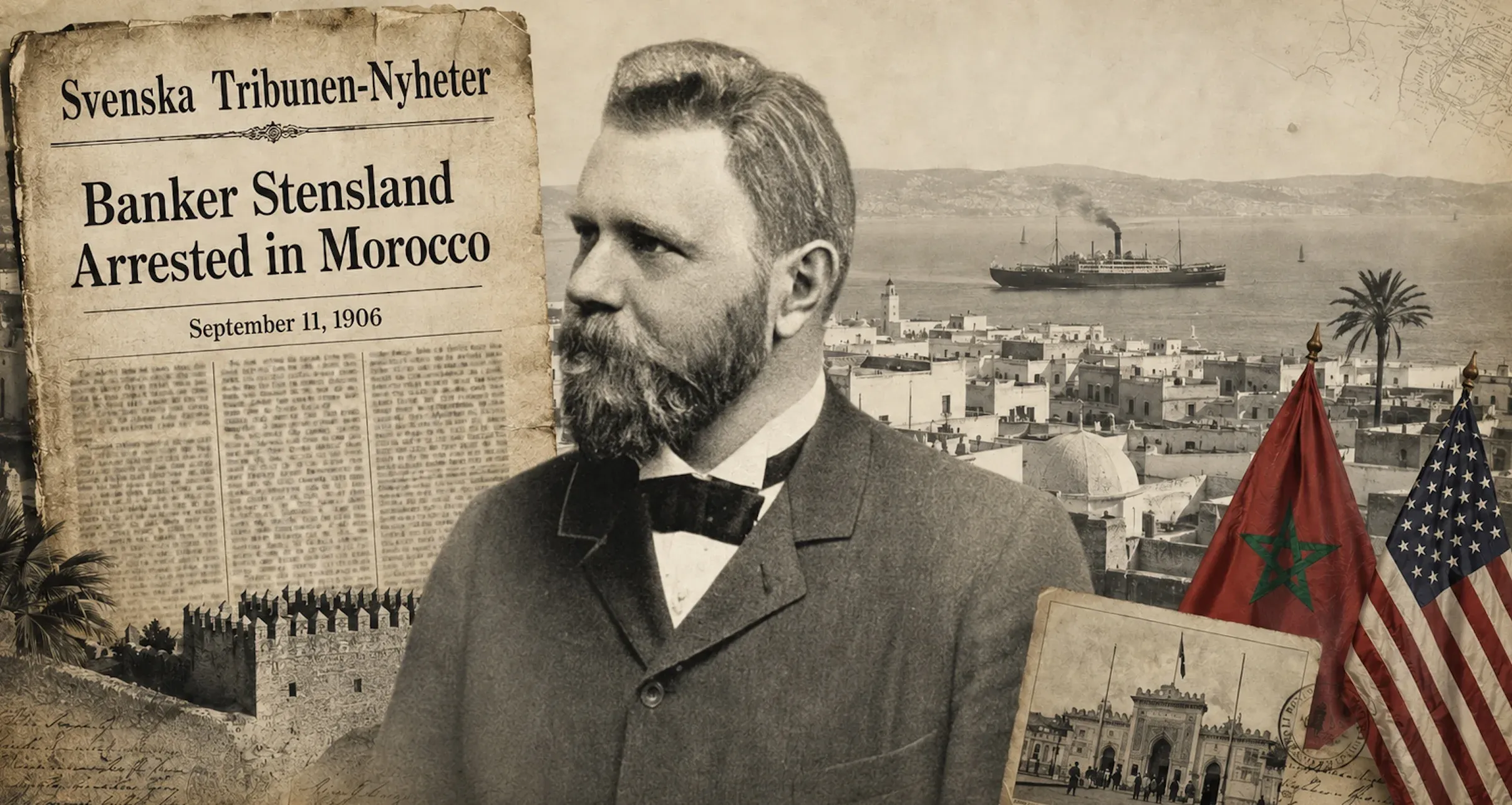

From Chicago to Tangier: A Banker's Flight
In the summer of 1906, Paul O. Stensland’s sudden disappearance from Chicago was not merely the escapade of a wealthy American indulging in an extended sojourn abroad. Stensland, the president of the Milwaukee Avenue State Bank, was in fact embroiled in a significant banking scandal that had sparked nationwide outrage. As investigators began to trace his whereabouts, Stensland had already made his way across the Atlantic Ocean, setting his sights on Morocco—a choice that at the time appeared to be a clever evasion tactic, given that the United States had no extradition treaty with the Moroccan kingdom. However, Stensland’s plan was soon thwarted by an unexpected hurdle: the robust diplomatic relations that already existed between Morocco and the United States.
The Pursuit of Stensland: Journalists and Prosecutors in Action
Stensland departed from Chicago to New York on July 12, 1906, as detailed in an account published by the Swedish-American newspaper Svenska Tribunen-Nyheter, preserved by the Foreign Language Press Survey at the Newberry Library. From New York, he traveled to Liverpool, spent a couple of days in England, and eventually arrived in Tangier. There, he checked into a modest hotel under the alias P. Olsen, claiming to be Norwegian. Reports indicated that Stensland appeared to feel completely secure in Tangier and was not attempting to conceal his identity. He had substantial amounts of cash at his disposal; the American minister in Morocco, Samuel R. Gummeré, later confirmed that Stensland had deposited 60,000 francs at the Comptoir d'Escompte in Tangier. Meanwhile, back in Chicago, authorities were actively searching for him.
The trail led two Americans to Tangier: James Keeley, a reporter for the Chicago Tribune, and Harry Olsen, an assistant district attorney from Chicago. The most comprehensive official account of the ensuing events can be found in Document 270 of the 1906 U.S. diplomatic archives, which contained a dispatch from Gummeré to the State Department dated September 6. Gummeré recounted that he first encountered Keeley and Olsen in Gibraltar on August 31, where they were, as he put it, 'on the trail of a certain Paul Stensland, a fugitive from Chicago guilty of embezzlement.'
By September 2, Keeley and Olsen had determined that Stensland had been residing for several weeks in what Gummeré described as 'a shabby hotel' in Tangier. Stensland subsequently took a trip through Spain but was expected to return, prompting the U.S. legation to get involved. A false alarm occurred on the night of September 2 when a man arriving in Tangier was mistakenly believed to be Stensland. However, the following morning, Stensland himself disembarked.
He headed toward the British post office, trailed closely by Keeley and Olsen. According to Gummeré, Stensland seemed poised to continue southward to Mogador, modern-day Essaouira, raising concerns that if he disappeared further down the Moroccan coast, it would become exceedingly difficult to locate him. Gummeré decided to take action before even informing Washington. In a cable sent on September 3, he notified the State Department: 'Stensland, embezzler from Chicago, discovered in Tangier as he prepared to depart for the coast, where it would be nearly impossible to find him. I have authorized his detention, pending your instructions.'
Initially, Stensland was held at the American legation before being transferred to a monitored hotel. It was at this juncture that the diplomatic complications truly began. Washington expressed a desire for Stensland to be extradited for trial, but without an extradition treaty in place, there was little that the State Department could demand. Thus, they turned to diplomacy.
On September 4, Washington instructed Gummeré to gauge the Moroccan government’s willingness to extradite Stensland as a favor, clearly indicating that the U.S. would not be able to reciprocate in the absence of a treaty. The following day, Gummeré met with Sid Mohamed Ben Arby Torres, the Sultan’s representative in Tangier, and laid out the situation. Remarkably, the Moroccan response was conciliatory; Gummeré reported that Torres had no objections to Stensland’s forced departure and assured him that assistance would be provided, 'even to the extent of placing all available guards at his disposal.'
In a swift communication back to Washington, Gummeré stated: 'The Moroccan government is willing to facilitate in every way the departure of Stensland from Morocco, who remains under the custody of the United States legation.'
The final stage of this extraordinary affair is documented in Document 271 of the 1906 U.S. diplomatic archives, sent from Tangier by U.S. Consul General Hoffman Philip on September 12. A vessel from the Hamburg-American Line, the Prinz Adalbert, was scheduled to stop in Tangier on its way from Naples to New York. Until the ship's arrival on September 12, Stensland was kept in a small Moroccan house near the American consulate. Once again, the Moroccan authorities provided their assistance. Philip reported that Olsen and Keeley were 'helped in every possible way by the Moroccan authorities, particularly by the governor of Tangier.'
Stensland was then escorted aboard the Prinz Adalbert under their watch. At this point, after the intervention of a journalist, a Chicago prosecutor, American diplomats, the Sultan's representative, and the authorities of Tangier, the only thing that temporarily delayed Stensland’s departure from Morocco was a technical issue with one of the ship's boiler tubes. Once the issue was resolved, the ship was ready to set sail, and the man who had crossed the Atlantic to Morocco was now prepared to make the return journey.
As reported by yabiladi.com.