The Historical Significance of Casablanca's Grain Silos
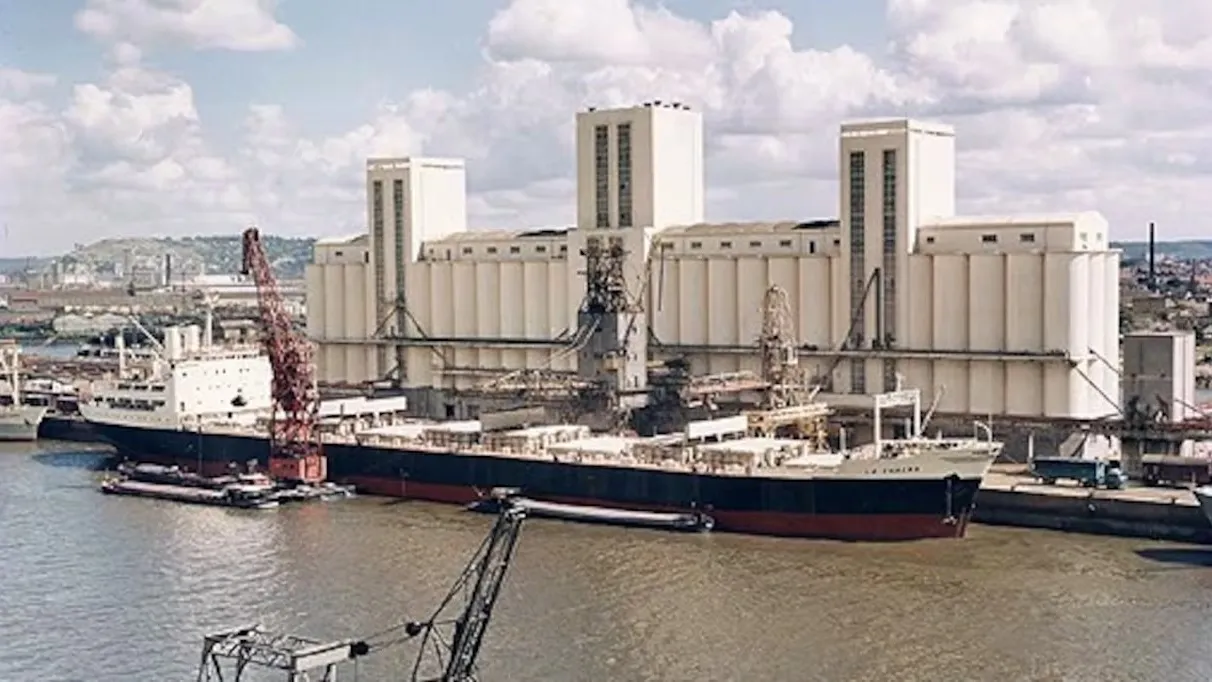
In the urban narrative of Casablanca, few structures symbolize the city’s economic purpose as powerfully as the grain silos located along the port. Their towering presence, oriented towards the Atlantic, has established them as a significant landmark in the maritime landscape over the decades. These structures are not merely technical infrastructures; they represent a long trajectory closely tied to the development of grain trade and the affirmation of the metropolis as a strategic hub. The origins of this grain terminal trace back to 1933, a period when port expansion accompanied the city’s economic growth. The modernized and enlarged port became a pivotal point for exchanges between the agricultural hinterland and international markets. Initially, the installations were designed with a strictly functional logic: to receive, store, and redistribute grains while ensuring their preservation and the smooth flow of trade, as discussed during a recent press conference organized by Casamémoire.
A Testament to Architectural and Economic Evolution
The establishment of the Port Silos Company in 1977 marked a significant turning point in the organization of this activity, reflecting a commitment to structuring the management of grain stocks in line with the growing demands of maritime commerce. The subsequent decades saw a series of technical enhancements: increased mechanization, expanded storage capacities, and streamlined loading and unloading processes, all evolving with the transformations of maritime transport and international safety standards. The historiography suggests that beyond its technical dimension, the port complex addressed a major strategic imperative: securing the supply of staple goods. In a country where cereals are central to the diet, mastering storage capacities and ensuring logistical continuity were national necessities. Investments amounting to several hundred million dirhams over the years attest to this priority, enabling the infrastructure to handle substantial volumes and reinforcing the port's role as a vital link between production, importation, and distribution.
Architects consulted have noted that the silos are a significant example of 20th-century industrial architecture. Constructed from reinforced concrete, they rise to several meters, forming a compact and monumental ensemble. Their verticality contrasts sharply with the horizontal expanse of the surrounding docks and warehouses. The repetition of cylindrical cells, the simplicity of lines, and the frankness of materials reflect an aesthetic characteristic of utilitarian constructions of the era, where form directly stemmed from function. Spanning several hectares within the terminal, the complex integrates into a landscape shaped by cranes, ships, and commercial flows. It stands as a testament to an era where modernity was expressed through technical performance and the ability to command space. In this regard, it contributes to the economic and maritime memory of the city, narrating a story of exchanges, massive imports, cargoes unloaded in rhythm with the tides, and redistributed inland.
This historical dimension is not secondary. In a metropolis marked by profound changes, the remnants of port industrialization serve as tangible landmarks. They allow one to read, in the materiality of concrete and the organization of volumes, the stages of urban growth based on trade and raw material transformation. Thus, the silos emerge as constructed archives, preserving within their mass the traces of an economy structured around grain flows. The history of modern ports shows that these facilities often transcend their initial function to become urban symbols. Their monumental nature, originally designed to meet specific technical needs, eventually contributes to the visual identity of maritime cities. In Casablanca, the silhouette of the silos accompanies that of the docks and basins, embedding in the landscape the memory of a century of intense activity.
As reported by lopinion.ma.