Historical Echoes and Contemporary Realities
The draw for the 2026 World Cup has proven to be a pivotal moment, evoking nostalgia by grouping Morocco, Brazil, and Scotland together, reminiscent of their encounter in 1998. This convergence of teams not only brings back memories of the past but also highlights the significant transformations that have occurred within the football world over the past 28 years. In the 1998 tournament, Brazil was an unstoppable force, Morocco was striving for recognition, and Scotland was merely a traditional competitor seeking its mark. The 1998 tournament ended dramatically for Morocco, who, despite their commendable performance, faced elimination due to a late Norwegian goal that dashed their hopes. Fast forward nearly three decades, and this matchup reemerges, albeit with vastly different narratives.
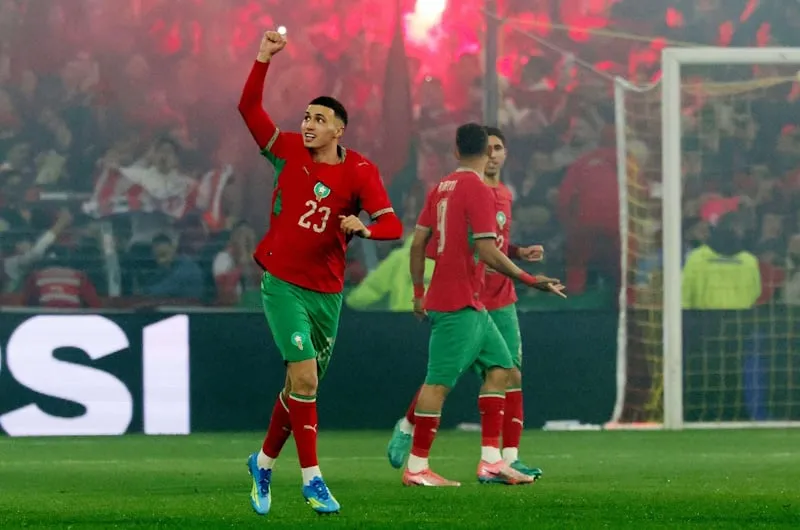
Today, Morocco has evolved from a team seeking acknowledgment to a formidable global contender. The history-making achievement at the 2022 World Cup was not merely a surprise but a watershed moment that transformed the global perception of Moroccan football. Entering the tournament with newfound confidence, Morocco is bolstered by a remarkable generation of players and ambitions that surpass the mere goal of qualification.
Shifting Dynamics and New Aspirations
On the other hand, Brazil finds itself facing a different kind of challenge. While the team retains its historical prestige, it is no longer the universally feared powerhouse it once was. The absence of a World Cup title since 2002 has created an ongoing pressure, making each new tournament a test of identity. Under the guidance of coach Carlo Ancelotti and a fresh wave of talent, the Brazilian national team aims to reclaim its former glory. Meanwhile, Scotland returns to the World Cup stage after a long hiatus of 28 years, fueled by a renewed spirit and a generation eager to prove itself. No longer just a number in the group, Scotland emerges as a team capable of pulling off surprises.
The intrigue of this group lies in the absence of any clear frontrunner, with each team carrying its unique narrative and motivations. Morocco rides the momentum of its recent successes, Brazil is burdened by its historical legacy, and Scotland brings a drive to re-establish itself. This dynamic creates a compelling storyline where no match can be taken for granted, and the outcomes are far from predetermined.
While the names may echo the past, the 2026 encounter represents a completely new era in football, one that disregards historical precedents and demands fresh narratives on the pitch. The transformation of Moroccan football has shifted the dialogue away from mere participation to a comprehensive football project. The Moroccan national team now embodies a clear system that balances defensive strength with attacking audacity, a noticeable evolution over recent years. This shift—from a team aiming for the group stages to one competing for advanced rounds—reflects the substantial growth of football infrastructure within the country.
Brazil, on the other hand, carries the weight of its illustrious history. As the most decorated team in World Cup history, the pressure to perform has intensified with each new generation being compared to past legends. Recent failures have been magnified due to high expectations. Ancelotti’s leadership signifies a clear intent to reconstruct their identity, seeking a balance between traditional Brazilian flair and modern European discipline.
Scotland's return to the World Cup is marked by both emotional and technical significance. No longer reliant solely on enthusiasm as in the past, the team has matured into a more organized and composed unit on the field. The presence of experienced players like Scott McTominay and Andy Robertson provides essential balance, while coach Steve Clarke instills a clear identity rooted in discipline and teamwork.
As the teams prepare for this tournament, they each carry distinct motivations: Morocco plays with the confidence of ambition and progress, Brazil under the weight of historical expectations, and Scotland driven by a desire for resurgence and validation. This complexity transforms every match into a narrative struggle rather than just a quest for points. Unlike 1998, there are no clear favorites, no guaranteed surprises, and the margins between these three teams have narrowed, illustrating that modern football values systems and readiness as much as it does individual talent.
As reported by alquds.co.uk.