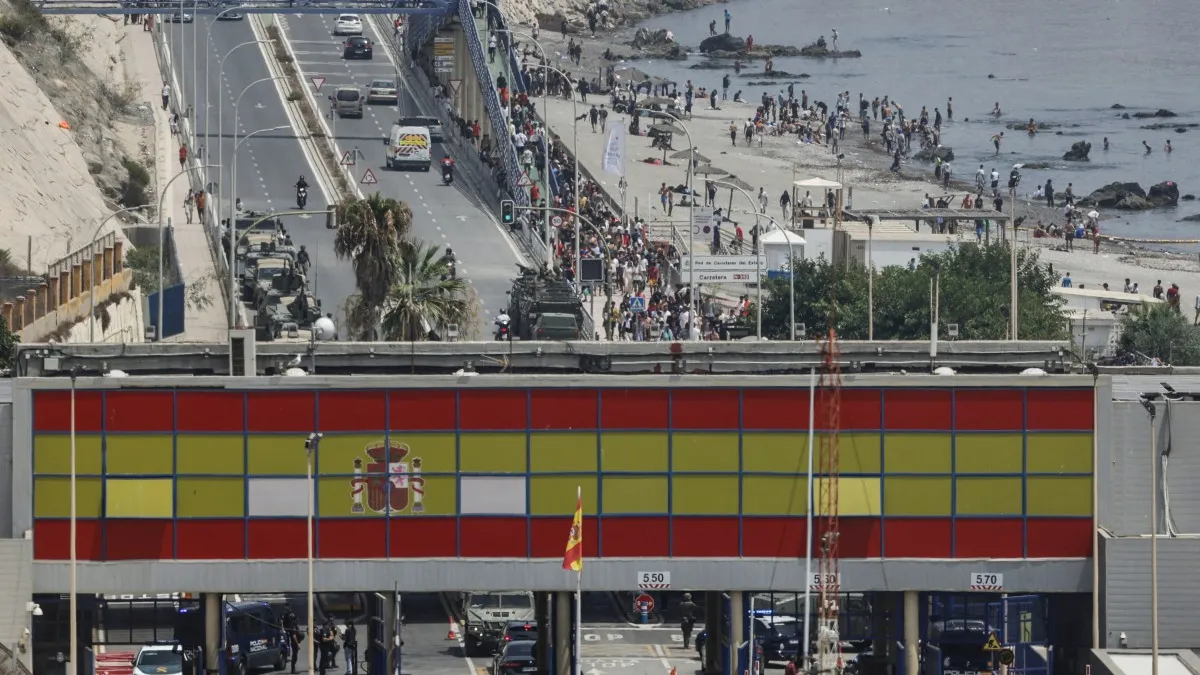

The irregular entries into Ceuta through its land border with Morocco have surged dramatically, increasing by more than five times since 2021. In that year, the autonomous city saw 753 individuals cross into its territory. By 2025, the last year for which complete data is available, the Ministry of the Interior recorded a staggering 3,523 entries. When combining figures from both Ceuta and Melilla, the rise is equally striking: 1,845 people entered Spain irregularly in 2021, and by 2025, that number had climbed to 3,850. As of July 2026, excluding the mass entry incidents on the 30th and 31st, an alarming 4,182 individuals had already managed to circumvent the border security measures. These statistics raise serious questions about the effectiveness of border control, especially when contrasted with the financial investments made by the European Union (EU) and Spain to enhance Morocco's border oversight.
How much funding does Morocco receive to bolster its migration control efforts? José Bautista, the director of investigative journalism at the organization porCausa, highlights a significant lack of transparency regarding the flow of funds from Brussels to Rabat. He notes that while some funds are obscured, others are misallocated and do not contribute to the intended migration control initiatives. Nevertheless, some key figures are known, such as the EU's approval to allocate €500 million to Morocco for the period from 2021 to 2027 specifically aimed at strengthening its border controls. This information was initially reported by El País and later confirmed in March 2023 through a parliamentary response from Ylva Johansson, then European Commissioner for Home Affairs. Johansson affirmed that the Commission had announced an indicative aid package of €500 million for Morocco in the realm of migration.
Johansson was also responsible for establishing an operational partnership focused on combating human trafficking during her visit to Morocco in July 2022. In the same parliamentary response, she indicated that as of July 2023, €150 million of the allocated €500 million had already been budgeted. Additionally, in 2025, another €160 million was noted in a funding annex for African countries available on the European Commission's website, which also falls under the €500 million umbrella. In the previous funding period (2014-2020), the EU allocated €346 million to Morocco's migration management.
However, the funds associated with Morocco's migration control come through various channels. Público has discovered a project from the Foundation for the Internationalization of Public Administrations (FIAP), under the Ministry of Foreign Affairs, that allocates €44 million to Morocco for "supporting border management and migration." The European Commission is also the funding source for this project. As of the publication of this article, the Ministry of Foreign Affairs has not confirmed whether these €44 million are part of the €500 million projected by the EU or if they are additional funds.
Moreover, since 2021, the Spanish government has approved several aid packages for Morocco in the area of migration. In 2022, the administration authorized a €30 million aid package aimed at police cooperation. The same year, Morocco was listed as one of the beneficiaries—alongside Senegal, Mauritania, and Gambia—of an aid package amounting to nearly €43.5 million to strengthen operational capacities against irregular immigration and human trafficking networks. This operation was repeated in 2024 with a fund of approximately €20.5 million, along with a specific aid of over €4 million for Morocco in police cooperation.
So, has this funding effectively curbed irregular entries? The short answer is no. The data is quite revealing: in 2021, 1,845 individuals entered the autonomous cities of Ceuta and Melilla irregularly, and by 2025, after the aforementioned financial disbursements, that number rose to 3,850—more than double. Each year has seen an increase in entries, with the exception of 2023, which saw a decrease to 1,234 individuals. Following this, irregular entries resumed their upward trajectory, with 2,647 in 2024, 3,850 in 2025, and 4,182 between January and July of 2026.
These statistics, provided annually by the Ministry of the Interior, do not account for the significant migrant influx into Ceuta during May 2021—reported to be around 10,000 individuals—or the July entries this year, which the government estimates at 72,000. The ministry argues that these figures are estimates and therefore "do not fit into statistical work" and add that both events were extraordinary and "require specific analysis."
Moreover, it is instructive to examine the entries into Ceuta and Melilla separately, as they represent different migratory flows, and the importance of each has fluctuated significantly in recent years. Over the last decade, from 2017 to 2022, the majority of entries from Morocco occurred through Melilla, totaling 17,671 individuals during those six years. In comparison, Ceuta saw only 7,609 entries. However, from 2023 to 2025, the entries into Ceuta nearly matched the total from the previous seven years, at 7,122, while Melilla saw just 609 entries, marking a dramatic decline. For example, from January to December 2026, 3,835 individuals crossed into Ceuta (excluding the mass entry in July), while only 347 entered Melilla.
Cecilia Estrada, a professor at Comillas University and a doctor in International Relations, attributes the decline in entries through Melilla to the "Nador tragedy" of 2022, where dozens lost their lives due to police intervention while attempting to cross with a group of around 2,000 people. This event has tarnished Nador's reputation as a hotspot in migratory routes. It could also explain the drop in arrivals to Spain in 2023, as Melilla saw a decrease from 1,175 entries in 2022 to just 166 in 2023. Additionally, the COVID-19 pandemic significantly depressed the region, leaving it devoid of commerce. Estrada notes that in this case, Moroccan authorities did work to reduce the volume of entries, which primarily originated from other parts of Africa, such as the Sahel.
The increase in entries to Ceuta, according to Estrada, can be explained by the mixed profile of individuals attempting to cross the border. Beyond those coming from lengthy migratory routes across various parts of Africa, there has been a notable rise in the number of young Moroccans attempting to swim from beach to beach, using false documentation or hiding in vehicles to ultimately make their way to the mainland. In this context, Estrada emphasizes the significant influence of social media on these children and young individuals. Finally, the researcher points out that the situation in Ceuta reflects the other side of Morocco's actions. "72,000 people do not move spontaneously; it was a display of force," she concludes in her conversation with Público.
As reported by publico.es.