Strategic Military Alliance between Morocco and the U.S.
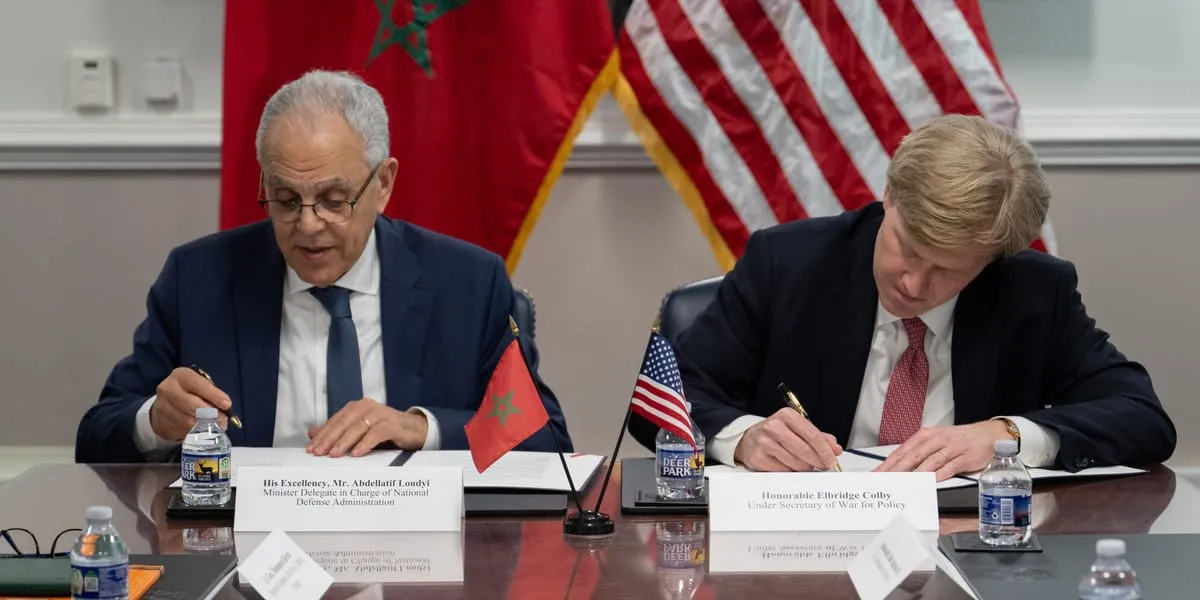
The recent bilateral agreement between Morocco and the United States marks a significant step in military cooperation, granting Morocco access to advanced military technology in exchange for aligning more closely with Washington and Israel's interests across Africa and the Middle East. Signed on April 16, 2023, in Washington, this 'defense cooperation roadmap' binds the two nations in a military partnership for a decade, spanning from 2026 to 2036. The accord was formalized by Abdelatif Loudyi, Morocco's Minister of Defense Administration, and Elbridge Colby, the U.S. Deputy Secretary of Defense and a key architect of Donald Trump's security policy. As highlighted by El Confidencial, this commitment solidifies Morocco's role as a strategic pawn for U.S. interests on the African continent, alongside Egypt, enabling a smoother transfer of public resources to the American military-industrial complex.
Morocco's military budget for the current year stands at €6.713 billion, accounting for 4.8% of its Gross Domestic Product (GDP). This figure is complemented by a spending cap of €13.793 billion dedicated solely to the acquisition of armaments. According to diplomatic sources cited by El Confidencial and Le Desk, the roadmap aims to modernize the Royal Armed Forces with previously restricted technologies, including Apache AH-64E helicopters and precision-guided GBU-39B bombs, thereby enhancing Morocco's status as the leading purchaser of U.S. arms in the region.
Integration and Military Exercises
A central component of this agreement is the integration of the Moroccan military into the NATO tactical data network, Link-16, which allows real-time interoperability among ground, naval, and aerial units without relying on radio communications. This technical assimilation will be tested during the upcoming African Lion exercises on April 20, where around 40 American tech companies will utilize Morocco as a testing ground for their new combat tools. Additionally, plans have been announced to reopen a regional center in Morocco, managed by the Pentagon, aimed at training African armies in the use of drones.
This deepening military dependency serves as a counterbalance to the diplomatic support offered by the Trump administration to Morocco's expansionist aspirations. Washington has pushed a resolution in the UN Security Council favoring Morocco's 'autonomy plan' for the occupied Western Sahara, disregarding international resolutions on decolonization. In return, the Alaouite Kingdom remains committed to the Abraham Accords, normalizing relations with Israel. In this context, the Israeli company BlueBird Aero Systems is set to establish a plant in Morocco for the production of the kamikaze drone SpyX, thereby enhancing the trans-Eurasian military axis aimed at countering Iranian and Algerian influence.
Various analysts linked to conservative think tanks, such as Amine Ayoub, suggest that this alliance could shift the strategic importance from European bases like Rota to Moroccan facilities in Alcazarseguir, located between Tangier and Ceuta. Meanwhile, high-ranking officials within the Moroccan monarchy, such as Lahcen Haddad, openly advocate for this total alignment with the U.S. and Israel as a pathway to positioning the country among the 'geostrategic powers.'
As reported by diariosocialista.net.