
Spain's Military Strategy Under Scrutiny Amid Moroccan Military Growth
Since the 2002 crisis surrounding the island of Perejil, Morocco has invested approximately $70 billion into enhancing its military capabilities, acquiring advanced weaponry and military technology. This includes American F-16 fighter jets, state-of-the-art French frigates, and plans for Israeli spy drones and satellites. Such significant military advancements have led to a qualitative and quantitative shift, compelling the Spanish military to reevaluate its defense strategies in response to potential crises involving Morocco. The Spanish armed forces now acknowledge that their deterrent power over Rabat has weakened considerably, with a military superiority that once defined their stance over two decades ago now being a shadow of its former self, as highlighted in a report from the Army published last year.
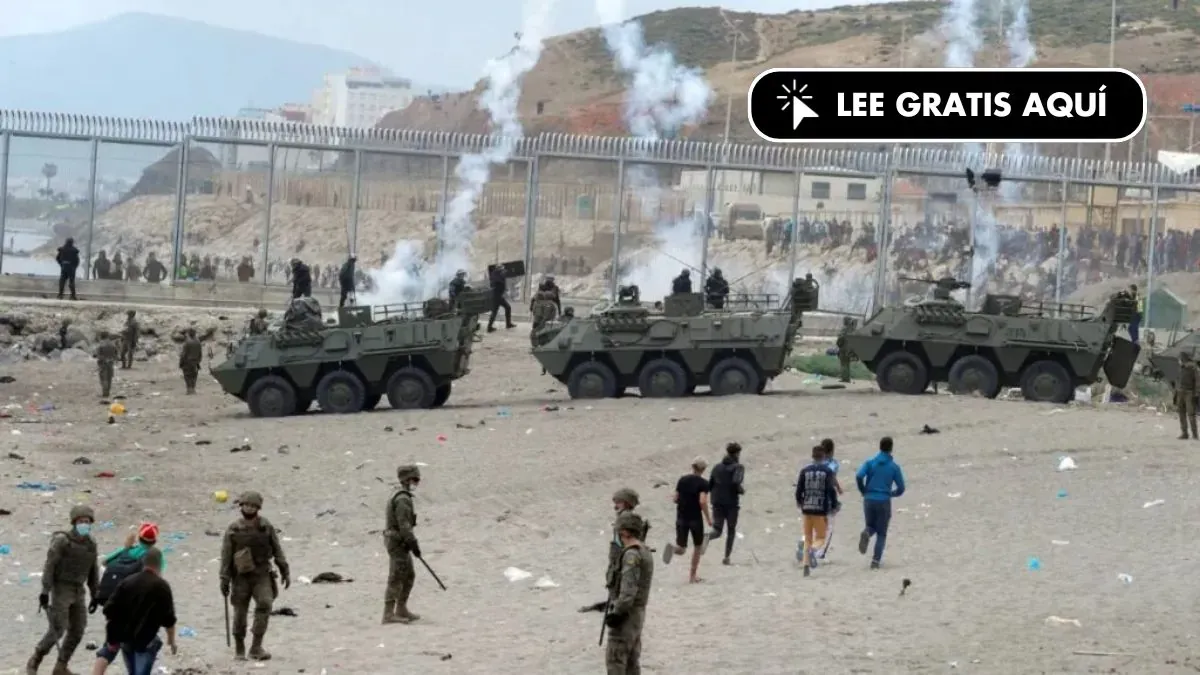
The events that unfolded in Ceuta on July 30 did not catch military analysts by surprise. In fact, the potential for an assault on the city is one of the most analyzed scenarios among Spanish military scholars. In July 2025, the Higher School of the Armed Forces (ESFAS) released a crucial document titled "Spanish Deterrence Strategies Against Unshared Threats in the 21st Century," detailing in 16 pages the resources and capabilities Spain possesses to dissuade Morocco from attempting to seize Ceuta and Melilla, through any means necessary.
This report underscores the challenges Spain faces in defending against a massive assault from Morocco, both politically and militarily. The analysis, authored by a commander from the General Army Corps, indicates that the Spanish Armed Forces can no longer rely on the military superiority they once enjoyed over their neighboring country. The primary deterrent strategy, according to Commander Arias Otero, revolves around the military capabilities of the Armed Forces: "It is a fundamental pillar of deterrence, providing the means to protect national interests and project power. For Spain, a relative military superiority remains the best deterrent against Moroccan ambitions regarding Ceuta and Melilla." In the past, as noted in the ESFAS report, Spain demonstrated its capacity to impose military deterrence, particularly during the crisis at Perejil Island, showcasing its ability to defend its sovereignty. Moreover, the ongoing military presence in Ceuta and Melilla reinforces Spain's deterrent posture.
The Moroccan Military Build-Up: A Growing Concern
However, the ESFAS document emphasizes that the situation has changed significantly since those earlier times. "The increasing military expenditure of Morocco and the modernization of its armed forces pose future challenges to maintain this relative superiority," it states. Since the 2002 crisis, Morocco has embarked on a strategic military rearmament plan, with cumulative defense spending exceeding $70 billion, raising its annual budget to nearly 4% of its GDP. This investment cycle has transformed the Royal Moroccan Armed Forces into one of North Africa's military powers. Significant acquisitions include American F-16 Block 72 fighters and AH-64E Apache attack helicopters, alongside strategic military cooperation agreements with the United States. In recent years, Morocco has also procured long-range artillery systems like HIMARS, drone fleets such as MQ-9B SeaGuardian and Bayraktar TB2, advanced air defense shields like the Barak-8 system, and electronic warfare technology from Israel, with whom they initiated a strategic partnership in 2021.
Israel is particularly noteworthy as Morocco seeks to renew its strategic military capabilities through spy satellites, which were reportedly used to monitor the recent assault on Ceuta. The Mohamed VI-A and Mohamed VI-B satellites were developed covertly in partnership with France, specifically Thales Alenia Space and Airbus Defence and Space France. However, Morocco has now pivoted towards Tel Aviv, showing interest in Ofek 13 satellites manufactured by Israel Aerospace Industries (IAI), with an estimated cost of around a billion dollars contributing to its total military expenditure.
Furthermore, the ESFAS report insightfully highlights a critical aspect of the current crisis: the role of Spain's allies and partners in the face of a "non-shared threat," meaning one that only concerns Spain. "The effectiveness of this form of deterrence largely depends on the perception of possible retaliation from Spain's allies. Although NATO and the EU have publicly supported Spain's sovereignty over Ceuta and Melilla, the reality is that their active participation in specific conflicts may be limited," the document notes, recalling the 2002 Perejil Island incident, where the resolution did not involve direct military action from allies but rather U.S. mediation.
The report concludes that while collective deterrence offers significant theoretical deterrence due to the potential for a collective response, the absence of explicit guarantees and historical experiences suggest its limited capability to dissuade Morocco. Spain's reliance on diplomacy and international mediation to resolve incidents indicates that while extended deterrence is a valuable component of the security strategy, it alone is insufficient to halt Morocco's ambitions regarding the autonomous cities.
Additionally, the report delivers a significant political message to the government led by Pedro Sánchez, reminding them that changes in stance, such as the recent recognition of Western Sahara in favor of Morocco without any known compensatory measures for Spain, suggest a potential drift towards appeasement theory. "This approach of conceding certain demands without requiring anything in return is a precarious way of engaging between disputing states. Following this path of appeasing the aggressor poses notable risks, including the uncertainty of when the aggressor's demands will cease and identifying the limits and red lines of the concessions made by the aggrieved party," the analysis warns.
As reported by theobjective.com.