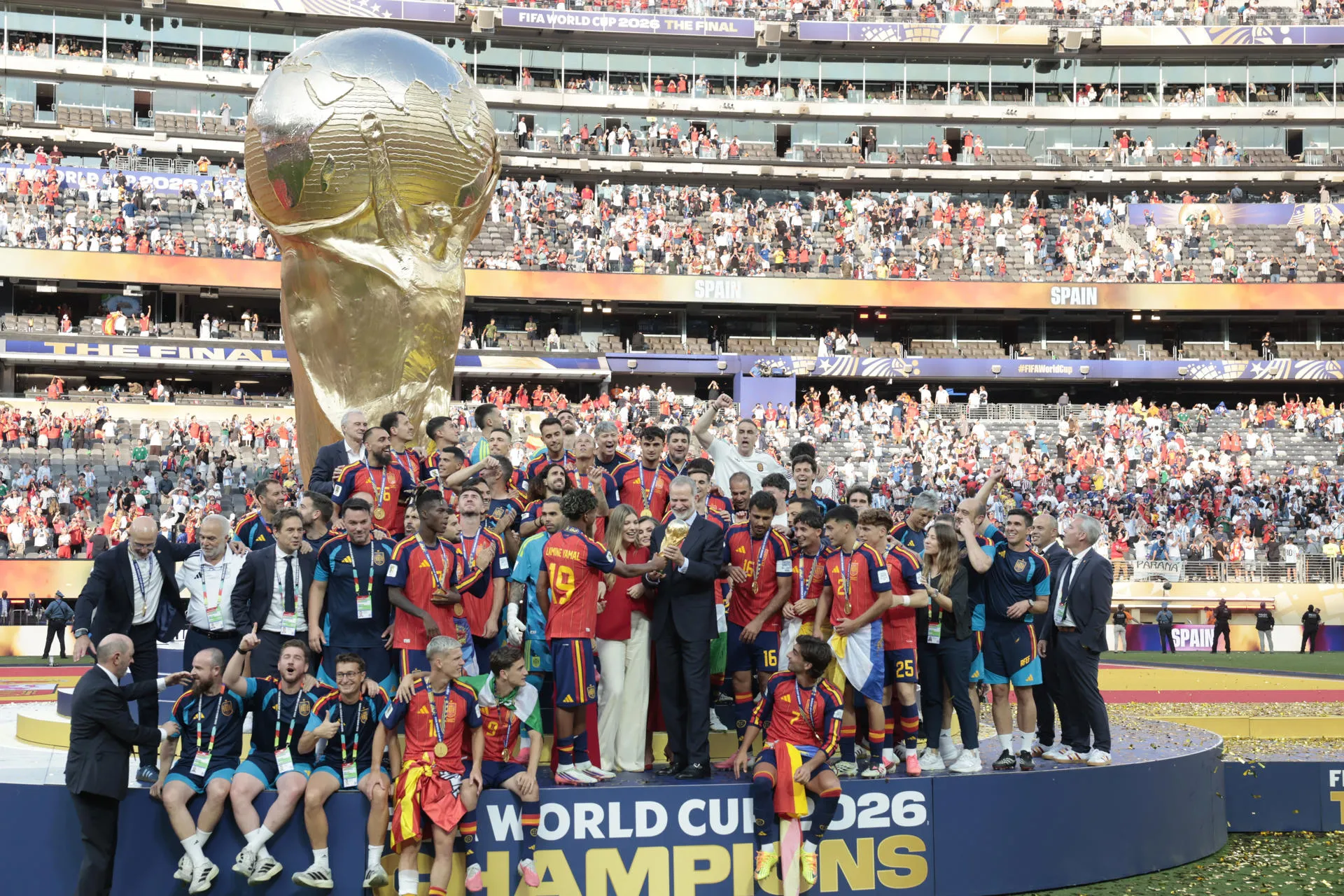
In a thrilling finale at the MetLife Stadium in East Rutherford, New Jersey, King Felipe VI of Spain celebrated alongside Princess Leonor, Infanta Sofía, and rising star Lamine Yamal as Spain triumphed over Argentina to clinch the FIFA World Cup 2026 title. This monumental victory not only marks a significant achievement for the Spanish national team but also paves the way for preparations for the upcoming FIFA World Cup 2030. Set to be co-hosted by Spain, Portugal, and Morocco, with three additional matches taking place in South America, the anticipation is building as details about the tournament's format and final venue remain to be confirmed.
The 2030 World Cup is poised to be a historic event, as it will be the first tournament organized across three different confederations—UEFA, CAF, and CONMEBOL—spanning three continents. This edition is particularly noteworthy as it commemorates the centenary of the World Cup, which began in 1930 in Montevideo. To honor this milestone, FIFA has decided to host three inaugural matches in Argentina and Uruguay, the finalists of the first tournament, along with Paraguay, the headquarters of CONMEBOL.
Initially, the 2030 World Cup was expected to follow the format established in 2026, featuring 48 teams and a total of 104 matches. However, FIFA President Gianni Infantino recently hinted at the possibility of expanding the tournament to include 64 teams, which would be an increase of 16 teams compared to the recently concluded World Cup. This proposal, championed by CONMEBOL President Alejandro Domínguez, emphasizes that the centenary celebration should be an extraordinary event, allowing as many nations as possible to participate in the festivities.
With a potential format of 64 teams, the tournament structure would be more straightforward, enabling the top two teams from each of the 16 groups to progress directly to the round of 16, eliminating the need for complex algorithms to determine the best third-placed teams, a challenge faced in the previous edition.
Infantino has opened the floor for discussions regarding this expanded format, asserting the importance of organizing a World Cup that represents the entire globe, not just Europe and South America. He stated, "Every nation should be allowed to dream of participating in the World Cup." His remarks highlight the growing quality of teams from regions that are not traditionally known for their football prowess, such as Cape Verde, Egypt, and Congo, which have shown they can compete against football giants like Spain, Argentina, and England.
Aside from the format discussions, another significant debate surrounding the 2030 World Cup remains the final venue. Spain is advocating for the honor of hosting the final match, while Morocco is also in contention, currently constructing a stadium in Casablanca that will have a capacity of 115,000, making it the largest stadium in the world. With these exciting developments on the horizon, the footballing world is poised for an unforgettable World Cup in 2030.
As reported by larepublica.ec.