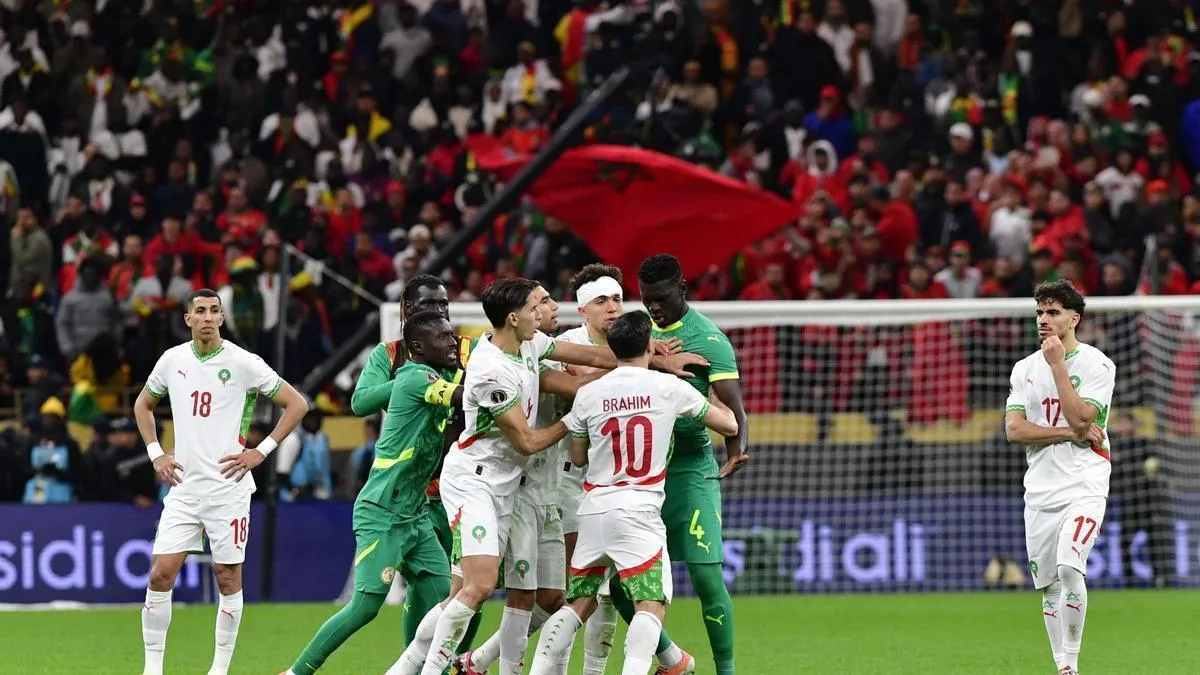
The Ongoing Controversy Surrounding the Morocco-Senegal Showdown
The controversy surrounding the Morocco-Senegal match continues to unfold, more than three months after the final took place in Rabat. Senegal initially celebrated their victory, having lifted the African Cup title shortly after leaving the pitch at the end of the match. However, as of now, Morocco has been declared the official winner, and the saga seems far from reaching a resolution. The situation remains under investigation, and in this context, the French newspaper 'Le Monde' recently published five comprehensive reports detailing the events of the final that occurred on January 18. Among these documents are accounts from the officiating referee, the general coordinator responsible for logistics, and the commissioner overseeing the match, alongside two additional reports focusing on security issues and various incidents that transpired during the event.
These reports contain serious allegations against Morocco concerning the conditions under which the match was played, while they also include the defense arguments from the nation that was ultimately declared the winner in administrative proceedings, despite having lost on the field with a score of 0-1. Notably, 'Le Monde' highlights troubling incidents that occurred during the press conference, physical altercations and verbal confrontations in the locker rooms, food poisoning affecting three Senegalese players, and the arrest and sentencing of 18 fans—all following what Senegal deems to be a 'disastrous' organizational effort.
Details of the Match Day Chaos
The most contentious aspect of the final was undoubtedly Senegal's exit from the field prior to Brahim taking his penalty kick. However, the problems began long before the final whistle. According to the aforementioned source, Senegal faced various forms of harassment upon their arrival in Rabat, reporting an abysmal logistical organization that starkly contrasted with their interests. The Senegalese delegation was initially set to travel to Rabat on a high-speed train (TGV), only to discover that their accommodation was to be at the Rihab Hotel, a mid-range facility that 'fails to meet the high standards necessary for the preparation of a final.' Consequently, Senegal refused to stay there, prompting the CAF (Confederation of African Football) to recommend the Amphitrite Hotel, located on the outskirts of the capital, which was significantly more comfortable.
Following this, the secretary general of the Senegalese football federation issued a statement of protest, emphasizing that neither the Hotel Rihab nor the Amphitrite Rabat appeared on the official list of initially approved venues communicated by the CAF, raising legitimate concerns about compliance with competition specifications. Morocco's response was that 'everything was planned and known beforehand,' asserting that any changes were made to accommodate Senegal, which they claimed had been consistently complaining. Furthermore, Senegal raised additional concerns regarding their training being conducted at the Mohammed VI complex, a Moroccan base, citing safety concerns and a lack of tactical confidentiality, fearing the presence of 'spies' from Morocco.
Additionally, Senegal argued that 'the police had not provided adequate security' upon their arrival at the train station in the Moroccan capital, where local fans exhibited uncontrolled behavior towards the players. Even Senegal's coach, Pape Thiaw, reported an 'abnormal' security breach, stating that 'the players were in danger.' The tumult did not cease during the match, as 'Le Monde' revealed altercations between the technical staff and substitutes of both teams, alongside 'inappropriate behavior' from Moroccan ball boys attempting to snatch away the towel from the Senegalese goalkeeper. Ahmed Osman, the Egyptian commissioner of the match, detailed in his report that 'the fans were out of control and displayed extreme violence,' necessitating intervention from riot police to manage the situation and secure both the stands and the pitch. To add to the turmoil, reports indicate that 'three Senegalese players were transported to a medical center after suffering from food poisoning in the locker room.'
As reported by sport.es.