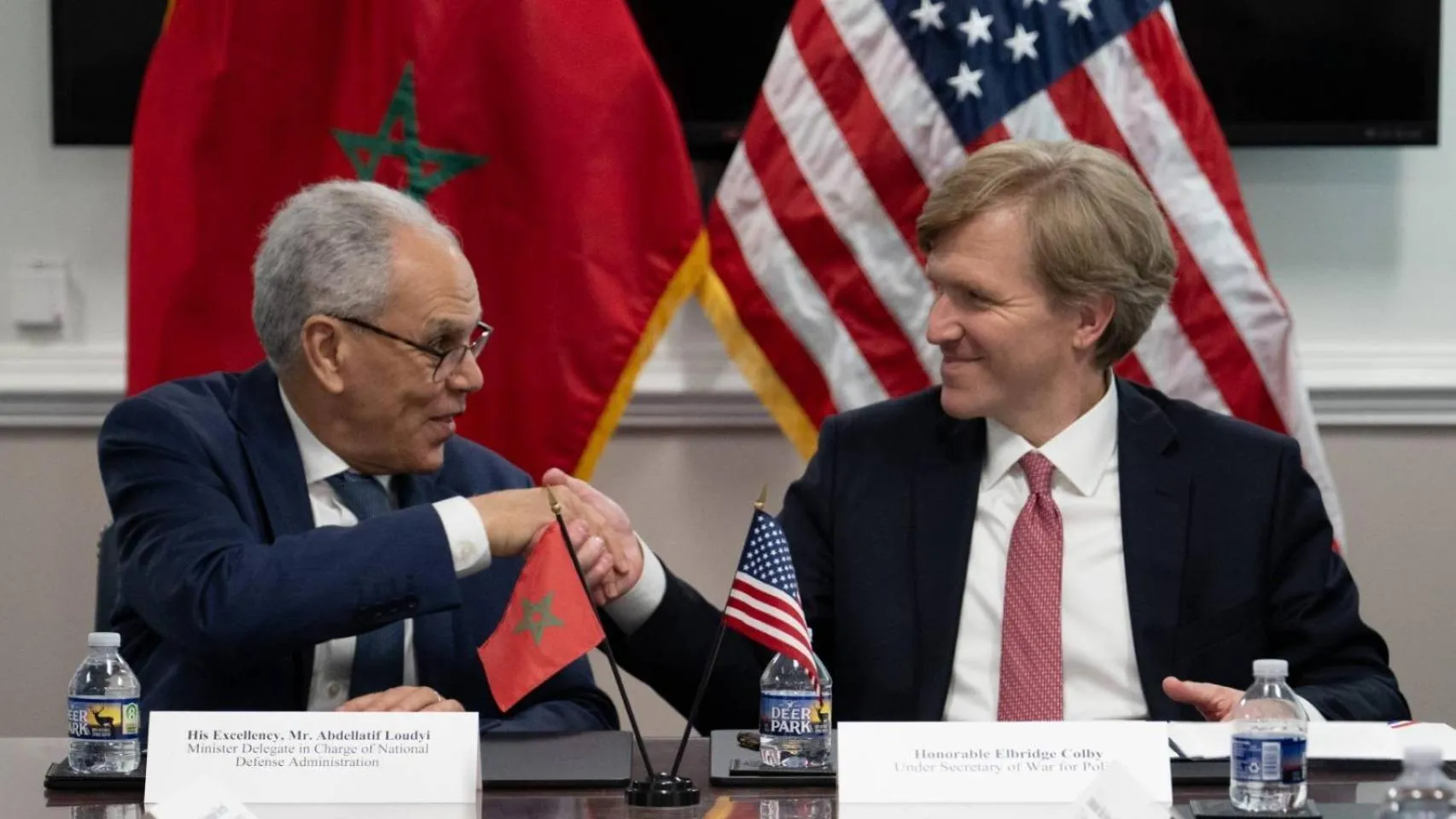
In a significant development for military collaboration in North Africa, Elbridge Colby, the U.S. Under Secretary of Defense for Policy, met with Abdelatif Loudiyi, Morocco's Minister Delegate for National Defense, in Washington. This meeting culminated in the signing of a new Defense Cooperation Roadmap for the years 2026-2036, which will empower Morocco to procure military equipment comparable to that of NATO countries over the next decade. The agreement not only emphasizes military training and joint exercises, such as the African Lion, but also focuses on enhancing technical knowledge in areas such as intelligence gathering and counter-terrorism efforts.
Both nations highlighted Morocco's pivotal role as a strategic ally for the United States in Africa, particularly regarding its active participation in regional peacekeeping missions. This recent roadmap builds on a previous agreement from October 2020, which already laid the groundwork for military support and technological collaboration between the two countries. Colby noted on social media that this roadmap is set to steer their historic defense relationship for the coming decade, reflecting a partnership that has flourished for 250 years since Morocco was the first nation to recognize the United States.
During the Pentagon meeting, Colby praised the collaboration with Loudiyi and Lieutenant General Mohammed Berrid, Inspector General of the Royal Moroccan Armed Forces. The defense and cybersecurity sectors stand out as the two main pillars of this partnership, which is increasingly relevant given the evolving security threats facing both nations. The Royal Moroccan Armed Forces (FAR) recently tested the tactical communication system Link-16 in Agadir, a secure technology previously exclusive to NATO members, enabling real-time data sharing among ground, air, and naval units.
The Link-16 system facilitates encrypted and interference-resistant communication, providing a reliable connection between military platforms. This technology is essential for enhancing situational awareness among dispersed combat forces by allowing the exchange of critical information, positional data, command orders, imagery, and other intelligence through a secure common communication link. The new roadmap signifies a mutual commitment to invigorating bilateral military cooperation, emphasizing the determination to expand and improve the effectiveness of this partnership.
The Moroccan delegation's visit to Washington, which took place from April 14 to 16, was ordered by the Moroccan monarch and coincided with the 14th meeting of the U.S.-Morocco Defense Advisory Committee. The discussions, attended by U.S. Secretary of War Pete Hegseth, Moroccan Ambassador to Washington Youssef Amrani, and U.S. Ambassador to Rabat Duke Buchan III, delved into various aspects of military cooperation, highlighting a satisfactory balance in several areas of partnership between the Moroccan and U.S. armed forces. This includes leadership training, knowledge exchange, and organizing large-scale joint exercises, such as African Lion, alongside matters related to military capabilities and equipment.
The military collaboration between Morocco and the United States is grounded in mutual interests, establishing one of the region's strongest alliances. For Washington, it serves as a strategic foothold in Africa, while Rabat enhances its defense capabilities through privileged access to U.S. military equipment and technologies. Operationally, the FAR benefit from this alliance through leadership training in U.S. military academies, technical knowledge transfer in intelligence and counter-terrorism, and the acquisition of cutting-edge weaponry. The reciprocal nature of this partnership is particularly evident in the upcoming African Lion exercises, scheduled for April 20 to May 8, which will take place across various cities in Morocco.
General Dagvin Anderson, commander of AFRICOM, has noted the symbolic significance of this year's exercises, coinciding with the 250th anniversary of the United States and Morocco's recognition of each other. More than forty American technology companies are set to join the troops to validate next-generation combat tools, turning Morocco into a real-world testing ground for tactical artificial intelligence systems, advanced command operations, and deep-strike capabilities.
During their Washington meeting, the Moroccan official underscored U.S. support for Moroccan sovereignty over its entire territory, including Western Sahara, as well as Morocco's role as a stabilizing force in the region. In return, the U.S. representative acknowledged Morocco's contributions, under the leadership of King Mohammed VI, to promoting peace and security in the regional context. Additionally, they discussed initiatives spearheaded by the Moroccan monarch regarding the African Atlantic Facade and the Morocco-Nigeria gas pipeline, along with Morocco's active involvement in peacekeeping missions across Africa. Furthermore, both nations are working on a commercial agreement in two key economic sectors and are defining the new contours of their free trade agreement, as reported by Africa Intelligence.
As reported by elespanol.com.