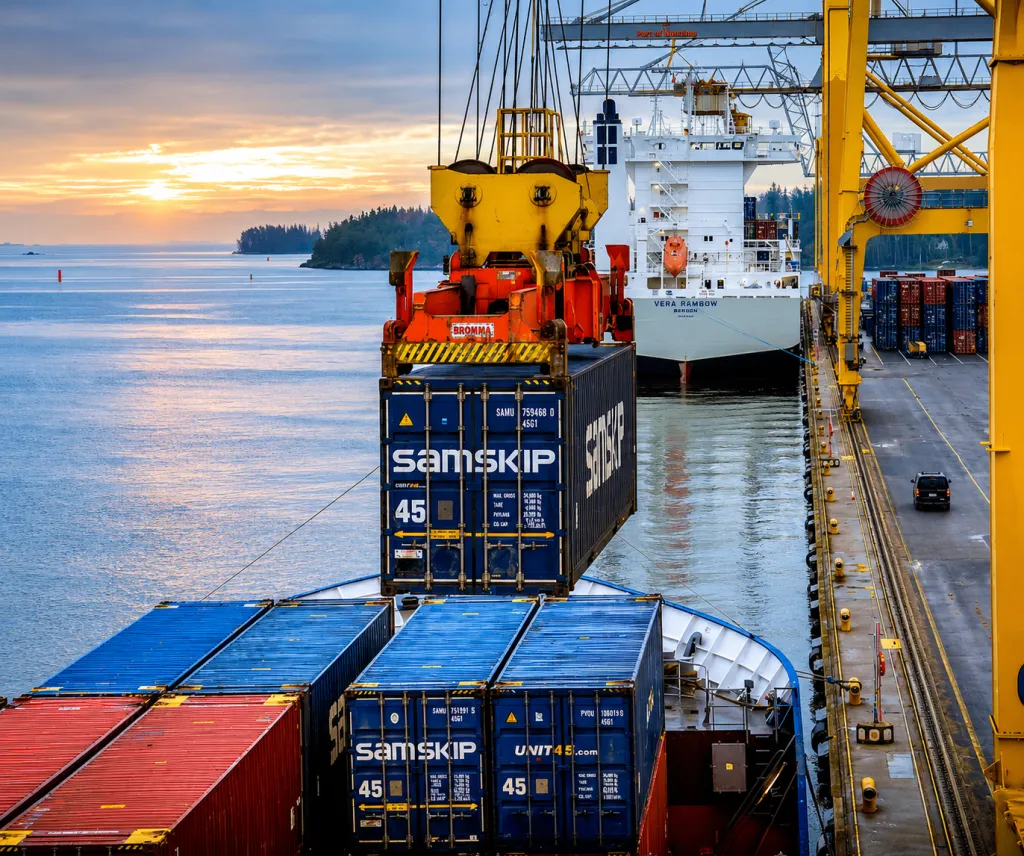
The logistics group Samskip, which connects Morocco with Northern Europe, has announced its new seasonal route linking Rotterdam, Tilbury, Casablanca, and Agadir as a key development for 2025. This information was highlighted in their sustainability report reviewed on July 10, 2025. Under the leadership of Ólafur Orri Ólafsson, who has been at the helm since October 2025, the company presents this route as a significant extension of its network to North Africa. Samskip boasts a net revenue of €807 million, operates 39 offices across 22 countries, owns or charters over 22 vessels, and employs 1,614 staff. However, the report does not provide details regarding the frequency of the Moroccan rotations, the volumes transported from Casablanca and Agadir, or the revenue generated from this particular line.
The new route serves Rotterdam, the British port of Tilbury, Casablanca, and Agadir, according to the company. The vessels Samskip Toubkal and Samskip Amina primarily transport perishable goods originating from Morocco's exporting regions, particularly tomatoes and citrus fruits destined for the UK and Western Europe. Previously, these goods would have traveled a significantly longer distance by truck, as stated by Samskip.
Samskip estimates that utilizing short-distance maritime transport, complemented by land transport, can potentially reduce carbon dioxide emissions by as much as 80% compared to a fully road-based route. This figure is based on a general comparison between the two transport modes. However, the report does not provide specific calculations for the Rotterdam-Tilbury-Casablanca-Agadir route, nor does it quantify the emissions actually avoided since its inception.
Moreover, Morocco holds a distinct position within the geographical organization of the group, alongside Western Europe, Southern Europe, the Nordic countries, the Baltic States, and Iceland. It accounts for 0.8% of the 1,439 people recorded in Samskip's social system, translating to approximately twelve employees. This figure differs from the financial workforce total of 1,614, which includes drivers employed by the group but not reflected in its social data system.
On a group-wide scale, direct emissions decreased by 8% in 2025, amounting to 247,442 tons of CO₂ equivalent, according to the report. Emissions related to purchased electricity fell by 6% to 1,149 tons, while emissions from the value chain decreased by 16% to 215,374 tons. Notably, the document presents two different figures for overall change; the executive summary indicates a 12% drop, while the CEO's message mentions an 8% reduction without clarifying the discrepancy.
The consumption of biofuels has increased by 24%, now representing 3.1% of all fuels used, as indicated by Samskip. The share of renewable energy has reached 4.3%, with total energy consumption amounting to 1,013,000 megawatt-hours. Furthermore, in November 2025, the group laid the keel for its first hydrogen-powered SeaShuttle, touted to be the first short-distance container ship driven by this fuel, with plans for it to enter service in 2027.
While greenhouse gas emissions have decreased, not all air pollutants have followed suit. The cumulative emissions of nitrogen oxides and sulfur have risen by 4.6%, as acknowledged by Samskip, which plans to set specific targets for 2026. The group aims for a fifty percent reduction in total emissions by 2030 and aspires to achieve carbon neutrality by 2040.
As reported by barlamane.com.