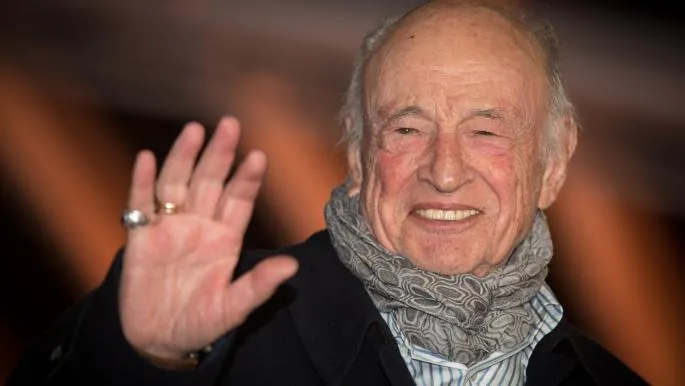
With the passing of Edgar Morin at the age of 104, the world has lost one of its most influential thinkers of the 20th and early 21st centuries. Morin was not merely a prominent French philosopher and sociologist; he was a living witness to a century filled with political, intellectual, and human transformations. His life was a unique blend of deep personal experience and an unwavering concern for the fate of humanity, making his existence a laboratory for his profound ideas on complexity, identity, and our shared human destiny.
Born Edgar Nahum in Paris in 1921 to a Sephardic Jewish family with roots in Thessaloniki, Greece, Morin's life was inherently tied to the concept of human fragility. His birth came after medical warnings to his mother regarding serious health issues related to pregnancy. However, the most significant event in his childhood occurred when his mother, Luna, passed away from a heart attack in 1931, when he was just ten years old. He later described this trauma as an "internal Hiroshima," marking a pivotal turning point in his intellectual and emotional development. From that moment on, the question of life and death became a central theme in his thoughts.
During his early schooling, the sorrowful child found refuge in literature, cinema, and music. He voraciously consumed novels and spent countless hours in Parisian cinemas, discovering the worlds of imagination, myths, and human drama. His passion for classical music, particularly Beethoven’s works, resonated with him as expressions of the world’s birth and the struggle of human will. These early cultural experiences significantly shaped his identity as a "cultural glutton," a trait that remained with him throughout his life and led him to reject the boundaries between high culture and popular culture.
The Advocate for Humanity and Complexity
In the 1930s, Morin was drawn to philosophy, particularly Hegelian thought, which viewed contradiction as the essence of life and history. He found in Marxism a framework to understand the social and political conflicts sweeping across Europe at the time. However, with the rise of Nazism and the outbreak of World War II, his intellectual interests transformed into practical commitments. In 1942, he joined the French Resistance against Nazi occupation, adopting the code name "Morin," which became an integral part of his identity post-war.
The years of resistance were crucial in shaping his character. He lived in a constant state of pursuit across various French cities, ever at risk of arrest and death, while losing friends and companions to torture and assassination. Morin recounted a mysterious incident that he considered one of the most enigmatic moments of his life. When asked about faith, he stated that he did not consider himself a believer in the conventional religious sense, yet he struggled to rationalize a peculiar experience during his resistance years. One day, as he approached his safe house, he felt an invisible hand push him back onto the street, leading him to leave immediately. Shortly thereafter, he discovered that the Gestapo was waiting inside to apprehend him. This incident remained an unsolved mystery for Morin; he neither attributed it to a religious miracle nor reduced it to mere coincidence. It highlighted his intellectual stance on the limitations of human knowledge and acknowledged the areas of human experience that defy complete explanation. This experience not only left him with a memory of fear but also instilled in him a profound sense of human solidarity and shared destiny. He would later assert that the resistance offered him "life" rather than just a "profession," as it allowed him to experience the true meaning of commitment and responsibility.
A Legacy of Complexity and Ethical Commitment
After the war, Morin became disillusioned with the political reality and the practices of the French Communist Party, to which he had belonged during the resistance years. As his doubts about Stalinism grew, he gradually distanced himself from the party, eventually being expelled in 1951. He later regarded this expulsion as a moment of intellectual liberation, deciding that he would no longer submit reality to any preconceived ideology or sacrifice his freedom of thought for any appealing doctrine.
However, Morin's most significant achievement was the development of the concept of "complex thought," which became the hallmark of his philosophy. He believed that the modern world could not be understood through simplistic or reductionist explanations, as reality comprises a complex web of interrelated relationships between the individual and society, order and chaos, nature and culture, and the local and global. Thus, he advocated for a new method of thinking that interconnects various fields of knowledge rather than separating them.
This project culminated in his monumental work "Method," which took nearly thirty years to complete, from 1977 to 2004. In this work, he developed three fundamental principles: the dialogical principle that unites opposites without negating either, the holographic principle that posits the whole is present in the part and the part in the whole, and the principle of organizational recursion that asserts results return to influence their causes. Through these principles, he aimed to construct a new worldview based on the recognition of complexity rather than the evasion of it.
In addition to his intellectual pursuits, Morin remained actively engaged in the pressing issues of his time. He was among the first thinkers to recognize environmental challenges, warning since the 1970s of the dangers threatening the planet's biosphere. He was also concerned about globalization and the future of human civilization, advocating for a new global consciousness that views the Earth as a shared homeland for humanity. In his book "Earth-Homeland," he urged transcending narrow national divisions and contemplating our shared human fate. Morin's smile was not one of hypocrisy; it was an invitation for all to shed rigid stances and engage in self-criticism for the benefit of humanity and the Earth.
Morin's ethical commitment was not merely abstract; it manifested in his positions on contemporary political issues. He championed the rights of oppressed peoples and rejected all forms of racism and intolerance. He did not hesitate to criticize Israeli policies towards Palestinians, stating that it is "hard to imagine that a nation of refugees, descended from the most persecuted people in human history, which has endured the worst humiliations and scorn, could transform, within two generations, into a controlling and self-assured people, except for a few admirable minorities, into a contemptible people that finds solace in humiliation." He believed that a past suffering does not grant moral immunity to practice injustice in the present.
Edgar Morin did not remain silent in the face of the rampant Islamophobia and intellectual McCarthyism among certain French political and media figures who sought to understand social phenomena calmly and scientifically, labeling them as radical Islamists. He willingly embraced this latter classification, advocating for the elevation of those who empathize with the marginalized, arguing that there is no point in countering extremism with extremism.
In his later years, Morin continued to write, reflect, and engage intellectually without interruption, recently summarizing what he viewed as a worsening regression, stating that "we must no longer think of a better society, but of how to avoid the worst. What kind of world will we leave to our children? And what kind of children will we leave to this world?"
Edgar Morin has departed, yet his intellectual legacy remains alive. He left behind dozens of books and ideas that have inspired generations of researchers and thinkers around the world. More importantly, he provided a rare model of the intellectual who combined knowledge with commitment, criticism with hope, and reason with compassion. A witness to a century of wars, revolutions, and crises, he remained, until his last days, a believer in the possibility of building a more humane world. Thus, his passing signifies not just the end of an individual’s intellectual journey but the conclusion of an era embodied in one man's extraordinary depth that encapsulated the complexity and richness of the human experience.
As reported by alaraby.co.uk.