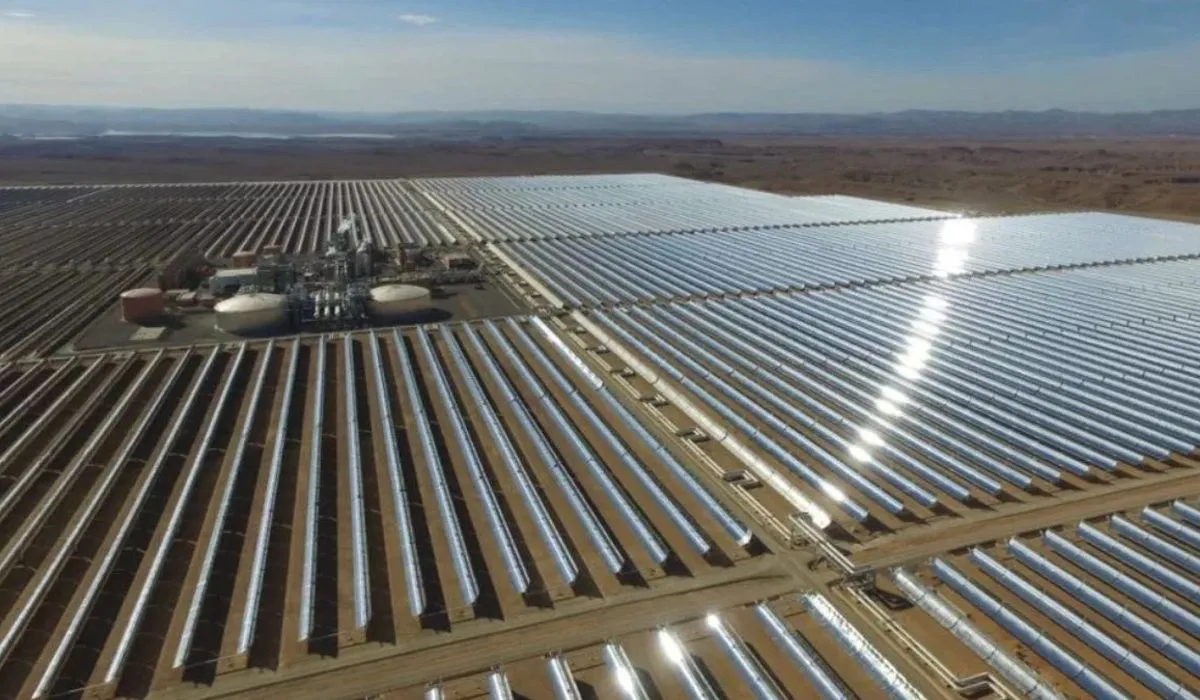

The Noor Atlas Mega Complex: A Solar Power Revolution
The Noor Atlas Mega Complex, situated over an expansive area of 45,000 hectares in the Moroccan Sahara, is now operational and stands as a monumental achievement in solar energy generation. Spanning an area equivalent to 63,000 football fields, this colossal facility boasts an impressive installed capacity of 20,000 megawatts, making it the largest concentration of solar power generation in a single location worldwide. This capacity is theoretically sufficient to meet the electrical demands of a medium-sized country such as Iceland or Estonia, all supplied from a single installation.
Innovative Technologies and Economic Impact
What sets the Noor Atlas apart from conventional solar plants is its use of three distinct technologies spread across interconnected facilities: photovoltaic panels, solar power towers, and molten salt storage. The latter plays a crucial role in the system’s efficiency, allowing the complex to store heat generated during the day and release it gradually, thus producing electricity even after sunset. This innovation provides thermal storage capacity for up to 16 hours, enabling the complex to function as a reliable power source around the clock. This combination of technologies distinguishes Noor Atlas from most large solar parks globally, which typically rely solely on direct sunlight and external batteries for nighttime energy needs.
Countries like Mauritania and Algeria have taken notice of this solar boom and are beginning to initiate their own green energy projects. The Sahel region is experiencing such a surge in interest that China is also getting involved in various capacities, recognizing that these installations can meet energy requirements not just for North Africa but also for parts of Europe.
Electricity generated at the Noor Atlas is transmitted through a 1,400-kilometer high-voltage direct current (HVDC) corridor to northern Morocco, where a new underwater cable crosses the Strait of Gibraltar, linking directly to the Spanish electrical grid. This interconnection is not merely experimental; Morocco has been exporting electricity to Spain since 1997 through existing cables. The new corridor significantly expands this capacity and integrates it into a system designed from the outset for continental-scale export.
During a recent power outage in Spain, the Moroccan grid contributed 38% of its capacity to help restore electricity in the southern regions of the country, showcasing the critical role of this facility in regional energy stability.
According to estimates from the Moroccan Agency for Sustainable Energy (MASEN), the World Bank, and the African Development Bank, continuous exports to Europe are projected to reach around 4,500 megawatts, generating approximately €2.8 billion annually from clean energy sales. This revenue is comparable to what Morocco historically earned from phosphate exports, its primary export product for decades. Moreover, with the operational commencement of Noor Atlas, Morocco is set to eliminate its dependence on fossil fuel imports for electricity generation, which previously constituted a significant portion of the country’s energy needs.
The impact on neighboring countries has been immediate, with ten North African nations submitting formal proposals to explore agreements enabling them to replicate this successful model within their territories. The vast expanse of the Sahara, characterized by uninhabited land with some of the highest solar irradiation levels on the planet, makes regional expansion of this model technically feasible.
If this initiative proves successful, North Africa could emerge as the primary source of renewable electricity for Europe in the coming decades, potentially reducing the continent's current reliance on liquefied natural gas from the Persian Gulf and Norway.
The Noor Atlas is not merely a power plant; it represents the first large-scale implementation of a long-discussed model in energy and international policy: transforming the world’s largest desert into the most significant electricity generator in history. However, scaling this model presents challenges, including transmission losses over long distances, the high costs and vulnerabilities of underwater cables, and the need for investment in infrastructure designed for a different operational logic. Despite these obstacles, the successful operation of this facility, its actual electricity exports to Europe, and the interest from multiple countries signify a pivotal shift in the energy landscape. It is no longer a theoretical debate but a tangible project in progress.
As reported by vozpopuli.com.