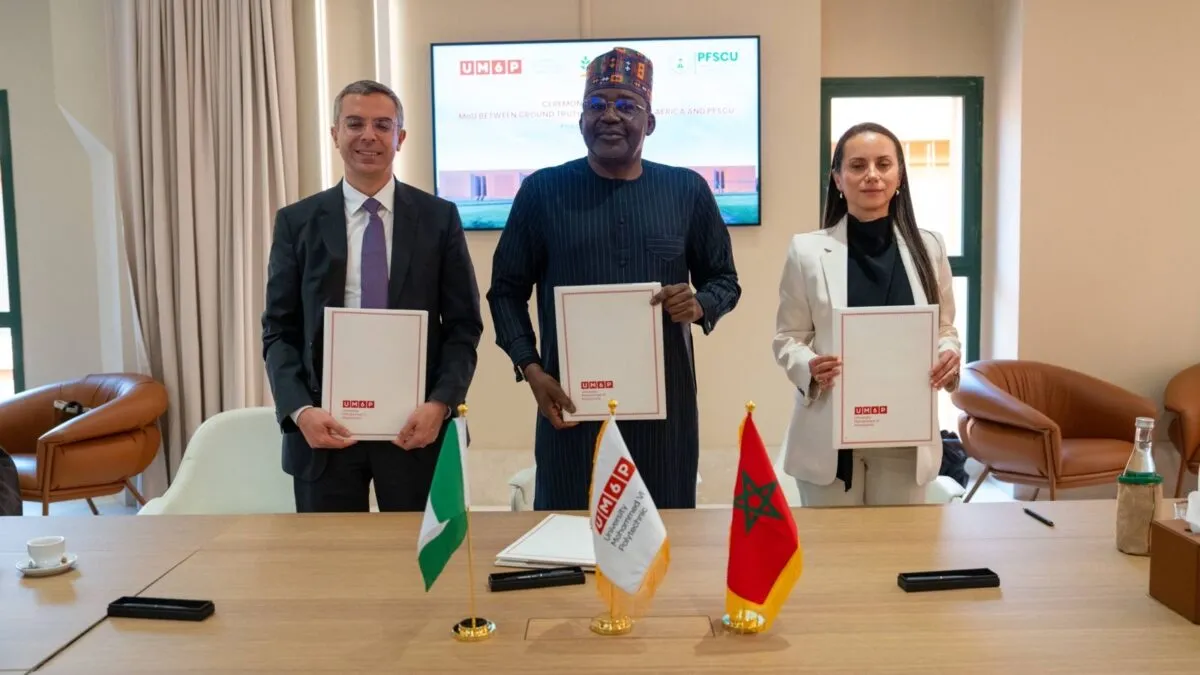
The Federal Government of Nigeria has recently formalized a strategic partnership with Moroccan entities to implement a cutting-edge satellite and artificial intelligence (AI)-driven agricultural monitoring system, targeting fifteen states across the nation. This significant development aims to bolster food security by providing real-time intelligence on crop performance and facilitating data-driven decision-making processes in agricultural policy.
The Memorandum of Understanding was officially signed at the Mohammed VI Polytechnic University in Ben Guerir, Morocco. This initiative will empower both federal and state governments to effectively monitor agricultural lands, analyze crop distribution, assess production efficiency, and identify emerging food security challenges using advanced satellite imagery coupled with AI technology.
Senator Ibrahim Hassan Hadejia, serving as the Deputy Chief of Staff to the President in the Office of the Vice President, represented the Federal Government during the signing of the agreement, collaborating with OCP Africa and Ground Truth Analytics, a geospatial technology firm. Hadejia was present at the ceremony on behalf of Vice President Kashim Shettima, who chairs the Presidential Food Systems Coordinating Unit (PFSCU).
According to Marion Moon, the Technical Assistant on Agriculture to the President, this partnership marks the launch of the National Agro-Productivity System (NAPS), which is Nigeria's inaugural satellite-enabled national crop monitoring platform. The system is meticulously designed to deliver real-time insights on crop yields, land availability, and potential threats to food security. This intelligence will empower governments at all levels to make informed decisions regarding agricultural planning, investment strategies, and trade regulations.
During the ceremony, Hadejia emphasized the necessity for Nigeria to cultivate its own capabilities in deploying and enhancing emerging agricultural technologies instead of solely depending on imported solutions. He articulated that the challenges faced should not restrict aspirations but rather motivate the development of relevant technologies, institutions, and expertise to confront them effectively.
Highlighting the transformative potential of data, precision farming, AI, and geospatial technologies in agriculture, Hadejia asserted that Nigeria must develop the necessary skills to tailor these innovations to its unique context. He elaborated that the platform will significantly enhance seasonal planning, agricultural investment, productivity monitoring, and policy coordination by supplying timely and trustworthy agricultural intelligence to both Federal and State Governments.
Furthermore, Moon elaborated that the National Agro-Productivity System was conceived to address the prevalent information gap between anticipated agricultural outputs and the actual harvest. She pointed out that the absence of reliable in-season monitoring often leads to policymakers making crucial decisions without accurate data regarding farmers' production activities.
Moon stressed the importance of enhanced visibility during the farming season, questioning whether farmers are genuinely planting the crops they report, such as maize, or if they are switching to other crops like rice. She indicated that inaccurate production data can significantly influence decisions regarding food reserves, imports, and exports, making real-time monitoring indispensable for effective food security planning.
Operating within the framework of the National Agribusiness Policy Mechanism, which was ratified by the National Council on Agriculture and Food Security in November 2024, the platform has been piloted across 13 states over three planting seasons. This initiative has engaged approximately 250,000 farmers, surveyed over 50,000 of them across more than 2,000 communities, and collected over one million agricultural data points.
Alafifi Laadel, the Chief Executive Officer of OCP Africa, characterized the agreement as a long-term collaboration focused on knowledge transfer, institutional development, and enhancing local capacity, rather than a typical procurement arrangement. This initiative aims to ensure that Nigeria acquires the requisite expertise for the ongoing improvement and expansion of the technology.
Driss Kitane, the Chief Executive Officer of Ground Truth Analytics, showcased how the platform utilizes artificial intelligence to analyze satellite imagery, identify individual farm plots, and monitor crop growth stages without the need for manual intervention. He revealed that satellite images would be updated every five days, enabling authorities to continuously track agricultural activities throughout the farming season. The implementation will commence with a pilot state before extending to three states with full crop intelligence, ultimately encompassing all 15 priority states through multi-season monitoring. Kitane also assured that all sensitive agricultural data generated by the platform would remain under Nigeria’s control and hosted on servers within the country.
This federal delegation to Morocco included officials from various governmental departments, including the Office of the Vice President, the Federal Ministry of Agriculture and Food Security, the Federal Ministry of Justice, the National Space Research and Development Agency, the Nigeria Governors’ Forum, among others, all supporting the rollout of the National Agro-Productivity System.
As reported by leadership.ng.