China's Strategic Investment in Morocco's Automotive Sector
China's increasing financial commitment to Morocco is transforming the nation into Africa's preeminent automotive manufacturing hub, positioning it as a significant focal point in the global electric vehicle (EV) industry, particularly in relation to Europe. With Chinese manufacturers investing billions into the establishment of factories dedicated to the production of batteries, vehicle components, and other essential EV parts, European policymakers are expressing growing concerns. They fear that Morocco could be leveraged as a strategic entry point for Chinese goods into the European Union (EU) market, thereby circumventing substantial tariffs imposed on direct imports from China.
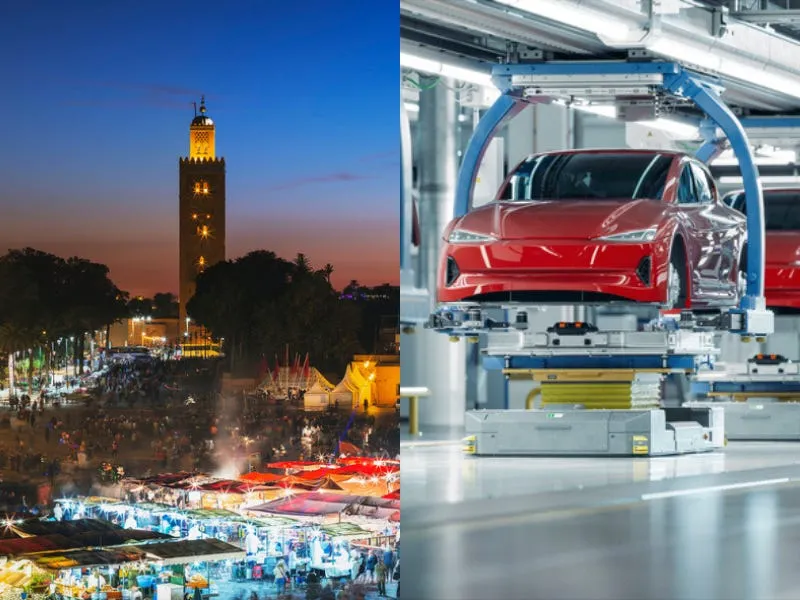
Located just outside the port city of Tangier, the expansive industrial zone known as Tanger Tech City is rapidly replacing agricultural land with manufacturing facilities. A multitude of Chinese enterprises are mobilizing to set up operations focused on producing crucial components such as tires, brakes, and battery parts. Further along the Atlantic coastline, a Chinese battery manufacturer is in the process of constructing an impressive $1.3 billion gigafactory. Morocco's ambition is to create a comprehensive manufacturing supply chain capable of producing parts for up to half a million electric vehicles annually by the conclusion of 2026.
The Economic Implications and EU Concerns
The influx of approximately $6 billion in Chinese investment since the onset of the pandemic has raised significant alarm among EU policymakers in Brussels. To safeguard their domestic automotive industry, the EU has enacted stringent tariffs that can reach up to 45 percent on electric vehicles imported directly from China. European officials are increasingly apprehensive that Morocco could serve as a strategic backdoor for Chinese manufacturers, allowing them to bypass these trade barriers. There is a prevailing fear that heavily subsidized Chinese components may undergo only minimal processing in Morocco before being exported tariff-free to Europe, thereby facilitating China's ability to offload its surplus industrial capacity.
In response to these concerns, the EU has already initiated measures to counteract potential unfair trade practices, including penalizing shipments of aluminum wheels from Morocco after discovering they had benefitted from inappropriate state subsidies. However, Moroccan trade officials firmly contest the notion that their economic zones are merely a façade for Chinese companies to evade Western trade restrictions. Instead, they promote Morocco as a legitimate and highly competitive manufacturing partner, highlighting the country's attractive incentives such as a five-year corporate tax holiday, a youthful workforce, and abundant local renewable energy sources that help businesses mitigate Europe's stringent carbon taxes.
Significantly, Morocco maintains free trade agreements with both the EU and the US, which adds an additional layer of complexity. Local authorities emphasize that Chinese firms must adhere to strict rules of origin, ensuring that components undergo substantial transformation within Moroccan territory to qualify for tariff-free export. This delicate balance presents a considerable challenge for European regulators, as imposing aggressive trade penalties against Morocco is fraught with complications. Major automotive players like Renault and Stellantis have established extensive manufacturing operations in Morocco and depend on the local supply chain.
Moreover, strict labor laws in Morocco mandate that these new factories employ local workers, contributing positively to the local economy and generating employment opportunities. Nonetheless, geopolitical analysts caution that China possesses the financial capability to dominate Morocco's entire vertical supply chain for electric vehicles, from harnessing its vast phosphate reserves to constructing the necessary transport infrastructure. As the EU deliberates on new legislation to protect its diminishing industrial base, Morocco is evolving into a critical economic battleground where Europe's defensive trade strategies are increasingly at odds with China's ambitious manufacturing goals.
As reported by africa.businessinsider.com.