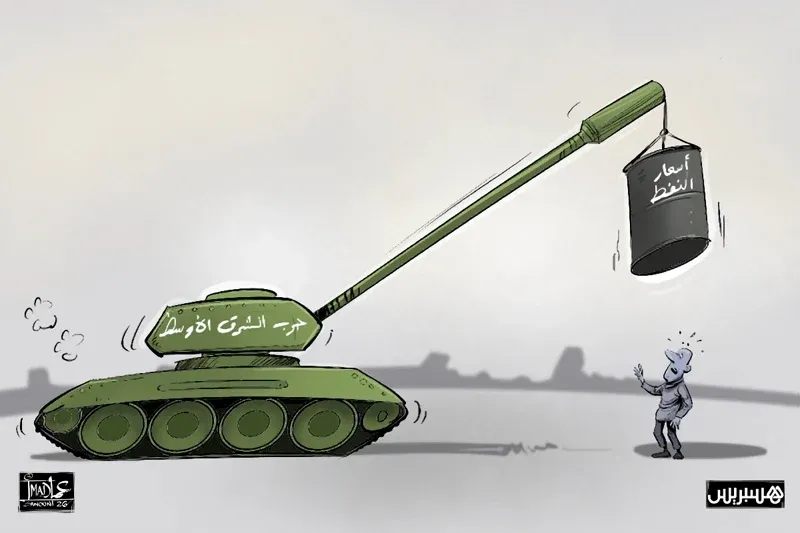
Ongoing Price Fluctuations in Morocco Amidst Global Tensions
The price of oil surged by approximately 6% on Monday, driven by persistent uncertainty surrounding peace talks between the United States and Iran in Islamabad, Pakistan, as well as incidents of violence involving oil tankers in the Strait of Hormuz, which Iran has announced it will close again. Analysts note that fears over the potential collapse of a fragile ceasefire have influenced the futures contracts for Brent crude, which rose by $5.10, or 5.64%, settling at $95.48 per barrel. Concurrently, the price for West Texas Intermediate (WTI) increased by $5.76, or 6.87%, reaching $89.61 per barrel.
A senior Iranian official stated to Reuters that Tehran is considering participating in peace negotiations, although no decision has been made yet. In response to a question about the possibility of extending the ceasefire, former President Trump remarked, "I don’t know. Maybe not. Maybe I won’t extend it. But the blockade will remain in place." On the same day, shipping data revealed that navigation through the Strait of Hormuz, a vital artery for global energy, remained nearly halted, with only three transit operations recorded within a 12-hour period, according to Reuters.
Possible Scenarios for Future Oil Prices
Energy expert and university professor Abdeslam Malawi indicated that the global energy landscape is currently burdened by escalating tensions in the Middle East, particularly due to the ongoing conflict between the U.S. and Iran. He elaborated that the prospects of a complete closure of the Strait of Hormuz and disruptions to several Gulf energy production facilities have led major international institutions, such as Goldman Sachs, the Korean Institute for Energy Research, and the World Bank, to formulate varying scenarios regarding future price movements.
Malawi outlined three primary pathways for price evolution based on current field and temporal data: in the short term (one week to one month), if the current ambiguity and tension persist, oil prices are expected to hover between $90 and $110 per barrel. However, any sudden military escalation could push prices beyond the $120 mark, with extreme pessimism potentially seeing prices rise to $150 per barrel in scenarios involving a full closure of the strait. In the medium term (three to six months), price stability will depend significantly on the progress of negotiations between Washington and Tehran. Malawi pointed out that there is considerable uncertainty within Iran due to conflicting views between the military wing (the Revolutionary Guard), which is responsible for field escalations, and the political wing engaged in negotiations. Should an agreement be reached and commitments implemented, prices might stabilize within the range of $75 to $85.
Looking ahead to the long term (the second half of 2026), Malawi referenced forecasts from the International Energy Agency and the World Bank predicting a decline in prices to levels between $60 and $70 per barrel during the second and third quarters of 2026. This anticipated drop is attributed to external non-OPEC countries, such as the United States, Brazil, Guinea, and Canada, increasing production, alongside a slowdown in global demand, particularly from China, the world's largest oil consumer.
On the local front, the international energy expert confirmed that Morocco will continue to feel the effects of rising global prices in the coming weeks. He stated, "An additional increase in fuel prices of between one and one and a half dirhams per liter is expected, as long as the price per barrel remains above the $100 threshold. However, the long-term predictions of a return to declining global prices may positively impact Morocco's energy bill and the prices of petroleum derivatives in the domestic market in the future." Malawi emphasized that all expert forecasts and international institution predictions remain contingent upon unpredictable geopolitical variables in the strait region, concluding that the current situation is characterized by a range of possibilities, where any new military escalation could invalidate all predictions and lead to economic strains affecting non-oil goods and services, thus presenting complex challenges for the global economy.
Additionally, economic analyst Mohamed Adel Eisho noted that recent developments have signaled a significant return of geopolitical risk factors in the oil market, particularly following the closure of the Strait of Hormuz on April 19 amid stalled U.S.-Iranian negotiations. According to data from the U.S. Energy Information Administration, approximately 21 million barrels per day pass through this strait, accounting for about 20% of global consumption and nearly one-third of maritime oil trade. Consequently, prices surged by over 7%, with Brent crude hovering between $88 and $92 per barrel.
However, Eisho cautioned that the current shock is not one-dimensional; it is also accompanied by widening refining margins (Crack Spread), meaning that the prices of final products like diesel are sometimes rising at a faster pace than crude oil, especially in cases of logistical bottlenecks. He explained that this situation has a compounded effect on Morocco due to its energy dependency exceeding 90% and its reliance on importing refined products based on the Rotterdam benchmark (Platts CIF NWE). This dependence exposes Morocco to a double shock: rising oil prices, increasing refining margins, and escalating shipping and insurance costs. Furthermore, periods of tension can multiply insurance premiums for oil tankers several times over, which are factored into the final import price. The fact that diesel prices surpassed 15 dirhams per liter in April 2026 reflects the complete transmission of these compounded costs to the domestic market, rather than solely the impact of the barrel price.
According to the interviewee for Hespress, there are also less-discussed technical and financial factors explaining the depth of this rise. Currently, the market tends towards a state of Backwardation (where spot prices exceed future prices), which raises the cost of immediate purchases for importers. As reported by hespress.com.