On June 18, 2026, the match between Morocco and Scotland was more than just a sporting event for Médias24; it represented a journey that began with a short night in Casablanca, followed by a nearly full flight across the Atlantic, culminating in Boston and the slow ascent towards Foxborough. Here, the vibrant display of jerseys, songs, flags, and accents created a unique tapestry of football culture. Ultimately, the Lions of the Atlas emerged victorious, but what stood out was the lively spirit of the World Cup, showcasing travel, camaraderie, rivalry without animosity, and a celebration that transcended mere scores. Let us embark on this journey together.
As the clock approached 3 AM at Mohammed V Airport in Casablanca, the terminal was nearly empty, save for the lion emblem of the Atlas, prominently displayed alongside the national colors of red and green. Despite a general lack of football fandom, the palpable excitement of the World Cup was undeniable, especially with Morocco in the fray. Gradually, supporters began to flock to the airport, many donning the national team's jersey, all eager to traverse the Atlantic and support Mohamed Ouahbi's squad in their second match of the North American World Cup against Scotland, following a hard-fought draw with Brazil just five days prior.
Among the travelers, one supporter expressed his eagerness: "I couldn't make it to Russia in 2018 or Qatar in 2022, so this is a wonderful opportunity to catch up." The Royal Air Maroc flight to Boston was scheduled to take off at 7:30 AM and last approximately seven and a half hours, landing at 10 AM Eastern Time. Typically, RAM services only New York, Washington, and Miami, but for the World Cup, the airline arranged thirty-two special flights to accommodate around 8,800 fans for Morocco's three group stage matches. The round-trip economy fare was approximately 10,000 DH, and purchasing a ticket also provided an opportunity to buy a match ticket from the Royal Moroccan Football Federation for a nominal fee of 550 DH, making it accessible for many Moroccans. Consequently, the Boeing 787-9 Dreamliner was nearly full upon takeoff.
A Sleepless Night to Boston
Seven and a half hours later, as anticipated, we landed at Logan International Airport in Boston—named after a general who notably served in the Spanish-American War and World War I. As we approached Boston Harbor, glimpses of the city began to appear beneath the aircraft wing, rousing passengers from their transatlantic stupor to sing the national anthem. Exhausted from the sleepless night in Casablanca, most passengers had spent the journey in a state of intermittent lethargy, punctuated by the flight crew's movements. They likely aimed to recharge for the busy forty-eight hours ahead.
At this moment, conversations began to spark among the travelers. A father, retrieving his luggage from the overhead compartment, shared his desire to let his two teenage sons experience one of the planet's most iconic football competitions. Their adventure in the United States wouldn't end in Boston; they planned to head to Atlanta for Morocco's match against Haiti on June 24. All three were ardent Raja supporters, and when a fellow Wydadi fan joined in, the father proudly adjusted his green and white striped scarf around his neck.
Logan Airport is located just 10 to 20 minutes by car from downtown Boston, depending on traffic. Buses like the Silver Line SL1 take a bit longer, which was our chosen mode of transportation after a restful stop at a nearby hotel.
Boston Under Scottish Colors
Boston, for those unfamiliar with the city, defies the grandiose image often associated with the United States from abroad, characterized by endless avenues and towering skyscrapers. Instead, it is a more compact, older city, with European charm in certain areas, where red bricks, Victorian facades, spires, campuses, and wharfs narrate the story of America’s origins and its prestigious universities. One might think of the Boston Tea Party, Harvard across the Charles River, the Kennedy dynasty, or the iconic Fenway Park, home of the Red Sox, while also recalling the rougher portrayals in films like _Good Will Hunting_ or _The Departed_. This city, rich in memory, knowledge, and sport, seemed to be joyfully embraced by Scottish supporters on this particular day.
As we returned to Logan for the Silver Line, jerseys emblazoned with the Scottish lion became increasingly visible against the backdrop of the city, alongside the blue flags featuring St. Andrew's cross, Scotland's well-known symbol. Near the Freedom Trail, a red line on the ground connecting Boston’s historic sites from the American Revolution, one could almost feel as though they were at the gates of Hampden Park, Scotland's national stadium, as the Tartan Army's rallying cries saturated the atmosphere.
One of the most notable signs of the day was beer, which reportedly flowed freely from bars in the city center to the narrow sidewalks, with local media even reporting stock shortages due to the insatiable thirst of these tireless hop enthusiasts. Chants of “No Scotland, No Party” echoed throughout, a festive anthem that would be heard again the following day in Foxborough.
The Moroccan presence was more subdued, with fewer fans in the streets and noticeably less inclined toward revelry. However, they were still present, clad in red jerseys, waving flags, and willingly joining in this impromptu celebration. The atmosphere was devoid of tension; instead, it felt like a joyous communion, with laughter and banter filling the air. When a confident Scottish supporter claimed his team would win 1-0, a smiling Moroccan retorted, “I don’t like what I hear!” prompting laughter from all around. Even before the match began, Boston already embodied the spirit of the World Cup, a celebration where identities could proudly coexist without conflict, and where the temporary rivalry served merely as a pretext for camaraderie.
None of this dissipated the following day. At 2:40 PM on June 19, we boarded one of the yellow buses designated for the Boston Stadium Express, the official service operated by Yankee Line connecting Boston, Logan, and various locations around Greater Boston to Foxborough, home to Gillette Stadium, the regular venue for the New England Patriots in American football and the New England Revolution in soccer. To adhere to FIFA's commercial regulations, the venue was temporarily renamed Boston Stadium.
On an ordinary day, the journey from Boston would take less than an hour, but due to the World Cup, it took us twice as long to reach Foxborough. It was nearly 4:40 PM—just an hour and twenty minutes before kickoff—when our bus finally arrived at Lot 55, one of the parking areas around the stadium.
As we stepped off the bus, the same impression struck again: the Scots were more prominent. Between rows of vehicles and coolers, many had already set up camp, beers in hand, indulging in the quintessential American tradition of tailgating—eating, drinking, and socializing near the stadium before entering. After passing this pre-match gathering, we navigated the gravel, crossed the road, followed the signs, and were guided by the personnel on-site, under the watchful eye of Foxborough police and Massachusetts state troopers. For a first-time visitor, the route required a few minutes to adapt.
Among the crowd, familiar faces emerged. In the distance, we recognized a recent guest from Médias24's “12/13” weekly show, whose name we will keep private. Later, social media confirmed that several Moroccan personalities had made the trip as well, and perhaps the fifty-something gentleman we sat next to during the match had also been a guest on the Scottish equivalent of “12/13,” spotted by a certain Wissam McBouzdaini, donned in kilt and sporran.
Gillette Stadium initially impresses with its grand capacity. Certainly, the arena maintains a distinctly American feel, set within a vast asphalt ring designed for heavy vehicular traffic, NFL Sundays, and crowds from afar. Yet the entire complex is remarkably efficient: massive stands, clear visibility, giant screens, smooth traffic flow—all contributing to the sensation of entering a well-oiled sporting machine. The natural grass laid down for the competition, FIFA branding, and the global ceremonial atmosphere transformed this venue, born from a different sporting culture, into a true World Cup stage.
At that moment, it was hard not to think of the new Prince Moulay Abdellah Stadium in Rabat, where we had recently been. Comparisons are certainly warranted; Morocco has undoubtedly produced a facility of equal caliber—modern, spectacular, and fully deserving of major global events. If what is set to rise next year in Benslimane with the future Grand Hassan II Stadium continues this ambition on an even grander scale, the Kingdom will undoubtedly have solid arguments to host the World Cup final it co-organizes in 2030 with Spain and Portugal.
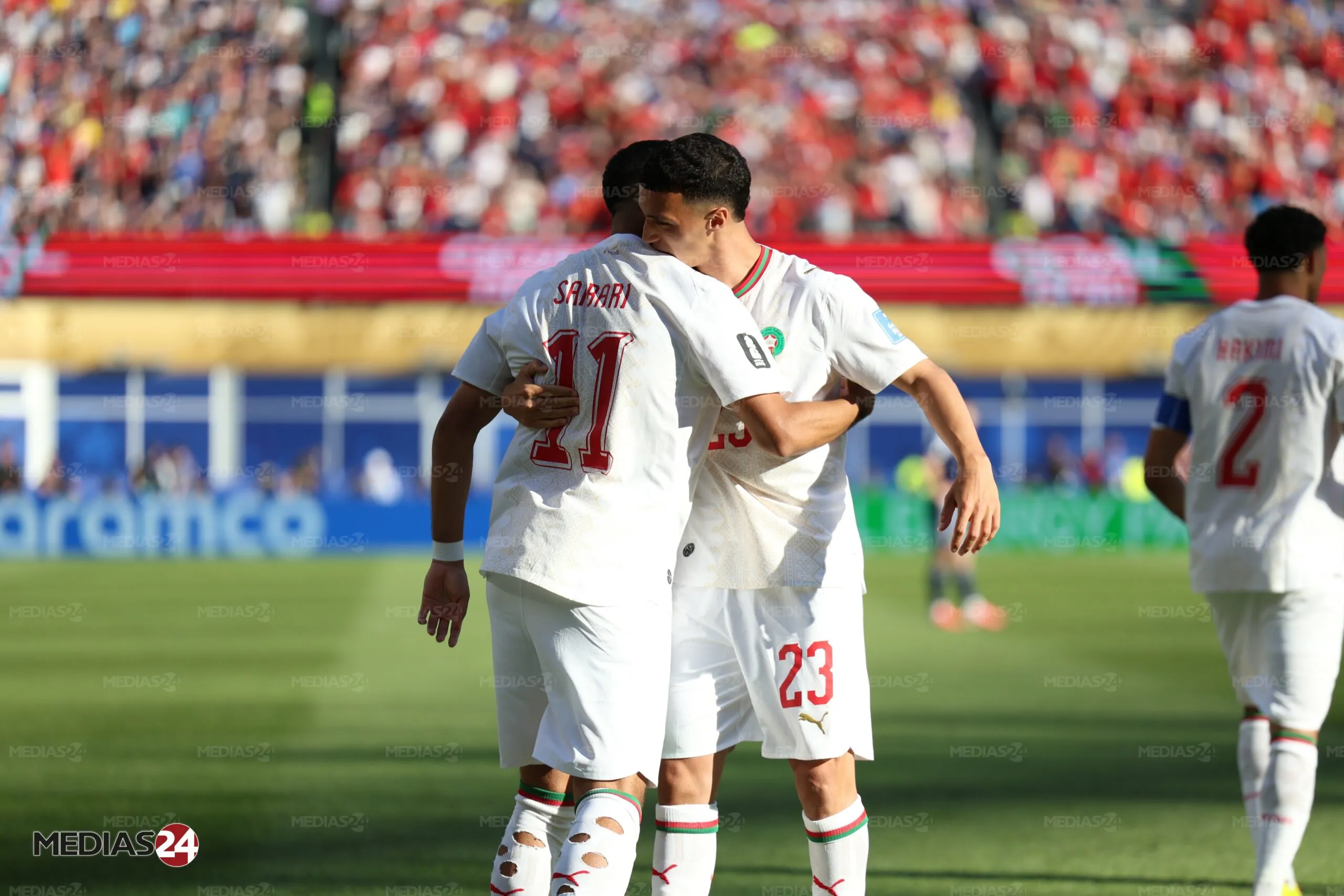
As anticipated, the match between Morocco and Scotland kicked off promptly at 6 PM. Just as the game began to unfold, Ismael Saibari sent the ball soaring into the top corner of Angus Gunn’s net, following a brilliantly orchestrated assist from Brahim Díaz, who played his role as an attacking midfielder from the right brilliantly. There’s no need to recount a match that most readers have likely seen already, but it is worth noting that the tactical machine orchestrated by Ouahbi was even more refined than it appeared on television. Every player was mobile; when one moved out of position to draw a Scottish player or simply because the play demanded it, another immediately filled the gap.
Ouahbi, known for his adherence to the “juego de posición” philosophy popularized by Pep Guardiola during his historic tenure at FC Barcelona from 2008 to 2012, also displayed elements of relational football, which focuses more on player interactions than their static positions on the field. The most well-known proponent of this new school is former Brazil coach Fernando Diniz, and it is clear that Ouahbi closely follows the latest developments in football tactics.
“We are dreadful,” lamented a Scottish supporter, his Northern British accent thick with disappointment. But it might simply be that Ouahbi's strategy was executed to perfection. Realistically, Morocco could have won by a larger margin; in the second half, Díaz opted for a more selfish play, withholding a second potential assist to Saibari that could have sealed the match. This desire to be a “superhero” rather than merely a “hero,” as former captain Romain Saïss had summarized months prior, may have played a role.
For those wondering, Ayoub Bouaddi is as visually striking in person as he is on screen—a player destined for a bright future, stepping up to the occasion at just under 19 years old. The excitement surrounding this match was palpable, as fans from both sides reveled in the spirit of competition and celebration, showcasing the beauty of football and the unifying power of the World Cup.
As reported by medias24.com.