
FIFA's Neutral Position Amid Spain and Morocco's Dispute
As Spain and Morocco engage in a heated public debate regarding the venue for the 2030 FIFA World Cup final, the FIFA organization remains largely detached from the controversy. An official decision regarding the final's location is not anticipated until at least a year from now, with some predictions suggesting that a resolution could be delayed until 2028. Current indications from Zurich suggest a clear preference for the Santiago Bernabéu Stadium as the site for the crucial match, with one semifinal potentially held in Casablanca and the other in Barcelona.
Despite the rising tensions between the two nations, previous reports remain unchanged. Spain continues to wield significant influence in the world of football, a fact that FIFA has never tried to conceal. Although Morocco has made considerable strides on various fronts, it still lags significantly behind Spain's established position in global football.
Unspoken Agreement on the 2030 World Cup Final
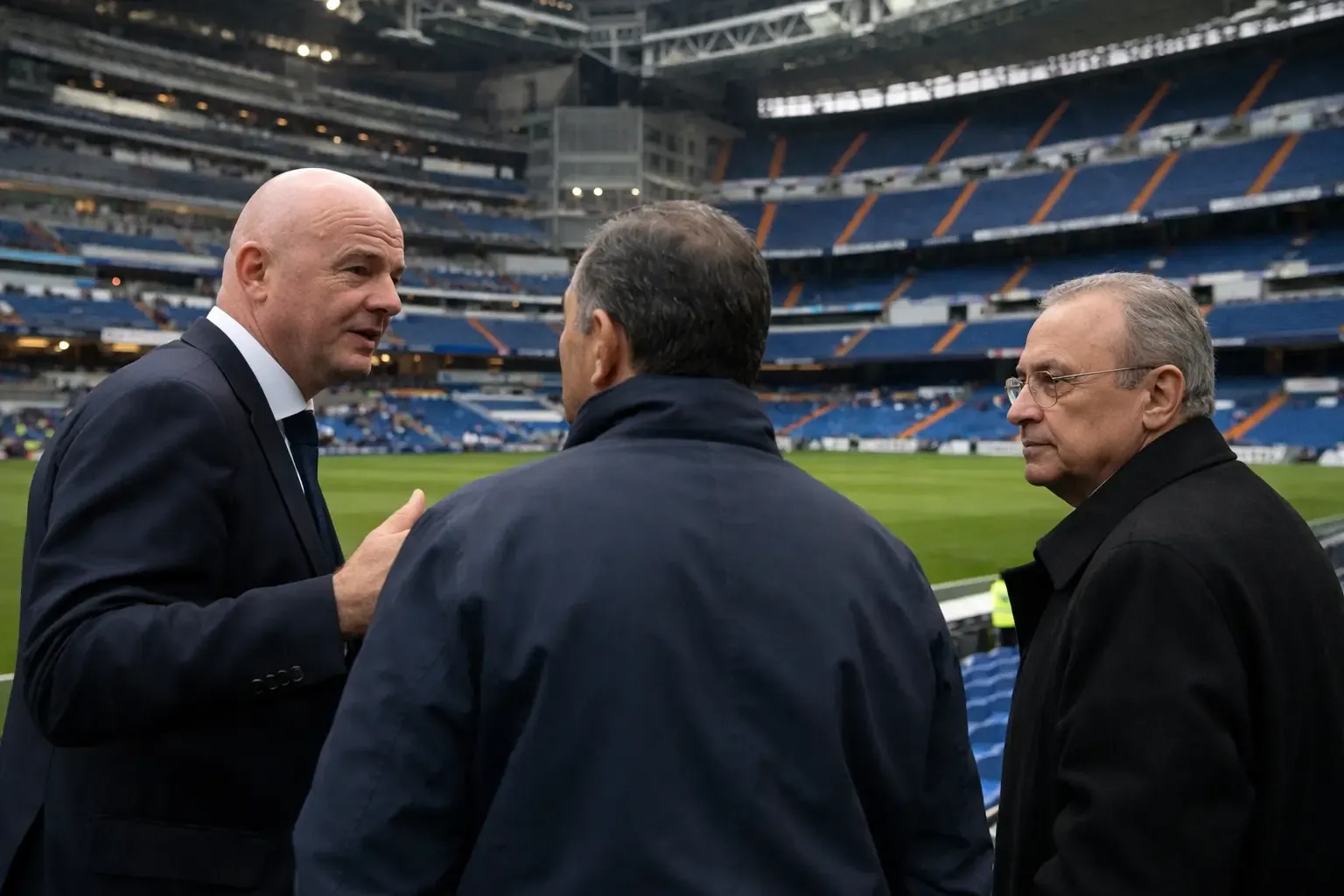
As previously reported, Real Madrid and FIFA President Gianni Infantino reached an unspoken agreement some time ago, rooted in the belief that the final should take place at the Bernabéu. Although the relationship between Infantino and Real Madrid has cooled somewhat—particularly after the club issued a statement regarding a proposal from the FIFA President—this does not imply that the plan has been abandoned. Furthermore, FIFA is currently navigating a phase of uncertainty that will not be fully resolved until the presidential elections in March. Infantino is already in campaign mode, with another significant date approaching at the end of November when it will be revealed whether he faces a challenger. Regardless, this electoral process is expected to clarify many of the outstanding questions surrounding the 2030 World Cup and football in general.
The ongoing debate surrounding the 2030 World Cup final highlights how far collaboration and mutual understanding still are from achieving an ideal resolution. Spain and Morocco continually speculate about which city will host the final, sparking discussions that reveal a lack of genuine comprehension of the processes surrounding the next men's World Cup. This situation underscores that harmony is not a guiding principle of the World Cup project.
Morocco, which has recently joined Spain and Portugal as a co-host, has gained political significance in recent months. Ongoing propaganda efforts emphasizing the quality of its stadiums, along with certain gestures from Infantino, have contributed to uncertainty in the media and public discourse.
When the three host countries were initially collaborating to secure the tournament, a roadmap was established that designated the Bernabéu as the final venue. However, no formal document was ever signed, reflecting the reality that FIFA, as the tournament organizer, ultimately makes all the decisions.
In the coming months, FIFA will assume full control over the World Cup. The first step in this process will involve establishing the organizational structure required to oversee the tournament—an action that has yet to be initiated. So far, there have been no records or meetings within the organization documenting the commencement of this process.
Once this structure is in place, FIFA will take charge of the World Cup and determine which venues remain in contention for hosting matches. Initially, documentation will be reviewed, cities will be visited, and the progress on the construction of new stadiums, along with adjustments to existing arenas to meet FIFA's requirements, will be assessed.
Ultimately, all operations will be under FIFA's jurisdiction. The final of the last World Cup, held on July 19 in New Jersey, was originally slated for Dallas but was relocated to New Jersey in 2024. This is particularly noteworthy as the controversy surrounding the last World Cup final did not originate within FIFA itself. Its officials will once again visit the stadiums and cities vying for selection, but an official framework for the competition will only be established in a year's time.
As reported by audimax.de.