
Discovering the Bahia Palace: A Marvel of Alawid Architecture
The Bahia Palace, located in the southern part of Marrakech's old town, is an expansive palace complex that stands as a testament to the architectural brilliance of the 19th century. Constructed during the latter half of the 19th century under the direction of Grand Vizier Si Moussa and his son Ba Ahmed, the palace is recognized as a prime example of Moroccan architectural style from the Alawid period. The palace's name, 'Bahia', translates to 'the Brilliant' or 'the Beautiful', highlighting its representative role in Moroccan heritage.
Occupying several hectares, the Bahia Palace is integrated into the historic fabric of Marrakech's Medina, which is designated as a UNESCO World Heritage site. Its location within the UNESCO-protected old town underscores the palace's significance to the urban landscape of Marrakech. The construction of the first section of the palace was initiated by Si Moussa, who envisioned this urban palace as a luxurious residence, while his son Ba Ahmed further expanded the complex from 1894 to 1900, solidifying its grandeur and prestige.
Architectural Elegance: A Fusion of Riad Courtyards and Grand Halls
Architecturally, the Bahia Palace seamlessly combines the traditional layout of a city palace, known as a Riad, with expansive ceremonial halls and garden courtyards. Unlike a rigidly symmetrical design, the palace's layout resembles an intricate web of interconnecting courtyards, galleries, and rooms, alternating between private living quarters and public reception spaces. This complexity in structure arises from the two major construction phases initiated by Si Moussa and completed by Ba Ahmed.
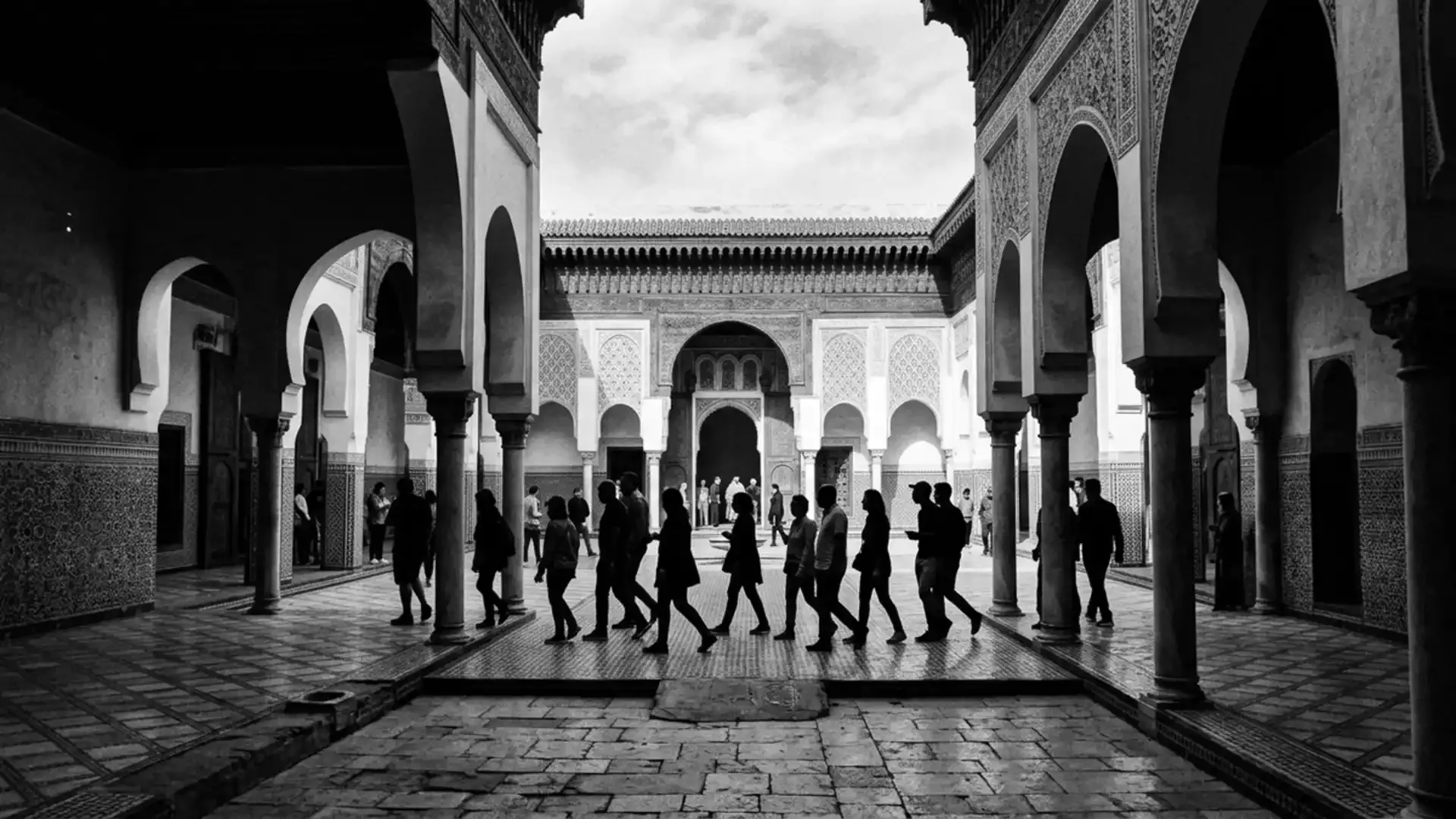
The architectural style is primarily classified as Islamic or Moorish architecture of the 19th century, characterized by decorative wooden ceilings, intricate Zellij tile work, and finely carved stucco detailing that adorns the walls, arcades, and door frames. The inner courtyards are often framed by arched colonnades and feature marble flooring, reflecting pools, or garden areas that juxtapose the strict geometries of the facades with lush vegetation and shaded areas. Painted wooden ceilings above the rooms exhibit a rich decor of plant motifs and geometric patterns, creating an atmosphere of opulence and artistry.
The overarching theme of the Bahia Palace is the experience of moving through a series of courtyards, halls, and gardens. The palace is not merely a single building; rather, it is a complex of wings organized around interior courtyards and interconnected by covered pathways. Key features of the palace include its gardens, a hammam, and a mosque located within the palace grounds. Each courtyard opens into different sequences of spaces, allowing visitors to transition between intimate courtyard environments and larger ceremonial halls, enriching their exploration of this architectural wonder.
With its lush gardens, the Bahia Palace establishes a unique connection between architecture and nature, showcasing trees and shrubs that contrast beautifully with the bright surfaces of the walls and the vibrant tile decorations. This harmonious blend of Islamic architectural design, Andalusian influences, and garden landscapes makes the Bahia Palace a quintessential example of 19th-century Moroccan residential and representative architecture.
Visitors planning to explore the Bahia Palace should note that it is conveniently situated in the southern part of Marrakech's old town, close to the Mellah district. Accessing the palace is straightforward via streets like Riad Zitoun el Jdid, which can be navigated by taxi or on foot from the main axes of the Medina. Within the palace complex, pathways lead through various courtyards and across paved areas, making a visit an engaging journey through a series of indoor and outdoor spaces.
As reported by ad-hoc-news.de.