The Enchanting Medina of Fès: A Culinary Adventure
Navigating the labyrinthine streets of Fès' Medina offers more than just a chance to lose one's sense of direction; it serves as an exquisite stage for the vibrant tapestry of Moroccan cuisine. However, to fully embrace this culinary journey, a spirit of adventure is essential. Take, for instance, the eye of a lamb, slow-cooked over charcoal for hours, perched enticingly on a platter. Although it may seem like a well-intentioned culinary offering, it hardly appeals to the uninitiated at such an early hour – well before noon. Yet, our amiable street food guide Chakib remains relaxed and understanding towards his German visitors, perhaps unaware that among our group, it is the tongue and cheeks of the lamb that are eagerly savored, praised for their extraordinary tenderness.
The young chef, hardly over thirty, listens with delight as he prepares us for the next stops in the Medina. Covering approximately three and a half square kilometers, this UNESCO World Heritage site holds the title of the largest Arab old town in the world. It not only provides a picturesque backdrop for countless artisans bustling along the narrow alleys but also showcases the rich culinary traditions of Morocco.
Moroccan cuisine, much like the country's diverse population, is a melting pot of Mediterranean, Maghreb, Arab, Sub-Saharan African, and Jewish influences. Initially, we indulge in a pureed, unseasoned bean soup drizzled with olive oil, a traditional breakfast dish that requires a sprinkle of salt, cumin, and chili to transform it into a flavorful experience. However, several stops later – following obligatory skewers of meat, sweet and savory pastries, and Moroccan dates stuffed with walnuts, which Chakib assures us are the best in the world – our culinary perspective shifts. This newfound appreciation culminates in the enjoyment of spiced camel meat nestled within a crispy flatbread, an offering that we dare not refuse after turning down the lamb’s eye. Perhaps it is time to set aside our European dietary delicacies and embrace the local flavors.
Social Dynamics and Culinary Heritage
According to Ahmed, our guide on this multi-day culinary exploration, Morocco embodies a tapestry of religions, prominently featuring Islam alongside a secular passion: football. The nation recently experienced a surge of excitement during the Africa Cup, where the Moroccan national team reached the finals, only to lose to Senegal. However, Morocco was later awarded the title due to Senegal's unsportsmanlike behavior during the match. By 2030, Morocco will co-host the World Cup with Spain and Portugal, and phrases like “Thanks to the World Cup!” frequently surface in conversations, particularly when discussing improvements in cleanliness and infrastructure within the country. The highways, regularly maintained and expanded, often evoke comparisons to Germany's dilapidated transportation system.
While food may not be a matter of faith, many Moroccans view their culinary culture as a mission, serving as a source of inspiration for international haute cuisine, brimming with flavors, spices, and fresh ingredients. However, the kingdom under King Mohammed VI, with its population of around 40 million, has recently been marked by social upheaval. Last year's protests by thousands of young people advocating for social justice, improved public services, and a fight against corruption and repression made international headlines as the “Genz-Z protests.”
Public criticism of authorities is considered risky, yet Ahmed assures us that change is in the air. For instance, women today enjoy more rights than in the past, and progress towards gender equality is palpable. This traditionally conservative country oscillates between modern technical advancements – exemplified by the high-speed train line between Casablanca and Tangier, the first in Africa – and a rural lifestyle that feels stuck in the 1960s. The maze-like Fès, the oldest of Morocco's four imperial cities, exists in this tension between past and present.
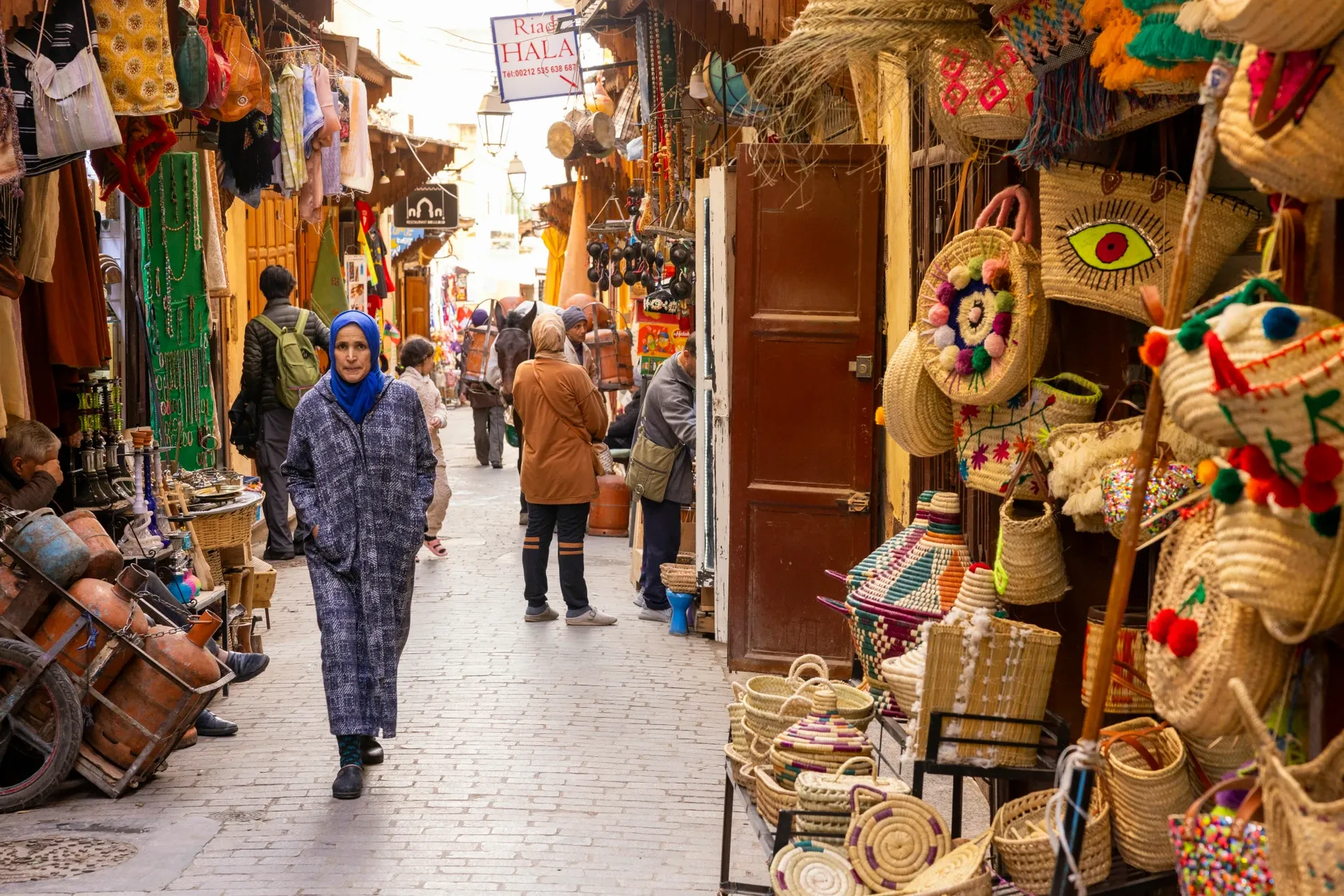
Within the Medina, myriad small grills, kitchens, and frying spots fiercely compete for attention. Artisans such as silver and copper smiths, coppersmiths, tanners, potters, cloth merchants, carpet weavers, textile dyers, grinders, and saddle makers populate the traditional souks, the vibrant markets that further enrich the sensory experience. Many guidebooks humorously mention that Fès boasts the largest car-free old town in the world, but this feels laughable to anyone who steps foot here. The alleys are sometimes so narrow that even two donkeys cannot pass side by side, tasked with carrying loads too heavy for merchants. The local inhabitants rely on diminutive donkeys for their work, while cars find no place in this Moorish-Andalusian miniature wonderland, where a sense of closeness prevails that European urban dwellers can hardly comprehend.
Tourists are advised never to venture alone into the Medina, warns the strict Ahmed, who spent part of his childhood here, not for safety reasons but due to the disorienting layout. Even locals can easily lose their way amidst the overwhelming complexity. Anyone familiar with already challenging European destinations like Venice or Naples will find Fès, with its plethora of sights and aromas, a formidable challenge for the senses, particularly the sense of direction. Whether to turn left or right at the end of a path, or what lies behind the many arches, gates, doors, and corners – attractions such as al-Qarawiyin, the oldest continuously operating university in the world, a Quran school, a pilgrimage site, an exquisite courtyard, a private residence, or a hidden trade – remains a mystery without external guidance.
Even the cardinal directions blur in Fès, where the sky is often obscured. The alleys can be so dramatically narrow that one’s gaze upwards, contorted to peer at the sky, is hardly rewarding. Alternatively, any glimpse of blue might be concealed behind partially overgrown wooden lattices that loom high above the heads of residents and visitors alike, intensifying the feeling of confinement. Whether Fès or Marrakech boasts the more overwhelming Medina is a matter of tourist debate, with Fès often labeled as the more authentic, spiritual capital of Morocco.
The logistical challenges of transporting furniture or quickly evacuating the sick or injured seem like an unsolvable puzzle in a city whose oldest sections date back to the ninth century, while more recent parts originate from the 14th and 15th centuries. Approximately half a million people reside here, supporting one another in daily life, as it would be nearly impossible to navigate without cooperation. Ahmed recounts a childhood anecdote to illustrate this sense of community: due to the narrow, crowded streets, residents sometimes traversed rooftops to expedite their journeys. He recalls stopping at various houses on his way to school, collecting drinks or food from neighbors, effectively having multiple mothers. The Medina is, in essence, like one large family.
Yet, the bustling improvisational spirit is just one visible facet of Fès. Hidden beneath the surface, often undetectable from the outside, lies the calm professionalism of places like the hotel where we stay, encapsulating the cliché of an oasis of tranquility. The vibrant hustle and bustle is palpable here too, yet it remains muted and serene. Instead, guests are greeted by splendid courtyards adorned with mosaics and tiles, pools or fountains, and lush vegetation featuring palm trees, shrubs, climbing plants, herbs, and fragrant blooms. It is no wonder that these traditional Moroccan houses are known as Riads, which translates to heaven or garden.
One such Riad is Palais Amani, a five-star boutique hotel with its own cooking school. Here, a staff member introduces us to Moroccan cuisine during a cooking seminar held on the rooftop, a welcome experience enhanced by a gentle breeze, as the outdoor kitchen can become quite hot. The young woman’s excellent, rapid-fire English is a product of her Moroccan upbringing: Morocco not only welcomes countless people each year from countries south of the Sahara but also loses millions of young individuals seeking their fortune in Europe. Our chef shares that she worked in marketing before her training as a cook led her abroad to France, Spain, and Romania. Her fluency in English, she attributes to American television shows, particularly "The Kardashians," and her voice now resonates with the entrepreneurial energy of those luxury sisters from the USA, with a striking visual resemblance.
Her commands are quick and energetic, particularly as we prepare a Tajine, Morocco’s national dish, which requires numerous steps before it is cooked to perfection in its namesake clay pot and served alfresco under citrus trees. She sourced fresh ingredients earlier with us – eggplants, tomatoes, onions, garlic, coriander, and parsley, all in hefty bundles. “Everything is fresh today,” she assures us, having procured the chicken from a butcher just a few steps away, where he slaughters the birds either before the customers’ eyes or discreetly beneath the counter. The process is swift regardless, as the chicken was just moments ago among its companions in one of the six cages behind the butcher. Freshness is the unequivocal priority.
A Tajine is a hearty meal commonly offered across Morocco at restaurants and street stalls for a handful of dirhams, equivalent to just a few euros. The ingredients may vary, with both meat-filled and vegetarian options available. Our Tajine appears almost divine despite its simplicity, likely due to our hands-on preparation, the mounting hunger, and the enchanting courtyard ambiance – not to mention the mild olive oil and a medley of spices that elevate this simple dish. A glass of wine served alongside completes the experience.
Yet, it is common knowledge that wine seldom graces the table without Ahmed reminding us that alcohol is generally absent in Morocco. Moroccans neither produce, sell, nor consume alcohol. The pregnant pause that follows this statement speaks volumes. What is difficult for locals to acquire is made readily available to tourists, just as it is in their home countries. This disparity extends to food as well.
This intricate understanding of the local culture reaches its zenith when we visit Château Roslane, located near Meknès, another former capital of Morocco and the nation’s olive metropolis. Situated towards the Middle Atlas, Guillaume Constant cultivates red and white wines on 3,000 hectares. The annual production of three million bottles constitutes 90 percent of Morocco’s wine industry, which boasts a mere dozen wineries in total.
The Bordeaux-trained oenologist manages the Château for its Moroccan owners, maintaining a relaxed rapport with his craft. After all, the Romans were the first to introduce wine to Morocco, and France's colonial history has further intertwined the two. “Moroccans drink a lot,” he states, with Ahmed quietly chiming in that they prefer red wine. The export figures he mentions reflect this reality, with only two percent of production leaving the country, indicating that Moroccan wine is not yet in high demand in Europe or elsewhere, but is certainly popular at home.
The calcareous soil conditions around Château Roslane mirror those of Bordeaux, according to Constant. However, summer temperatures soar higher – though not as extreme as in the lower Meknès, where 50 degrees Celsius is not uncommon. The cooler nights at an altitude of around 500 meters provide an ideal recovery period for the grapes. The wines produced here are now protected under the designation "Coteaux de l’Atlas." In his cellars, tens of thousands of hectoliters age, with most stored in steel barrels and high-quality red wines maturing in oak barrels.
From the windows of the adjoining four-star hotel, guests can gaze upon the sprawling gardens and large outdoor pool, and also witness who holds sway in the region. The vineyards are frequently bordered by thousands of olive trees that seem to shield the vines from wind and other adversities. Yet, it is not primarily protection they seek but rather visibility, ensuring the world becomes aware of the culinary treasures waiting to be discovered in Morocco.
As reported by faz.net.