
Spain's National Court Takes on Migrant Crisis Case
The situation surrounding the migrant crisis in Ceuta has now escalated to Spain's National Court, where a judge has labeled the incident as a severe attack on the nation, implicating Moroccan officials in what appears to be active assistance. The Spanish government, however, is maintaining its cautious stance. As tensions rise in Ceuta—with reports of vehicles set ablaze and the relocation of 152 toddlers due to a new migrant camp—nearly 90% of Spaniards are placing blame squarely on Morocco.
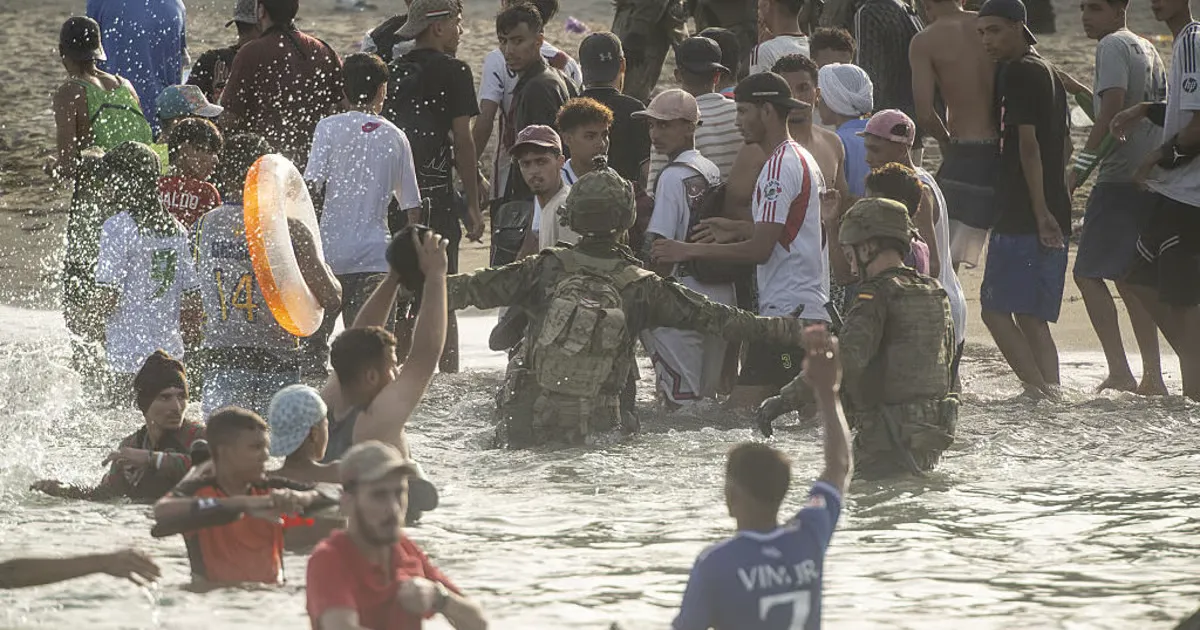
The controversy erupted after the mass influx of migrants on July 30 and 31, which has led to a significant debate among the government, police, and opposition regarding responsibility for the event. As of Monday, the case has been officially handed over to the Audiencia Nacional, Spain's central national court located in Madrid, marking the first time that judicial authorities have made serious accusations. Judge María Tardón has initiated a criminal investigation, citing evidence of actions that allegedly constituted a serious offense against Spain's territorial integrity.
The investigation includes possible charges related to threats against peace and independence, organized crime, and negligent homicide, with reports indicating that approximately 140 individuals lost their lives during this mass influx. Even more concerning are the findings presented by Judge Tardón regarding Morocco's involvement. She references a report from Spanish police that describes a “clear and undeniable facilitation” of the migrant movement by Moroccan authorities, suggesting that the situation was not merely overlooked but actively encouraged.
According to the evidence cited in her ruling, uniformed Moroccan police were reportedly directing migrants, guiding them to overcome barriers on their way to the border, and organizing access to the beach area of Fnideq. The judge explicitly mentions a “documented and graphically substantiated behavior” from Moroccan security forces, raising critical questions about whether the mass entry was merely tolerated or actively facilitated by state actors from the neighboring country. In stark contrast, the Spanish government's response remains cautious. On the same Monday, Deputy Prime Minister and Minister of Economy Carlos Cuerpo urged “extreme caution” regarding Morocco, asserting that there is currently “no solid evidence” implicating the neighboring country in the crisis.
Ceuta Faces Escalating Violence Amid Political Tensions
While political debates continue in Madrid about accountability, the situation in Ceuta is deteriorating rapidly. Reports from the EFE news agency indicate that the enclave experienced its worst night of vandalism since the mass influx on July 30, with three vehicles and several containers set on fire. Additionally, fires broke out in areas where makeshift migrant camps are located, prompting police intervention during clashes among migrants.
The identity of those responsible for these arson incidents remains unclear, but a particularly alarming incident occurred in the El Príncipe neighborhood. When the Guardia Civil and firefighters responded to a blaze, they were met with stone-throwing attackers, injuring one officer and damaging a service vehicle. The police union AUGC is urgently calling for additional forces to address the escalating violence.
Over the weekend, a similar incident led to immediate consequences when 21 Moroccan migrants were arrested following a stone attack on a military patrol and the Guardia Civil. They admitted their involvement, and after voluntarily opting for repatriation, they were returned to Morocco through the Tarajal border crossing.
This particular case is noteworthy because, while Spain is still processing thousands of other migrants with individual assessments and lengthy procedures, the return to Morocco can occur remarkably quickly under certain legal conditions and voluntary repatriation. Ceuta's President Juan Jesús Vivas intensified his rhetoric on Monday, asserting that he is convinced Morocco is behind the crisis, which he describes as a threat to security, community cohesion, and employment opportunities. He depicted the situation as one of “maximum alarm” for national security, likening Ceuta to a “pressure cooker” ready to explode at any moment. Vivas is demanding a specific timeline from the government regarding the restoration of normalcy.
The dispute surrounding the new migrant camps has immediate repercussions as well. A temporary tent camp is currently being constructed in the Los Rosales neighborhood, right next to the new public nursery Nuestra Señora de África. Just over the weekend, Ceuta's government had considered relocating the children, but by Monday, it was decided that all 152 children under three years old, who were set to attend the new facility starting September 28, would be dispersed to other kindergartens. The regional government justified this decision by stating the need to provide a “suitable and safe” environment for the children, even as Madrid remains committed to the migrant camp plans.
Opposition is also growing in the port area against Madrid's plans. The workers' council of the port authority has unanimously opposed the proposed camp at Muelle de Poniente, calling for a public protest at the designated site. Labor representatives are explicitly warning about security risks, noting that the port is “critical infrastructure,” with fuel tanks and a power distribution facility located just meters away from the planned camp.
Furthermore, the upcoming school year highlights how far Ceuta is from returning to normalcy. The Ministry of Education has hired private security services for all 35 educational institutions in Ceuta, with these services already in place since September 1, according to Minister Milagros Tolón. State security forces are also set to secure school routes, with Tolón assuring parents that educational institutions are safe and encouraging them to return to normal school routines.
Several sports and education facilities had previously been utilized or earmarked for housing migrants, including the temporary housing of 290 underage girls at the Colegio Reina Sofía sports facility, which occurred under heavy police protection over the weekend. Meanwhile, new figures regarding the crisis management have emerged. Territorial Minister Ángel Víctor Torres reported that since August 10, around 4,000 migrants have voluntarily returned to Morocco, and approximately 2,000 underage migrants have now been identified. This number is expected to rise, as there are still minors remaining outside official facilities, with family reunification in Morocco being prioritized.
However, the government continues to struggle with a fundamental question: How many migrants are still in Ceuta? Torres acknowledged that providing an accurate number is currently “impossible.” The discontent is no longer limited to individual residents or political parties, as dozens of inhabitants from nine neighborhoods heavily affected by the crisis took to the streets on Monday evening. Their protest march led from Príncipe Felipe towards Tarajal, where several migrant accommodations are situated. Participants demanded increased security, a normal school start, and the resumption of business operations in the commercial area, chanting slogans such as “Ceuta is not for sale, Ceuta is defended.”
In the public's perception, the question of accountability seems largely answered. A recent 40dB survey for El País and Cadena SER revealed that nearly 90% of Spaniards hold Morocco partly responsible for the Ceuta crisis. The Spanish government is also viewed unfavorably, with about 72% attributing significant responsibility to Pedro Sánchez's cabinet. Close to 63% rate Sánchez's crisis management as poor or very poor, with only 14.2% giving him a good or very good rating. Notably, the survey was conducted before the police report detailing the alleged active facilitation by Moroccan forces became public.
This survey underscores a marked hardening of attitudes concerning migration and security issues, with 70% supporting stricter border controls, even if it means preventing vulnerable individuals from entering. Additionally, 63.6% believe Spain's sovereignty over Ceuta and Melilla is non-negotiable, and 63.8% would support military intervention to defend the two cities in the event of an external attack. Politically, the right-wing parties are gaining ground, with the same 40dB survey indicating that the PP and Vox have surpassed the 50% mark for the first time during this legislative period, collectively receiving 50.2% of the vote.
On Tuesday, the crisis is set to return to the political forefront, with Interior Minister Fernando Grande-Marlaska visiting Ceuta for the third time since July 31. He plans to visit the temporary reception center and hold a press conference in the afternoon. Concurrently, a significant decision is expected in Madrid that could further impact the entire affair.
The dispute is also making its way to Brussels, where Ceuta's President Vivas will meet with EU Commissioner for Home Affairs Magnus Brunner and Mediterranean Commissioner Dubravka Šuica. Additionally, Foreign Minister José Manuel Albares will hold discussions with Brunner in Brussels, and the EU Commission is expected to send a technical mission to Ceuta this week.
On Tuesday, the Spanish cabinet plans to declassify previously secret reports and warnings regarding the Ceuta crisis. Starting Wednesday, these documents, which include information from police, military, and intelligence agencies, will be made publicly available. Sánchez aims to support his claim that his government did not receive any specific warnings about a mass influx of this magnitude prior to July 30 and 31, asserting that previous indications were merely routine alerts.
However, since Monday, a more pressing question has emerged: Not only what did Madrid know beforehand but also what actions did Morocco take? A judge from the Audiencia Nacional has already provided a notably clear preliminary answer. The investigation into a serious attack on Spain is ongoing, with Morocco allegedly playing an active role. As the situation escalates, the Spanish government remains notably reserved.
As reported by exxpress.at.