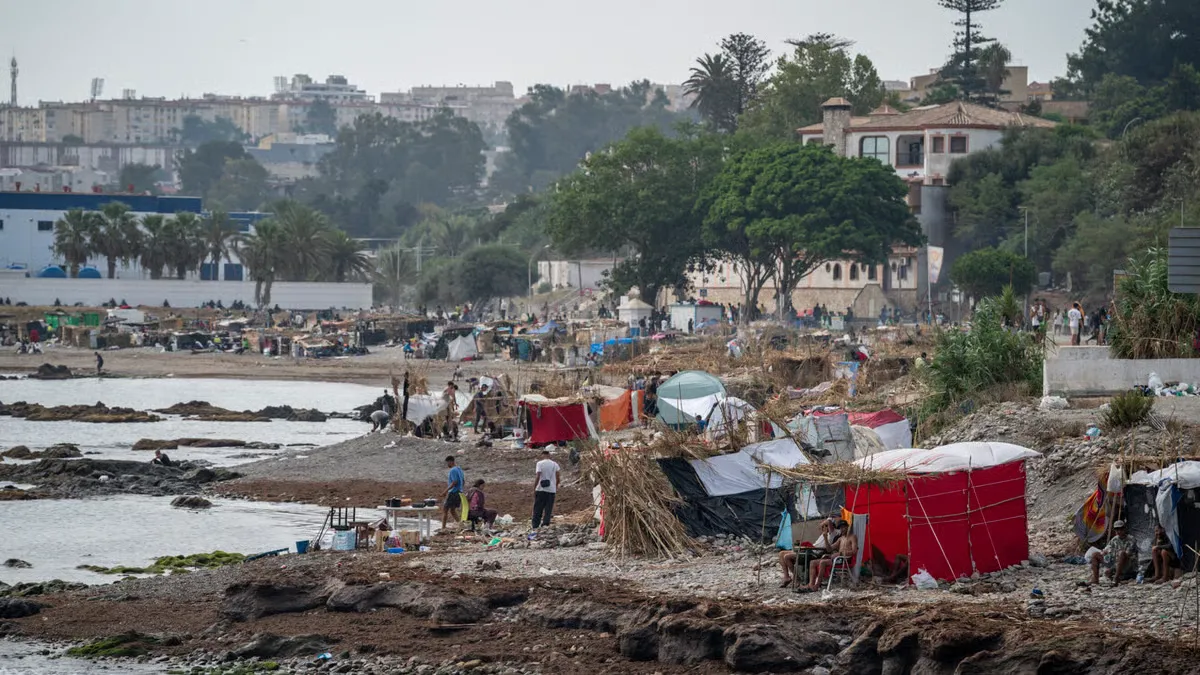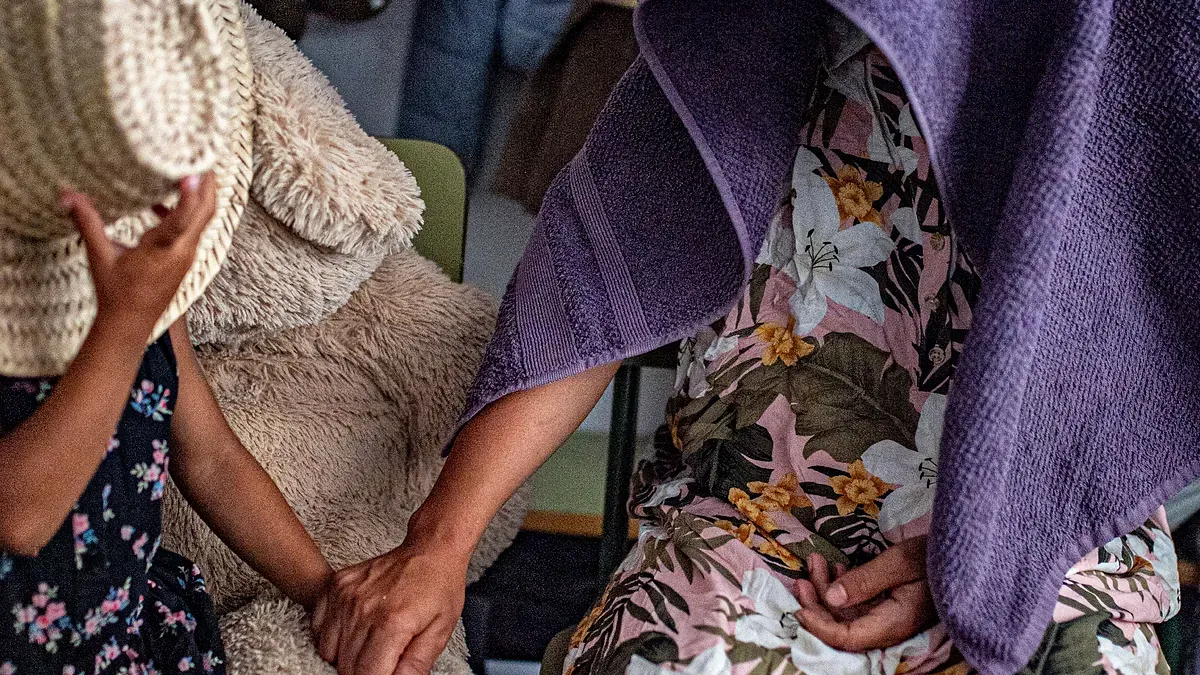

Linda speaks slowly, her timid nature evident in her few words. Sitting on the ground in front of the makeshift shelter constructed from cardboard boxes, she communicates through an Arabic translator app on her mobile phone. Nearby, her daughter Nani plays with other children who remain in the industrial zone of Tarajal. Some individuals have brought toys, and the children share what they have. Among them is Cao, another girl living there with her mother, along with several younger minors. Throughout the day, the children run around the streets of the industrial area while the women focus on finding food, water, clean clothes, or any place to wash themselves.
Of the approximately 80,000 people who entered Ceuta since July 30, it is estimated that between 6,000 and 8,000 still remain in the city. Nearly a thousand stayed directly in Tarajal after crossing the border and have been there since. Some sleep by the doors of warehouses, while others have settled in an old parking lot. Within this space coexist single women, divorced mothers, single mothers, families with young children, and unaccompanied minors. Some of these women have recounted experiences of violence endured in Morocco. Linda has shared her story in detail, and after reaching Ceuta, she received a threat that this reporter heard directly: “They will throw you out of Spain, and I will be waiting to take your life and keep your daughter.”
Linda recounts her life leading up to that threatening call. She wishes to apply for international protection, share her story with the help of a lawyer and an interpreter, and have the authorities assess her situation before any decisions are made regarding her possible deportation. “I am very scared. I have anxiety. I fear returning to Morocco because I am afraid for my life and my daughter's safety.”
“I PREFER TO DIE HERE WITH MY DAUGHTER”
When discussing her future, Linda focuses on Nani. “I want my daughter to grow up in Spain to secure her rights and future. In Morocco, she will be lost.” When asked what returning would mean for her, she pauses for a few seconds before replying: “I prefer to die here with my daughter than to go through all that again.”
Her childhood unfolded in a small village nestled among the mountains of northern Morocco, in the region of Fez-Mequinez. She recalls it as a simple and happy time spent with her parents and siblings, despite economic difficulties and certain deprivations. Her father, she recounts, did everything possible to ensure his children lacked nothing and provided for them with what little he had. “We were a humble family, but we were okay,” she summarizes.
Challenges and violence arose after she married and entered her husband’s family. Three years into the marriage, she became pregnant with her first child. “I was living under immense pressure and experiencing violence. When I was two and a half months pregnant, my husband’s sister came. She grabbed me, pushed me against the wall, and began to hit me. I ended up on the ground. I had to be taken to the hospital, where they gave me an injection, oxygen, and IV fluids. Afterward, they sent me home.”
She claims the abuse continued, with her husband also physically assaulting her. “He would come home, and if he found anything out of place, even after I had done everything I could and fulfilled my responsibilities, he would start hitting me. There was always some reason.” When it came time to give birth, her water broke, but she remained home for three days losing amniotic fluid. She alerted her mother-in-law, who told her it was normal, while her husband did nothing. Eventually, an aunt came to see her and took her to the hospital. “When I arrived, they said I had waited too long, and the baby had inhaled the fluid. They told me both of us were in danger and rushed me to surgery.”
“HE TOLD ME MY BABY HAD DIED”
The newborn was transferred from the city where Linda lived to Beni Mellal because, as she explained, her local hospital lacked the resources to care for her. She remained unaware of her baby’s condition and called her husband for updates. He assured her the baby was fine and would return soon. “On the fourth day, I called him again, and he told me my baby had died. I couldn’t accept it. I had a panic attack. I told him not to lie to me, that I wanted to see my daughter. They did not allow me to see her. When they brought her back from Beni Mellal, they took her directly to the cemetery and buried her. I couldn’t even see her.”
Afterward, Linda needed medication to sleep for an extended period. “It felt like being dead while alive, like a body without a soul.” Three years later, Nani was born, a new arrival that Linda interprets as a second chance from her faith. “I hadn’t sought her out. Subhanallah, she arrived on her own. I believe God wanted to compensate me for everything I had gone through and for the baby I lost. God gave me Nani.”
Violence, according to her testimony, continued during her second pregnancy, involving physical abuse and sexual assaults by her husband and family members. She worked until shortly before giving birth, asserting that her husband did not take care of her. After the divorce, she worked in a bakery and enrolled her daughter in daycare. However, her salary was insufficient to cover expenses, and she often had to borrow money to make ends meet. She claims her ex-husband did not pay the court-ordered child support either. The separation did not end the harassment from her ex-husband: “He would cross paths with me, insult me, and assault me. Many times he threatened to kill me and take my daughter away.”
There were times when she worked from eight in the morning until midnight. In those situations, she encountered men who interpreted her status as a divorced woman as an invitation for sexual availability. “They assumed that because I was divorced, I was a prostitute.”
On one occasion, she recounts, two young men intercepted her on her way home. “They stopped me with a car, grabbed me, ripped my clothes, and sexually assaulted me. Afterward, they beat me until I bled and left me lying in the street. I managed to get up and went to the police station to report what happened.” However, she found no protection there. “When they learned I was divorced, they didn’t believe me. A police officer told me: ‘Go away, we don’t have time for you.’ I left there crying.”
She eventually moved to Castillejos, a Moroccan town adjacent to Ceuta, to escape her ex-husband and find work to support her daughter. With the school year approaching, she faced new expenses. It was there that she found herself on July 30, when many people headed towards the customs area and the pier in an attempt to reach Ceuta.
“When this opportunity appeared, I thought it was my chance to secure her future,” she recalls. She took to the sea with her daughter on a rubber float. She remembers the crossing as a chaotic and terrifying experience. She was already in the water when she began to see people struggling to stay afloat, and she claims to have witnessed some drowning right in front of her. “The situation was horrifying. I saw people drowning before my eyes, and I couldn’t do anything. I was screaming, but I was powerless. I had my daughter with me, and I was terrified that we would both drown.”
Before launching into the water, she also witnessed Moroccan agents acting against people trying to reach the pier. “When people clung to the fence, they came and started hitting them with batons, pushing them to fall into the sea.” She remembers what, according to her testimony, they shouted while pushing them: “You will never leave alive.” More than a hundred people ended up as that officer predicted, many crushed and drowned in less than two meters of water. The danger continued in the water. A young man attempted to take the float on which she was carrying her daughter and, as she explains, tried to sink her to take it from her. “I started screaming. I was incredibly scared for my daughter. He almost managed to drown me.”
Another young man, whom she identifies as Spanish, came to her aid, grabbed both of them, and began to swim them toward the shore. “He told me not to be afraid. He started pulling us until we reached the shore.” Once on land, she hugged her daughter. “She was scared and crying. I also had a panic attack.” Linda also recalls Spanish police rescuing those still in danger and throwing flotation devices into the water to prevent drownings. When asked if she believes that intervention prevented more victims, she responds affirmatively.
Since that day, mother and daughter have remained in Tarajal. The little girl plays for part of the day with Cao and other children while her mother takes care of her and tries to meet their needs. However, reaching Ceuta did not end the threats Linda claims to have faced for years. After crossing, she received the threatening call from her ex-husband, which this reporter was present to hear.
Just a few meters from where this was happening is Nueva Esperanza, an old warehouse converted into a reception center managed by the Fundación SAMU, where unaccompanied migrant minors are housed, under the guardianship of the Minor’s Area of the Autonomous City of Ceuta, which already accommodates nearly 2,000 children according to official figures. The warehouses used to shelter people during previous crises remain closed for that purpose, and some are being adapted for the police units responsible for triaging and interviewing those who may request protection.
In the initial days, there was also no medical assistance in the industrial zone. About a thousand people remained there, including women and very young children, without a healthcare setup to attend to them. The situation began to change when Médecins du Monde started to visit Tarajal to offer consultations to those in need. Fifteen days after the mass entry on July 30, the Health Department added a doctor and two healthcare professionals to the operation. This medical intervention was accompanied by National Police agents, tasked with monitoring the setup amid the existing anxiety and the lack of care many of those gathered had endured.
Until then, the response to basic needs had been organized on the fly, primarily through associations and individuals who began bringing food, water, and other products. The first night, there were children shivering from cold in the open space and streets of the industrial zone, without a designated place to sleep. For days, those who stayed there depended on the aid arriving from outside to meet their most basic needs.
The immediate assistance has been predominantly provided by local associations and residents. Luna Blanca, a Ceuta-based organization operating out of the lower levels of the Sidi Embarek mosque, delivers food to Tarajal every day. The association had already been distributing food year-round to families in need within the city, and hundreds of people regularly visit their site for meals. Since the influx began, they have expanded their distribution to the industrial zone. Mustafá, its president, explains the reason: “I cannot leave these people without food.”
Resources are limited, and this aid ensures a daily meal. To shower, obtain clothing, drink water, or charge phones, other solutions must be found. One such initiative is Alas Protectoras, a small association whose president, Abdselam, stores clothing, food, and donations in a local facility situated in a peripheral neighborhood of Ceuta, in the area of the old fire station. Their work did not start with this crisis; during the arrivals in 2021, they took to the streets to assist those who had just entered the city. This time, they decided to keep the facility open so that people in need could come directly for help.
Linda visited there one day with her daughter and other women from Tarajal. They were able to shower, put on clean clothes, drink water, and charge their phones before returning to the industrial zone. “We are all brothers, we are all human, and we must help,” explains Abdselam.
As reported by elmundo.es.