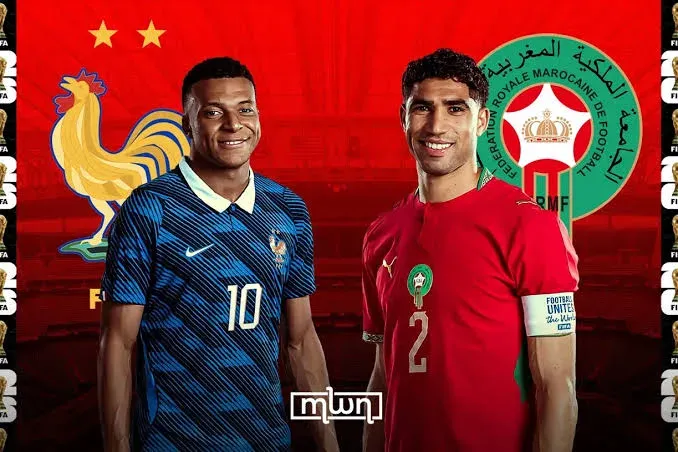
Rabat - For football aficionados, the upcoming match between France and Morocco in the World Cup quarter-finals signifies a competitive clash between two remarkable national teams. However, for the hundreds of thousands of Franco-Moroccans, it transcends mere sports rivalry. As both nations prepare to face off, many from the Moroccan diaspora residing in France find themselves contemplating their loyalties, as if this game necessitates a choice between their two homelands. Yet, the reality for most in the diaspora is that such a conflict does not exist. The love for two countries is not a matter of division; rather, it is akin to loving both a mother and a father or cherishing both hands, indicating that dual affection does not diminish one's attachment to either side. This match represents much more than a contest of skill; it embodies the narrative of a diaspora, a dual identity, and a multitude of individuals who have never felt compelled to prioritize one aspect of their identity over the other.
Embracing Two Cultures
My personal journey reflects this duality. Born in Belgium and raised from the age of four in a small town near Paris, my family heritage spans two shores of the Mediterranean: a father hailing from Fez and a mother whose roots trace back to Taounate, northern Morocco. My upbringing was shaped significantly by the cultural tapestry of both nations. While France provided my educational and social environment, Morocco resonated with me on a deeper level. The flavors of Moroccan cuisine, the sounds of chaabi music echoing from the kitchen, and the seamless integration of Moroccan phrases into our French conversations were all part of my daily life. Moroccan culture was not relegated to special occasions; it was woven into the fabric of our existence.
Some of my most cherished memories revolve around visits to my grandmother in Orleans, central France. Entering her home felt like crossing into Morocco itself; the Moroccan decor, the scent of incense, and the warmth of her welcome created an atmosphere that transported me to a different world. For me, visiting my grandmother was akin to experiencing the essence of Morocco, despite being physically miles away.
As I navigated my childhood and adolescence, a recurring question arose: “Do you feel more French or more Moroccan?” It was a query posed by family, friends, and acquaintances, as if identity were a binary choice. This notion intrigued me because both identities coexist harmoniously within me. Embracing my Moroccan heritage has never diminished my French identity, nor has my upbringing in France lessened my connection to Morocco. The Franco-Moroccan experience is inherently unique; the Moroccan identity is not lived the same way by those raised within its borders, just as the French identity differs for those from long-established French families. Yet, this divergence does not denote a contradiction; rather, it enriches both cultures, shaped by individuals who naturally belong to both worlds.
A New Era for Moroccan Football
Football has become the arena where my dual identity is not merely questioned but celebrated. My passion for the sport blossomed in the mid-2010s when Morocco struggled to make its mark on the international stage. The Atlas Lions had not qualified for a World Cup since 1998, and their African Cup of Nations efforts often fell short. As a child, the Moroccan national team was a distant concept. However, everything changed in 2022 with Morocco's historic victory over Belgium, igniting one of the most compelling narratives in World Cup history. A standout moment from that campaign occurred during Morocco's decisive group-stage match against Canada, which coincided with my school lesson, making it impossible to watch live. Yet, upon leaving class, the jubilant sounds of car horns and fireworks filled the streets, signaling Morocco's qualification and uniting the diaspora in celebration.
Following a remarkable journey to the World Cup semi-finals—the first ever for an African nation—and a title at the Africa Cup of Nations, Morocco now approaches the 2026 World Cup quarter-finals with a newfound confidence. Rather than disbelief, qualification is met with ambition, reflecting a significant evolution in Moroccan football, where reaching the last eight is recognized as a logical progression.
This Moroccan team resonates profoundly with millions abroad, embodying contemporary Morocco: a nation influenced by both those who grew up at home and a diaspora that remains intimately tied to its roots. The diversity within the squad illustrates this reality; players like Neil El Aynaoui from Nancy and Ayyoub Bouaddi from Senlis have chosen to represent Morocco, reinforcing the idea that Moroccan identity extends well beyond its geographic boundaries. This representation allows Franco-Moroccans to see themselves reflected in the national team, affirming that the diaspora has become an integral part of Morocco's football narrative.
Moreover, the historical context of the Moroccan diaspora in France—rooted in labor migration following the colonial era—explains the deep-seated connections between the two nations. France has become a second home for countless Moroccan families, and Morocco’s World Cup journey has coincided with encounters against countries hosting significant Moroccan communities, further solidifying these ties.
As the quarter-final approaches, it carries the weight of a sporting rematch, providing Morocco the chance to avenge its previous defeat to France in the 2022 semi-finals. This time, however, the stakes are higher, with a place in the last four at risk. The matchup has transitioned from a surprise underdog story to a highly respected competition between two formidable teams. Regardless of the outcome, this rematch encapsulates the progress both nations have made in football and beyond.
Ultimately, the question of allegiance remains complex, especially for Franco-Moroccans. While both countries vie for victory, the reality is that they are not competing identities. Football transforms this narrative into a moment of joy for one and disappointment for the other, yet both nations will remain home for millions long after the final whistle blows. For Morocco, a second consecutive World Cup semi-final would be a remarkable achievement, and lifting the trophy would not only rewrite the history of Moroccan football but also resonate deeply across Africa and the Arab world. It would signify the culmination of generations of dreams, uniting Franco-Moroccans and their homeland in a shared celebration of identity and belonging.
As reported by moroccoworldnews.com.