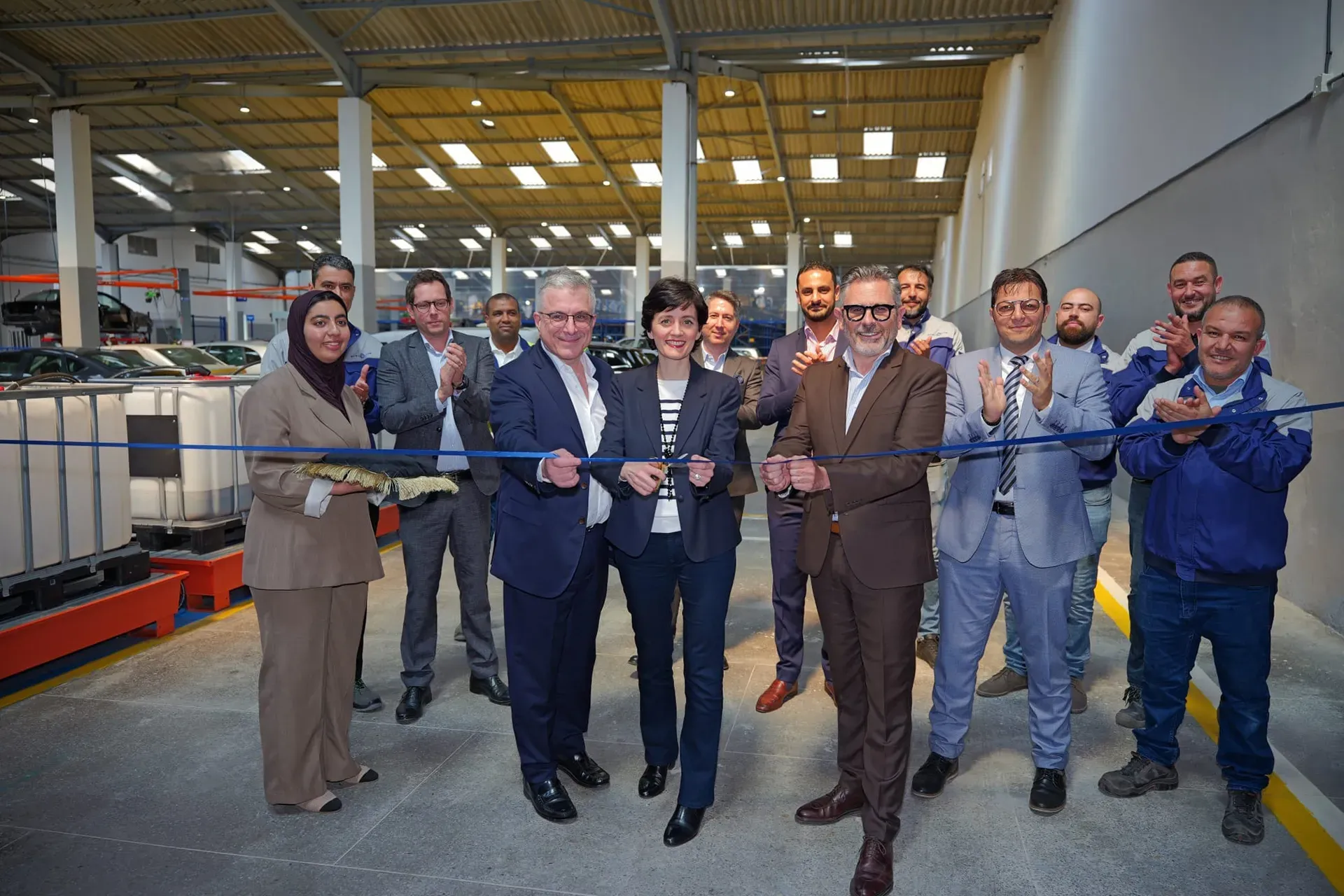
On June 5, 2026, the multinational automotive group Stellantis inaugurated a state-of-the-art car dismantling center in Morocco, marking a significant advancement in the country’s automotive industry and aftermarket services focused on reuse and recycling. This facility is strategically located in Casablanca and is notable for being Stellantis's first in the region and the third globally dedicated to vehicle dismantling, following similar centers in Turin, Italy, and São Paulo, Brazil.
The center, which spans an impressive area of 6,000 square meters, has been established with an investment of €1.6 million (approximately $1.9 million). It is designed to dismantle up to 10,000 vehicles annually and is expected to create around 150 direct and indirect jobs once it reaches full operational capacity. In a statement released on Wednesday, Stellantis emphasized that this new facility aligns with its circular economy strategy implemented through its Sustainera unit, aiming to extend the life of vehicles and spare parts, minimize waste, and optimize resource utilization within the automotive industry’s value chain.
The concept of a circular economy seeks to eliminate waste and promote the sustainable use of resources, contrasting with the traditional linear model that typically results in products becoming waste at the end of their lifecycle. Instead, materials are reintroduced into the economy, fostering a more sustainable approach.
Furthermore, Stellantis highlighted that the center is designed to serve both Morocco and Sub-Saharan Africa, particularly West Africa, positioning it as a regional industrial model for developing activities related to the dismantling of end-of-life vehicles, while also facilitating the reuse of parts or directing them towards recycling initiatives.
The facility’s operations will include acquiring end-of-life vehicles from insurance companies, auctions, and certified dismantling channels. The dismantling process will involve selling used spare parts and collecting components intended for recycling, including certain categories of used products like traction batteries.
Emphasizing Circular Economy Principles
According to Samir Cherfan, Stellantis's Chief Operating Officer for the Middle East and Africa and the global head of small mobility, the circular economy represents a strategic priority for the company in the region. This approach merges industrial performance with the provision of cost-effective solutions for customers while ensuring responsible resource use. John Christophe Bertrand, Stellantis's Vice President for parts and services in the Middle East and Africa, further elaborated that the Sustainera model is built on four fundamental principles: remanufacturing, repair, reuse, and recycling, operating under a scalable model without compromising quality.
As reported by Reuters, Bertrand projected that the market for reused spare parts in Morocco could reach a value of 5 billion Moroccan dirhams (approximately $542 million) by 2030. He noted that there are approximately 4.7 million vehicles currently in use in Morocco, with over 17,000 vehicles reaching the end of their lifespan each year.
The escalating prices of raw materials, combined with diminishing supplies and environmental burdens associated with their extraction, are prompting automotive companies to expand their recycling and reuse activities, particularly regarding spare parts that can be tested and reintroduced into the market at lower prices compared to new components. Stellantis’s circular economy offerings in the region encompass the sale of remanufactured parts, the sale of original used parts via the “Be Parts” platform, as well as recycling partnerships and initiatives for end-of-life vehicles, with distribution through a network of aftermarket services, partner repairers, and “Distrigo” centers.
Strengthening Morocco's Automotive Sector
The opening of this dismantling center comes at a time when Morocco is solidifying its position both regionally and globally in the automotive industry. In July 2025, agreements were signed between the Moroccan government and Stellantis to expand the Kenitra plant and launch new industrial projects, which will raise the plant's overall production capacity to 535,000 vehicles annually, including small transport vehicles. According to the Moroccan Ministry of Industry and Trade, these new projects are expected to create over 3,000 new job opportunities, adding to the 3,500 employees currently working at the Kenitra plant. It is also anticipated that Stellantis's procurement from local suppliers in Morocco will exceed €6 billion (approximately $7.1 billion) by 2030, with a local integration rate of 75%.
Recent government data indicates that Morocco's automotive sector exports surpassed 26 billion dirhams (around $2.8 billion) by the end of February 2026, reflecting a 10.3% increase compared to the same period in 2025. The Moroccan Foreign Exchange Office reported that automotive exports rose by 6.3% in 2024, reaching 157.6 billion dirhams (approximately $17.1 billion), maintaining the sector's status as the top exporting industry in the country for the second consecutive year. The automotive industry in Morocco relies on assembly plants and suppliers for components, cables, and internal systems, accompanied by an expansion of aftermarket services, making Stellantis’s center in Casablanca an integral part of a new value chain that not only focuses on vehicle production but also encompasses the reintegration of vehicle parts back into the usage cycle.
As reported by aljazeera.net.