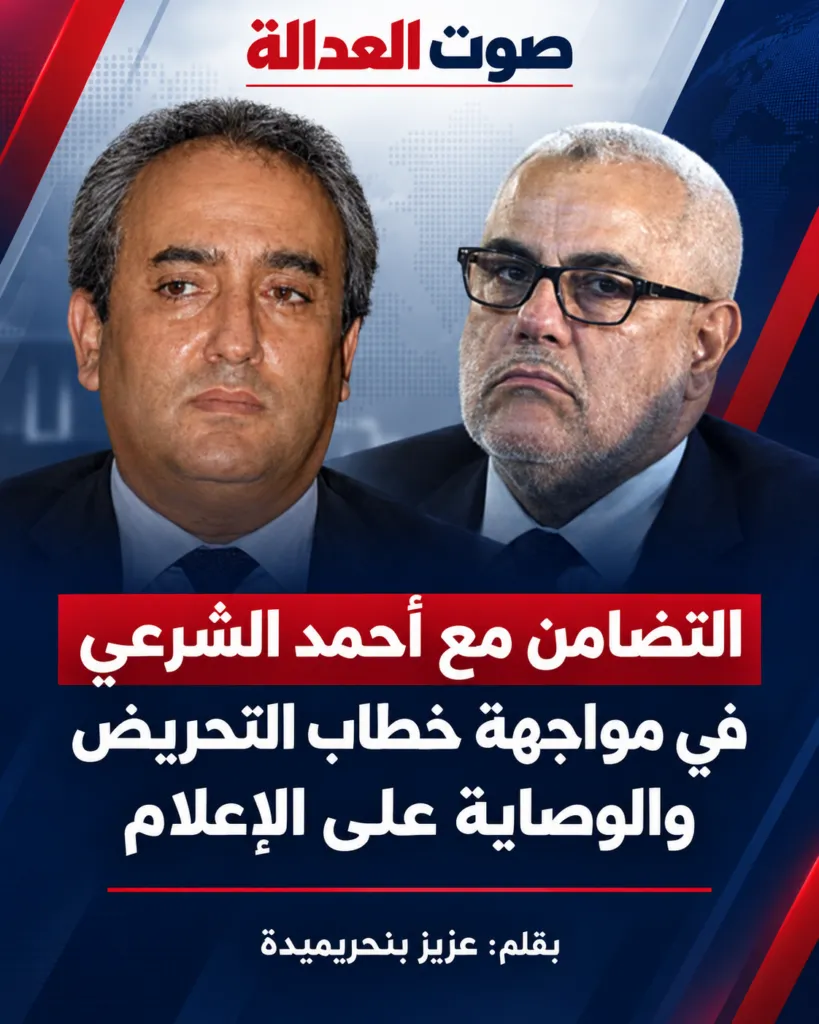

Recently, esteemed journalist Ahmed Al-Shara'i and his media group have faced intense media and political attacks from Abdelilah Benkirane and some of his associates. This approach transcends the boundaries of legitimate disagreement, veering into attempts to defame and undermine the rights of others to express themselves and make choices.
At 'Voice of Justice', we firmly assert that freedom of expression is not a privilege granted by a political leader to those who align with him, nor is it a benefit that can be withdrawn from those who oppose him. Rather, it is a fundamental constitutional right that should be enjoyed by all individuals without discrimination or oversight.
As a resident of Marrakech and a prominent media figure, Ahmed Al-Shara'i has the right to support his fellow townsman, Fatima Zahra Al-Mansouri, viewing her as a modern political figure worthy of backing. Conversely, others have the right to disagree with him, engage in discussions regarding his positions, and critique his choices. However, such disagreements do not grant any party the right to confiscate his opinion or incite hostility against him and his media institutions.
Politics should be a competition of ideas, programs, and community projects, not a court for scrutinizing consciences or distributing certificates of acceptance and belonging. Furthermore, the media should not be transformed into a battleground for settling political scores or a tool to force journalists and publishers into a mandatory alignment.
The attempt to convert political differences into personal attacks against Ahmed Al-Shara'i and his media group does not serve public discourse. Instead, it constricts the space for dialogue and diminishes trust in political practices. It would have been more prudent for Abdelilah Benkirane to counter the choices he opposes with reasoned arguments and political programs, allowing citizens the right to assess and choose between various projects and candidates.
Belonging to the city of Marrakech and taking pride in one of its political figures does not deprive an individual of their independent judgment, nor does it grant any entity the authority to hold them accountable for their inclinations or choices. Ahmed Al-Shara'i is entitled to express his convictions freely, just as Benkirane has the right to voice his opinions, but this should occur without accusations of treason, incitement, or exerting control over the media.
Respecting plurality begins with accepting the freedom of others, especially when they choose differently from us and see hope in what we do not. The nation must make room for everyone, and a healthy political life can only be built on responsible differences and adherence to ideas and programs, far removed from language of attack and exclusion.
From this standpoint, we declare our full professional solidarity with Ahmed Al-Shara'i and his media group in facing any inciting rhetoric that targets their right to express themselves. We affirm that the dignity of journalists and the independence of media institutions are red lines, and political differences, no matter how profound, should not devolve into moral intimidation, defamation, or calls to besiege dissenters.
Freedom of the press is indivisible, and defending it is not contingent on names or political stances, but on a steadfast principle: there can be no democracy without a free press, and no genuine pluralism without respect for others' rights to choose and express their views.
As reported by satv.ma.