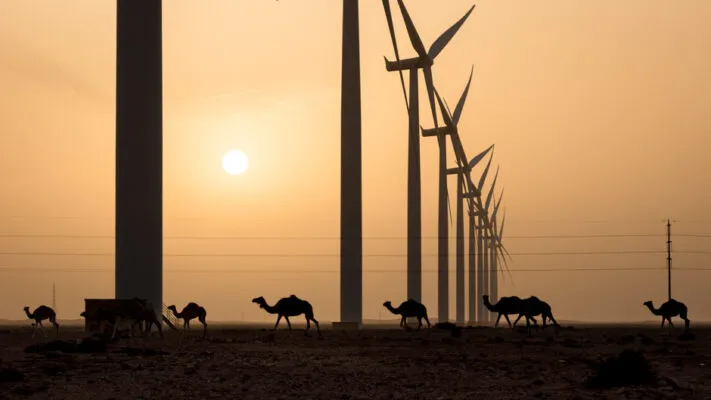
The Tarfaya Wind Farm: A Beacon in the Desert
Standing majestically just 20 kilometers from the small Moroccan port city of Tarfaya, the Tarfaya Wind Farm features an impressive array of 131 towering wind turbines that dominate the arid landscape. Despite its modest population of around 8,000 residents, Tarfaya holds a significant historical legacy, having been at the center of the Green March—a notable mass demonstration that played a pivotal role in Morocco’s territorial disputes with Spain over Western Sahara. This historical backdrop serves as a reminder of Tarfaya's resilience and strategic importance, which is now echoed in its status as the site of Africa's largest wind farm, a title it held until the Lake Turkana Wind Power Station in Kenya took over in 2018. The ambitious project required a staggering investment of approximately 5 billion MAD, translating to an extraordinary cost of around 620,000 MAD per resident, a stark contrast to the average annual salary in Morocco of about 72,000 MAD.
Morocco's Energy Transition and the Role of Renewable Megaprojects
The Tarfaya Wind Farm is just one component of Morocco's broader strategy to enhance its renewable energy landscape, which includes the Ouarzazate Solar Power Station (OSPS), once the largest concentrated solar power plant globally. The OSPS, with its central tower rising 243 meters, symbolizes Morocco's commitment to energy independence and sustainability, utilizing innovative molten salt technology to store thermal energy and generate electricity throughout the night. This ambitious project, costing upwards of 84 billion MAD (around 9 billion USD), serves as a cornerstone in Morocco’s transition away from fossil fuel dependency, a necessity given its status as Africa's largest energy importer. The Moroccan government launched its national renewable energy plan in 2008, aiming to shift from fossil fuel imports to sources such as solar, wind, and hydropower. By 2025, renewables are expected to comprise 46% of the national electricity mix, with a target of achieving a 52% share by 2030, positioning Morocco as a leader in sustainable energy in Africa.
While Morocco's renewable energy initiatives are noteworthy, they have sparked a significant debate about the implications for rural communities. The Moroccan government previously initiated the Global Rural Electrification Program (PERG) in 1996, aiming to achieve an 80% rural electrification rate by 2010 through cost-effective solutions. This program successfully expanded access to electricity to 99.89% of rural areas by 2024, illustrating the effectiveness of participatory approaches that prioritized local engagement and infrastructure repairs. However, the current focus on large-scale megaprojects may inadvertently sideline rural communities, limiting their access to the benefits of Morocco's energy advancements. Instead of solely concentrating on grand energy initiatives, it may be beneficial for Morocco to reinstate a more balanced approach that emphasizes equitable energy distribution, particularly in rural areas where the need is most pronounced. Implementing solar home systems and rooftop photovoltaic panels could empower these communities, enabling them to harness electricity for economic development and self-sufficiency.
As reported by farmersreviewafrica.com.