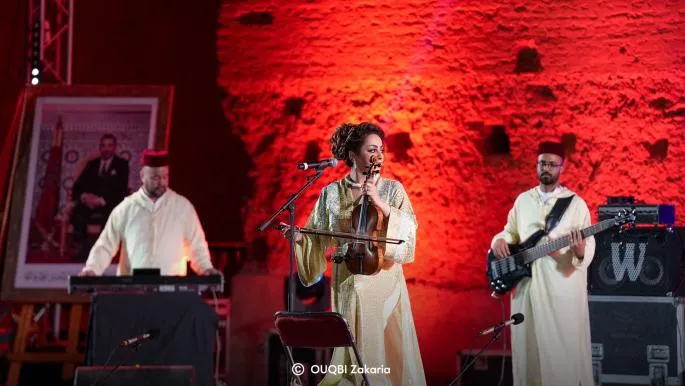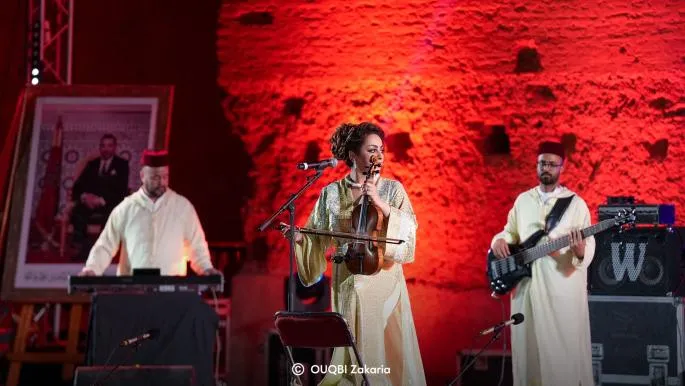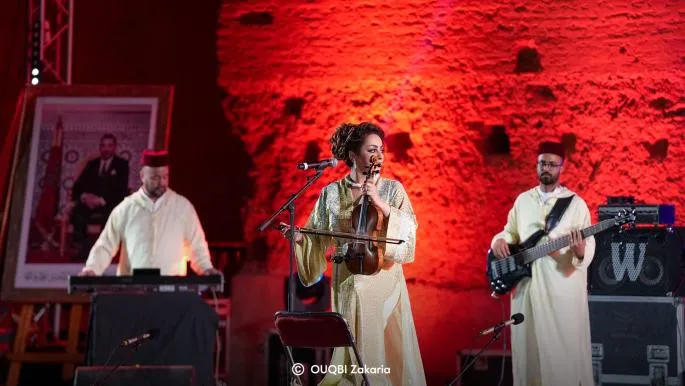
On July 6th, Zina Daoudia captivated the audience during the closing night of the 55th National Festival of Popular Arts in Marrakech with her poignant lyrics: "A day like my life today, my life today / My life I wished was not like this / Sometimes happy, sometimes angry, sometimes just ordinary / With tears I sang and cried out loud." The majority of the midnight crowd was made up of women who knew the famous song with its melancholic tone and steadfast rhythm. Each young woman held a phone, filming and watching the performance through her screen, seemingly more engaged in the digital presentation than the live show itself. This created a dual spectacle, as every young woman broadcasted and shared the song on social media, a lament of anger, bad luck, and the monotony of days.
Zina Daoudia opened the closing ceremony in the grand hall of the Palais El Badi, a historical palace built by Sultan Al-Mansour Saadi to commemorate his victory in the Battle of the Three Kings against the Portuguese in 1578. This festival, which took place from July 2nd to 6th, honored Zina Daoudia as a modern face of traditional folk music. The artist blends contemporary flair with a refreshing artistic approach. As a 'Sheikha,' or expert in song, she works to elevate the traditional 'Aita' music beyond its rural roots, enriching the folk rhythms with Western instruments like the organ, saxophone, and guitar, while ensuring that the sound levels of these new instruments remain low enough to allow the lyrics to be heard and understood.
This is how folklore is modernized in the era of social media, in spaces like the Palais El Badi, which is steeped in historical significance, reaching back to the Bahia Palace, a symbol of the glory of Morocco under Mohammed III, who signed the first treaty with the United States 240 years ago. The festival's events are organized in ancient royal palaces, surrounded by thick earthen walls. These palaces have transformed into cultural institutions, providing a traditional context where the past of architecture resonates with the modern content of songs that carry new lyrics yet retain an old melody, known as the 'Aita.'
The late King Mohammed V established the National Festival of Popular Arts in 1960 to showcase Moroccan heritage both nationally and internationally. As the oldest festival in the kingdom, it aims to preserve and transmit intangible oral heritage. This heritage, which cannot be captured in manuscripts or monuments, lives on through sound and movement, carried by performers from various regions of Morocco, from the Great Atlas Mountains to the edges of the Sahara, who present their dances amidst the earthen walls and the open sky. The dances, accompanied by drums, flutes, and clapping, narrate how "life and the concept of the world are reflected in folklore," as noted by Yuri Sukolov in his work on folklore.
The festival has reached its 55th edition, adopting the theme "Folk Arts: Treasures of Yesterday and Today." How does the festival connect the past, present, and future? By preserving and transmitting Moroccan oral and intangible heritage to future generations. In response to this question and affirming a forward-looking vision, festival director Dr. Mohamed Kanidri stated, "In a recent initiative, the festival has tasked the heads of musical groups with selecting children aged 9 to 15 for practical training, allowing them to participate in a significant artistic competition in the upcoming edition. This is to ensure the continuity of the art and its transmission across generations."
This year, performances were not organized in the famous Jemaa el-Fnaa square, recognized by UNESCO as a masterpiece of the intangible cultural heritage of humanity. The reason? The showing of World Cup matches on giant cinema screens coincided with the musical festival. It is no coincidence that Azeddine Ounahi stood before the press after winning the Man of the Match award following Morocco's 3-0 victory over Canada. He humorously touched the microphone and said, "This is the wedding microphone." Ounahi learned football in Casablanca with the Rahal team, managed by a Moroccan international event planner. Thus, folklore runs parallel to football.
Folklore is deeply rooted in Moroccan soil and transcends mere performance. It embodies the emotions and tastes of the people. All cultures resonate with rhythm and experience it. According to Sukolov, "The entire human race shares the same mentality. This explains the similarities in many cultural elements among distant peoples." One can watch football and dance with the eye, without the need for translation, as both are non-verbal arts. This is a global phenomenon. Norwegian striker Erling Haaland was seen drumming after Norway's win over Brazil, a movement that transitioned into the Norwegian parliament. In this way, sports and folklore animate bodies.
The festival honored the art of 'Aita' through its female representation via Zina Daoudia, who transitioned from playing football to joining the women's national team and then to singing. This complex profile intersects with the contemporary phase in which folklore accompanies football.
The 'Aita' art form was born in the plains of Morocco. It is a popular song that addresses the hardships of life in the fields, the caprices of time, the chivalric feats (fantasia), and the beauty of women, likening their walk to that of doves and their stature to horses. The root of identity is defined by the question, "Where am I from and where are you from? From the heart of Morocco." In this way, the oral sociology of rural Morocco was documented before being formally established by the Moroccan-French researcher Paul Pascon at Moroccan universities. The lyrics of 'Aita' songs about labor in the fields have gained more fame than the titles of rural sociology books.
Following Morocco's World Cup victory before their elimination, young women donned national team jerseys in upscale cafes in Marrakech, singing and chanting wedding songs whenever the handsome player Brahim Diaz appeared. The audience supporting the Moroccan team became more feminine. As a result, the behaviors of cheering transformed, blending dance with encouragement. The warlike lyrics of 'Aita' and collective dances described the goals scored against the Netherlands and Canada. Individuality in folk dances has become rare in favor of collective action, which also applies to football. Group coherence is essential for achieving victory; this is where football and folklore intersect.
'Aita' songs are accompanied by vibrant rhythms and emotional atmospheres. This does not fit well with the ambiance of a luxurious five-star hotel in the heart of Marrakech. To explain this vibrancy, Zina commented, "The popular is organized noise / in the popular, there's the 'hihiya.'" What is 'hihiya'? An analogy from collective hunting to express the communal dance on the edge of joy and chaos. Folklore is characterized by wild imagination, filled with exaggerations: "Folklore is an expression of the real interests and aspirations of the masses."
Thus, the treatment of folklore incites caution among serious writers, particularly in cinema. Sukolov noted that committed intellectuals often hold a negative view of popular heritage, as it reflects deficiency, impotence, the harshness of life, and its cruelty, much like Daoudia's song.
As reported by alaraby.co.uk.