Introduction to the Samir Refinery
Nestled a short distance from the Atlantic coast, Morocco's first oil refinery once symbolized the nation's energy independence. However, it has since devolved into a complex economic and legal saga. On a gray morning at Mohammedia Beach, an elderly worker stands before a massive, rusting iron gate, gazing at a faded sign that reads: "Moroccan Refining Company." This is the Samir refinery, a project that emerged from the aspirations of a modern state following independence but collapsed under the weight of privatization, debt, and international litigation, leaving behind a pressing question about the future of refining in the kingdom. Behind the walls, silent metal towers and storage tanks that once buzzed with activity now stand in quiet desolation. The man, with a tone tinged with nostalgia, reflects, "We used to produce nearly all the fuel for the country; today everything is imported."
This sentiment encapsulates the plight of the Samir refinery, Morocco's sole oil processing facility, which transitioned from a bastion of energy sovereignty to a tangled web of legal disputes.
The Historical Context of Samir Refinery
The idea of establishing the Samir refinery took root in the late 1950s when Morocco, a young nation seeking economic independence, envisioned a strategic dream: transforming from a complete importer of petroleum derivatives to a self-sufficient state capable of meeting its energy needs. In 1959, the Samir Company was founded through a collaboration between Moroccan state initiatives and foreign investment, facilitated by an Italian hydrocarbon agency in partnership with the Italian oil company Eni. By 1961, the refinery began operations with an initial capacity exceeding 1.25 million tons annually (25,000 barrels per day), marking its status as Morocco's first oil refinery, according to data from the Moroccan oil sector provided by a Washington-based energy platform.
The subsequent decades saw the refinery expand multiple times, ultimately achieving a refining capacity of approximately 10 million tons annually (around 195,000 barrels per day) before ceasing operations. This capacity accounted for about 64% of domestic consumption, complemented by storage facilities that could hold up to two million cubic meters. Before closing, the refinery produced five key petroleum products, namely gasoline, diesel, fuel oil, kerosene, and bitumen, playing a crucial role in the economic landscape of Mohammedia, a once-quiet coastal town that transformed into an industrial hub, fostering a network of workers, technicians, and suppliers.
The ripple effects of the refinery's establishment led to significant economic growth, with visible development in the city and its oil port.
However, the tides began to turn in 1973 when Morocco decided to buy out the Italian stakes in Samir. By 1996, the company was listed on the Casablanca Stock Exchange, and during the market liberalization wave of the 1990s, Samir was opened to foreign investment. In 1999, Swedish company Corral Petroleum Holdings, owned by Ethiopian-Saudi businessman Mohammed Al-Amoudi, acquired a majority stake in the refinery (67.27%). In 2004, the Moroccan government signed an agreement with the investor to modernize and develop the Samir refinery, with a commitment of $300 million for this purpose; however, the deal was never activated.
Expectations were high for this transaction to usher in transformative advancements in technology and management while alleviating financial burdens on the state. Instead, the following years revealed a darker side of privatization, as Samir accumulated massive debts exceeding 40 billion dirhams (approximately $4.3 billion) owed to customs and local banks due to a mixture of mismanagement and fluctuating global oil prices. A subsequent parliamentary report indicated that the company was purchasing crude oil at high prices while selling derivatives locally at minimal profit margins, leading to a persistent structural deficit.
In the summer of 2015, workers at the Samir refinery received a shock akin to an earthquake: a sudden halt in production due to a severe financial crisis. Distillation units were shut down, furnaces extinguished, and silence enveloped the facility that had once pumped hundreds of thousands of tons of derivatives monthly. By March 2016, the Commercial Court in Casablanca declared the company insolvent and appointed a liquidator to manage its assets while keeping the refinery in a state of "forced shutdown" without dismantling it. Since then, Samir has languished in limbo, awaiting a new investor or a political decision to restart operations. Amidst the fluctuations in global oil prices and discussions regarding budget deficits due to fuel subsidies, Morocco issued a decree in 2019 for the permanent closure of the refinery.
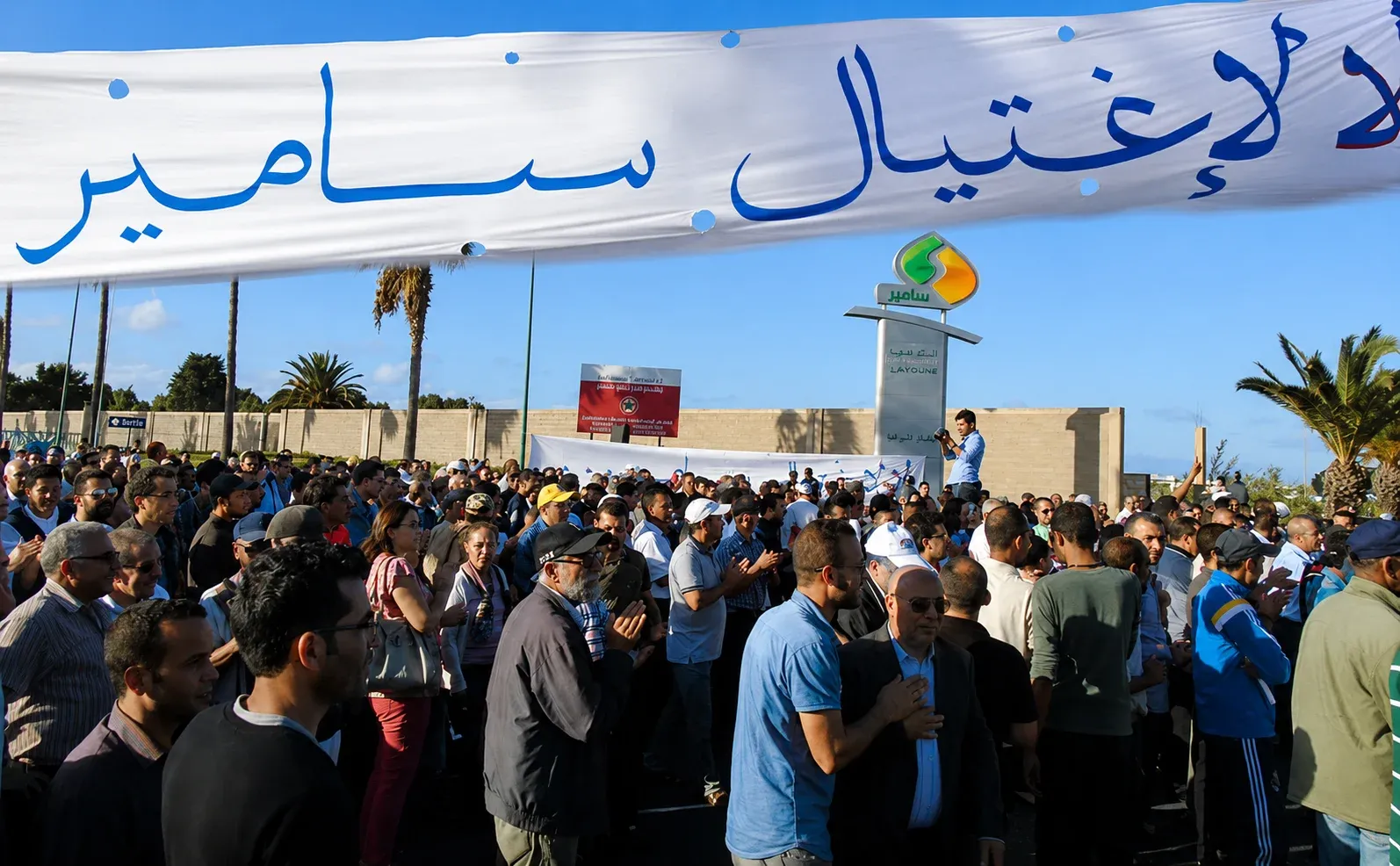
According to the last reported financial data (2014), Samir's revenues amounted to about $4.4 billion, with losses of $250 million. The last trading of the company's shares in 2015 saw prices plummet to 127 dirhams compared to a peak of nearly 1,100 dirhams in 2007. To this day, former employees report to the facility daily, spending their legal working hours at their posts and receiving monthly salaries, as the Commercial Court in Casablanca issues quarterly authorizations for the continuation of employee contracts. Consequently, numerous protests and marches have been organized over the years, calling for the revival and reopening of the Samir refinery.
But the story did not end with the closure; rather, it prompted legal battles. In 2018, Corral filed a lawsuit against the Moroccan government before the International Centre for Settlement of Investment Disputes (ICSID), claiming $2.7 billion in damages for what it deemed a breach of the investment protection agreement with Sweden. In July 2024, a ruling mandated Morocco to pay $150 million to Al-Amoudi, a decision confirmed by the centre in November of the same year, rejecting both parties' request for a review of the ruling. From the Moroccan government’s perspective, the case represented a failure of private investment that the state should not bear, while the investor argued that regulatory decisions contributed to the project's downfall.
Since the announcement of the liquidation, numerous offers have flooded in to purchase and acquire the refinery from various international parties. In 2017, Casablanca's commercial court offered all of Samir's assets for sale with an opening value of approximately $2.1 billion, receiving more than 35 local and international bids, yet none were accepted. In February 2023, the court opened the floor for new offers, resulting in 15 proposals ranging from $1.8 to $2.8 billion, some from companies in the U.S., India, the U.K., France, Spain, Saudi Arabia, and the UAE. Despite these offers exceeding the predetermined opening price, technical, financial, and legal obstacles have hampered the completion of any final deal.
Since the closure of Samir, Morocco finds itself in a unique predicament in the region; it has become a nation that consumes petroleum derivatives without local refining capabilities. The absence of the Samir refinery has created a void in the national supply system, forcing Morocco to rely entirely on imports to meet its fuel needs, rendering prices more susceptible to fluctuations in international markets. Consequently, Morocco's import bill for petroleum derivatives has surged into billions of dirhams annually, impacting the balance of payments and foreign currency reserves.
Estimates suggest that Morocco incurs annual losses between $3 and $4 billion due to the closure of the Samir refinery, manifesting as additional costs for imports and lost job opportunities and value-added. In response to calls for the refinery's revival, voices advocating for a transition to a new energy model based on renewable energies and liquefied gas have emerged, arguing that reviving the refinery may be a step backward in an era of green transition. However, experts contend that local refining does not conflict with the energy transition; rather, it provides a safety net for energy security during transitional decades.
In recent comments, the Minister of Energy Transition and Sustainable Development, Leila Benali, addressed the ongoing situation, expressing the government's view on the future of the Samir refinery.
As reported by attaqa.net.