
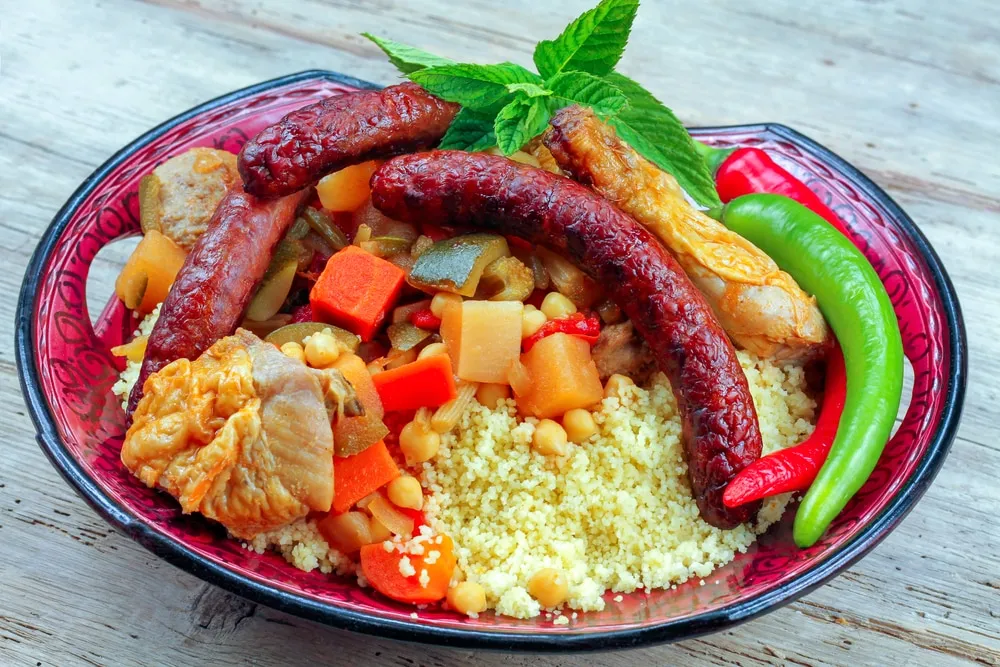
In December 2020, four countries—Algeria, Morocco, Tunisia, and Mauritania—jointly submitted a dossier to UNESCO to recognize couscous as a shared cultural heritage. This collaborative effort should have settled any ongoing debate regarding the origins of this ancient dish, yet discussions continue fervently on social media. Algeria and Morocco remain embroiled in a dispute over the rightful claim to couscous, a dish with a history spanning over 2,000 years. To draw a clear understanding, we must delve into historical facts and cultural significance surrounding couscous.
A Dish Older than the Modern Nations
Neither Algeria nor Morocco existed within their current borders when couscous emerged. Algeria gained independence in 1962, while Morocco followed suit in 1956. However, the Maghreb region has been home to various kingdoms and empires long before these modern states, including the Numidians, Almohads, Merinids, and Zianids. The origins of couscous can be traced back at least to the Middle Ages, and likely even earlier. Archaeological findings of tools resembling couscous makers have been unearthed in burial sites dating back to the reign of the Berber king Massinissa, around 200 BC, in what is now northeastern Algeria. These remnants, while significant, do not affirm any national identity; rather, they point to a broader geographical origin—Maghreb, populated by people who identified as Imazighen, without modern territorial boundaries.
Claiming couscous as exclusively Algerian or Moroccan imposes contemporary nation-states onto ancient civilizations that had their own kingdoms and identities, fundamentally different from today’s political landscapes.
The Berber Origin: A Consensus Among Historians
Historians generally agree on one pivotal point: couscous is an Amazigh dish with Berber roots. It emerged from a region that encompasses present-day Morocco, Algeria, Tunisia, and parts of Libya—yet not a single nation, but rather a cultural region. The very term 'couscous' is derived from the Berber word 'seksu', which denotes rolled semolina. Some argue that the Arabic term 'ta’am', meaning 'taste' or 'flavor', serves as evidence of an Arabic origin. However, 'ta’am' is not an etymological contender; it reflects the dish's sacrosanct status in Maghreb culture as the quintessential food, emphasizing its vital role across the region.
No singular country can lay exclusive claim to the Berber heritage that stretches across the entire Maghreb. The debate between Algeria and Morocco surrounding the origins of couscous is flawed from the outset.
In December 2020, UNESCO officially recognized couscous as part of the intangible cultural heritage of humanity, validating the collaborative submission from Algeria, Morocco, Tunisia, and Mauritania. This recognition is not merely a compromise; it institutionalizes the notion of a transnational culinary asset. In 2016, Algeria attempted to submit a solo application, which faced immediate backlash from Morocco, leading to a diplomatic resolution that saw the two nations collaborate alongside Tunisia and Mauritania. Ironically, those who sought exclusive ownership of couscous ended up sharing this accolade with two additional countries.
Each nation has developed its own unique tradition surrounding couscous, leading to distinct culinary variations that coexist harmoniously. The Algerian version showcases a remarkable regional diversity, incorporating red sauces in urban areas and butter or lben (a type of fermented milk) sauces in rural locales. The sweet variant, known as mesfouf, often features raisins or fava beans and is particularly popular in the north. The Moroccan interpretation is renowned for its 'couscous with seven vegetables', typically served on Fridays following prayers. The signature Moroccan flavor profile is enriched by the use of tfaya, a blend of caramelized onions, raisins, and cinnamon. Conversely, Tunisian couscous often incorporates harissa and tomatoes, lending it a distinctly spicier character, with fish variations that are rare elsewhere in the region.
While each country claims a unique style, it is important to recognize that the essence of couscous transcends national boundaries. It has evolved over centuries through the interplay of culture, trade, and adaptation. Thus, the notion of 'ownership' becomes irrelevant; rather, it is about how each culture has built upon a shared foundation.
Furthermore, the presence of couscous in France predates recent migration waves, with mentions dating back to as early as 1532 in Rabelais's _Pantagruel_ and further references by Alexandre Dumas in 1873. Its appearance at the 1889 Paris Exposition underscores its longstanding place in French culinary history, well before North African immigration made it a household favorite.
In summary, the historical and cultural implications of couscous reveal its true nature as a dish of shared heritage. The claims of exclusivity by either Algeria or Morocco overlook couscous's rich and complex history, marked by centuries of movement, exchange, and adaptation throughout the Maghreb. Those eager to engage in a spirited debate might instead ponder which version reigns supreme, allowing for a conversation that genuinely celebrates the diversity of this beloved dish.
As reported by generationvoyage.fr.


