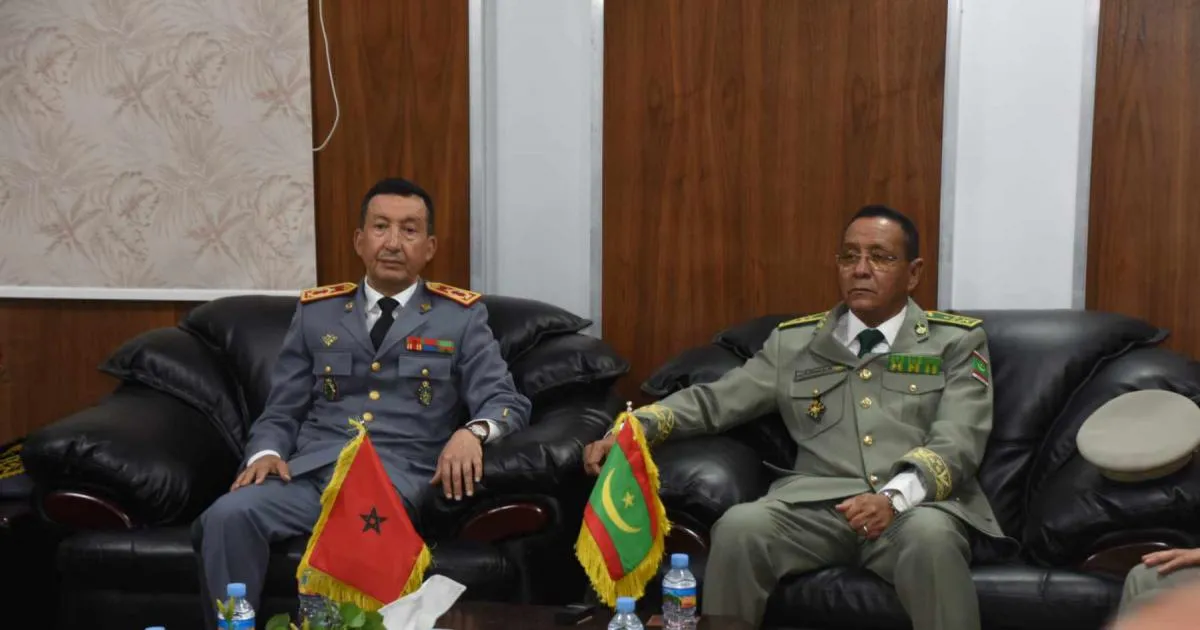
In a significant development for regional security, Morocco and Mauritania are advancing their military cooperation in response to increasing instability in the Sahel region, rising cross-border trafficking, and the persistent threat of terrorism, all exacerbated by geopolitical dynamics related to Western Sahara. The recent three-day visit of Lieutenant General Mohammed Berrid, Inspector General of Morocco’s Royal Armed Forces and Commander of the South Zone, to Nouakchott marks a pivotal moment in this evolving partnership, demonstrating that military relations between Rabat and Nouakchott are expanding from mere technical coordination to more substantial strategic integration.
Central to this visit was the sixth session of the Moroccan-Mauritanian Joint Military Commission, co-chaired by General Berrid and Mauritania’s Chief of General Staff, General Mohamed Vall Ould Rayess. Both leaders acknowledged the “tangible outcomes” of their defense collaboration, which is increasingly perceived as vital for regional security. The growing military relationship received high-level political endorsement when President Mohamed Ould Cheikh El Ghazouani welcomed Berrid in Nouakchott, accompanied by Morocco’s ambassador to Mauritania, Hamid Chabar. This meeting underscored the commitment of both governments to enhance their military ties.
Further solidifying this partnership, Mauritanian Defence Minister Hanana Ould Sidi presented Berrid with the National Order of Merit, recognizing the strategic importance of the alliance. Although military cooperation between Morocco and Mauritania dates back to 1971, the current framework was formalized in 2006 with the establishment of the joint commission, which has gained renewed urgency in light of the escalating insecurity that spans from the Sahara to the broader Sahel region.
Official dialogues now increasingly address critical issues such as border surveillance, irregular migration, terrorism, organized crime, and trafficking routes that traverse the fragile desert borders. Analysts highlight that one of the most sensitive aspects of this partnership is the effort to stabilize border regions that are particularly susceptible to infiltration by armed groups, including those associated with Polisario, as well as smuggling networks involved in cocaine trafficking, arms transfers, and illegal migration.
Security expert Mohamed Tayyar noted that Mauritania has historically been vulnerable to infiltration by both terrorist organizations and criminal gangs. “Mauritanian territory has often been seen as an open field for terrorist groups and organized crime syndicates involved in cocaine trafficking, small arms smuggling, and irregular migration,” he stated. He emphasized that both Rabat and Nouakchott are intentionally structuring their military cooperation as a stabilizing mechanism, rather than as a bloc-based alliance, which allows them to enhance their defense capabilities without provoking broader regional tensions.
This developing defense architecture is also evident in their training cooperation initiatives. In December, a delegation from Morocco’s Royal Military Academy in Meknes visited Mauritania’s Military Academy for Combined Arms, engaging in academic training, field exercises, and exchanges in areas such as operational planning and military sports. Such collaborations signal a significant shift towards joint training and capacity building, laying the groundwork for long-term defense integration.
Additionally, the Moroccan delegation’s visit to the G5 Sahel Defence College further reinforced this trajectory, where both nations explored operational simulation systems and reviewed training programs aimed at enhancing preparedness against increasingly sophisticated regional threats. The discussions from the fifth joint commission session held in Rabat in November 2024 already outlined a cooperation agenda for 2025, focusing on expanding security and defense collaboration, with the recent meetings in Nouakchott serving to deepen that roadmap.
The timing of these developments is particularly crucial. As instability in the Sahel intensifies, driven by the spread of extremist violence, entrenched trafficking networks, and increasing migration pressures, the international diplomatic landscape surrounding Western Sahara has also shifted, elevating the strategic significance of Morocco-Mauritania coordination. For both Rabat and Nouakchott, this burgeoning defense partnership transcends mere bilateral military cooperation; it is evolving into a regional stabilizing axis, aimed at securing borders, safeguarding trade routes, and containing the spillover of insecurity from one of Africa’s most volatile regions.
As reported by middle-east-online.com.