Morocco and Ecuador's relationship is entering a phase of institutional consolidation that extends beyond mere occasional cooperation. The anticipated establishment of a Moroccan embassy in Quito is poised to become one of the most significant movements in Rabat's diplomatic strategy in Latin America. This initiative aligns with Morocco's broader approach to expanding its network of allies beyond the traditional Euro-Mediterranean axis, marking a pivotal moment in diplomatic relations.
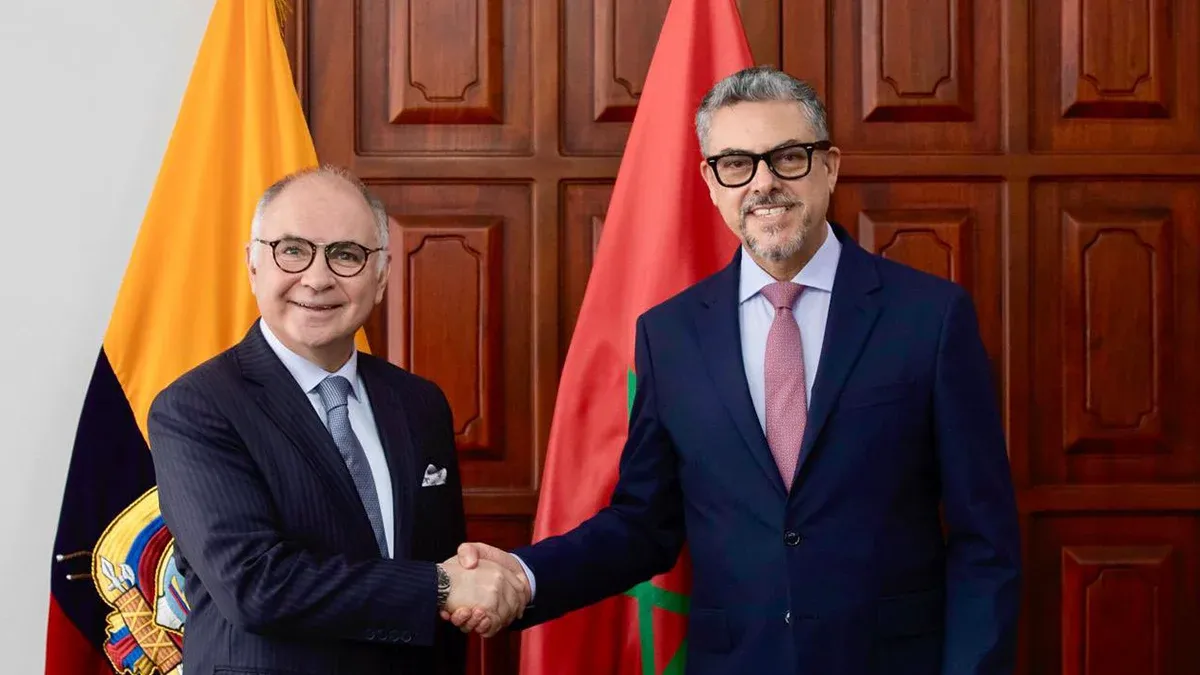
This process is unfolding alongside a bilateral agenda that intertwines political diplomacy, commercial interests, and cooperation in strategic sectors such as logistics, fertilizers, and foreign trade. In Quito, Ecuador's Deputy Foreign Minister Alejandro Dávalos welcomed the Moroccan delegation tasked with advancing the embassy's establishment. During their meeting, Dávalos emphasized the importance of this diplomatic step, asserting it as a “milestone that will strengthen bilateral ties with a strategic partner and open new avenues for cooperation in trade, investment, and development.”
The Moroccan delegation conveyed that the opening of this diplomatic mission in Quito reflects a long-term vision aimed at solidifying the Kingdom's institutional presence in Latin America, thereby enhancing political and economic channels with the Andean region. This move comes amid a backdrop of increasing Moroccan foreign activity, which has pursued a more assertive foreign policy over recent years, extending its reach towards Africa, the Arab world, and progressively, Latin America.
Simultaneously, the agenda during Ecuadorian Foreign Minister Gabriela Sommerfeld's visit to Morocco has reinforced this dynamic. Her visit included meetings with high-level business, industrial, and logistics stakeholders, thereby solidifying mutual interest in key sectors. A focal point was the business meeting between FEDEXPOR and the Moroccan General Confederation of Enterprises (CGEM). In this setting, the Ecuadorian Foreign Minister underscored her country’s commitment to “fostering partnerships that generate prosperity and real opportunities,” while the CGEM president highlighted the role of the Moroccan private sector as a catalyst for internationalization and a bridge connecting continents.
The CGEM, Morocco's primary business organization, is led by its current president, who orchestrates the Moroccan private sector's involvement in internationalization processes and investment attraction. Notably, the visit to the OCP Group emerged as a key highlight on the agenda. Led by CEO Mostafa Terrab, OCP is a significant global player in fertilizers and food security. During their discussions, the Ecuadorian Foreign Minister noted that “Ecuador is open to the participation of new actors who contribute to our common development goals,” emphasizing the interest in enhancing cooperation in agricultural supply chains, fertilizers, and innovations applied to the food sector.
OCP's leadership reiterated the importance of South-South cooperation and the group's role as a stabilizing force in global agricultural supply chains, especially in the current context of pressure on global food security. The logistical dimension of the visit focused on the Tangier Med Port, one of the Mediterranean and Africa's primary port hubs. This logistical complex is managed by the Tangier Med Port Authority, which is responsible for positioning it as a central node in global maritime trade.
With a capacity exceeding 9 million TEUs annually, the Tangier Med port ranks among the largest container ports in the Mediterranean and Africa. Its strategic location at the Strait of Gibraltar allows it to operate as a connection point between maritime routes linking Europe, Africa, America, and Asia, integrating into high-intensity global logistics chains. During the visit, Minister Sommerfeld expressed Ecuador's interest in this model, stating that her country seeks to “strengthen its presence in strategic markets and learn from successful experiences in logistics and international trade.”
Furthermore, the Ecuadorian delegation engaged with regional leaders in the Tangier-Tetouan-Al Hoceima area, discussing investment opportunities, connectivity, and territorial development. Local authorities underscored Morocco's role as a natural platform between Africa, Europe, and the Atlantic, a condition that enhances its appeal to international partners. This series of initiatives aligns with Ecuadorian President Daniel Noboa's strategy aimed at diversifying markets, attracting foreign investment, and expanding the country's international projection.
The potential opening of the Moroccan embassy in Quito is not merely interpreted as a diplomatic gesture; rather, it formalizes a relationship that has been maturing across various levels: political, economic, and institutional. Strategically, Morocco strengthens its position as an emerging player in Latin America, while Ecuador gains access to a partner experienced in advanced logistics, fertilizer industry, and intercontinental trade networks. The outcome is a relationship that extends beyond bilateral exchange, gradually integrating into a broader logic of reconfiguring global alliances.
For Mediterranean and Atlantic leaders, this relationship aims to serve as a bridge of communication, information, and understanding between cultures.
As reported by atalayar.com.