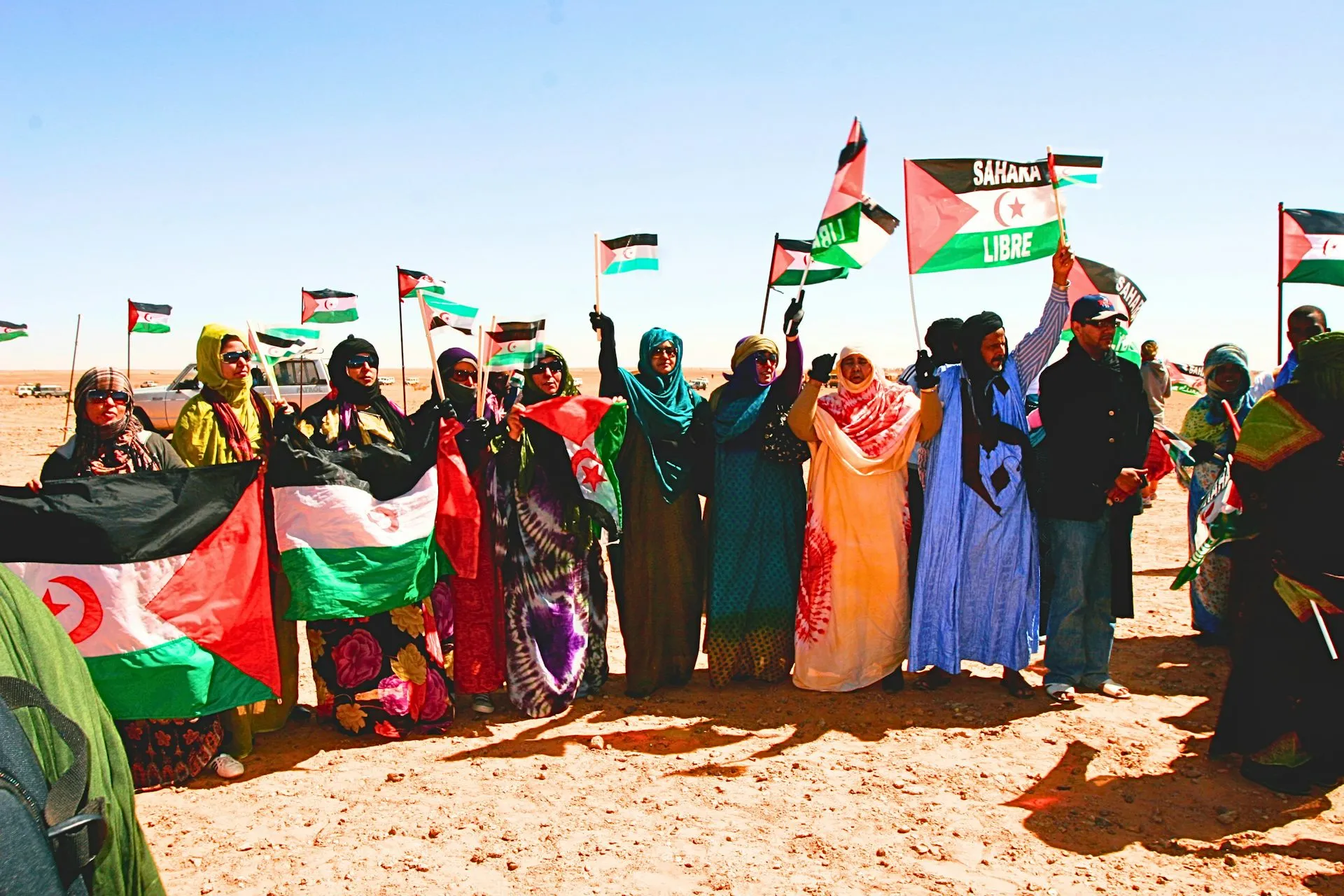
Pedro Sánchez, the Prime Minister of Spain, staunchly advocates for Ukraine’s right to determine its own future. However, since March 2022, he has supported Morocco's plan that denies the Sahrawi people their right to self-determination. The underlying reason for this apparent contradiction lies in Spain's reliance on Rabat for managing migration and ensuring security. This selective application of international law significantly undermines Spain's credibility on the global stage.
The stark contrast in Spain's position became evident following the drone strike that resulted in the death of Lahbib Mohamed Abdelaziz, a leader of the Polisario Front and the son of a prominent Sahrawi figure. This attack was attributed to Morocco and occurred amidst the visit of Staffan de Mistura, the UN Secretary-General's envoy for Western Sahara, to refugee camps in Tindouf, Algeria. The timing of these events highlights the ongoing conflict even as international negotiations are underway.
Spain's historical ties to Western Sahara complicate its current stance. As the administrative power until February 1976, Spain bears a historical responsibility that other European nations do not share. Therefore, any action taken by Madrid regarding the Sahrawi issue carries significant political, legal, and moral weight, transforming it from a distant crisis into a matter of national accountability.
The motivations behind Sánchez's shift from Spain’s traditional viewpoint are multifaceted. Firstly, the strategic partnership with Morocco plays a crucial role; Rabat is essential for Spain regarding migration control, police cooperation, and counter-terrorism efforts, as well as in commercial and energy matters. Following a diplomatic crisis in 2021, when Morocco allowed over 10,000 individuals to cross the Ceuta border in retaliation for the hospitalization of the Polisario leader, Brahim Ghali, normalizing relations with Morocco became a priority for the Spanish government.
This shift was formally announced in March 2022, when Sánchez sent a letter to King Mohammed VI, endorsing the Moroccan autonomy plan as the “most serious, credible, and realistic” basis for resolving the conflict. By doing so, Madrid aimed to stabilize essential territories like Ceuta, Melilla, and the Canary Islands. While this decision is understandable from a power dynamics perspective, it raises significant legal concerns.
Herein lies a fundamental contradiction. While Spain invokes international law to condemn Russia’s occupation of Ukrainian territories and demands respect for civilian populations in various conflicts, it simultaneously accepts a solution for Western Sahara that, as proposed by Morocco, restricts the Sahrawis' right to self-determination. This right was already acknowledged by UN Security Council Resolution 690 in 1991, which led to the establishment of MINURSO, a UN mission tasked with organizing a referendum that has yet to take place.
In essence, Spain applies the principle of self-determination vigorously in some contexts while allowing it to be relativized in others. This inconsistency erodes Spain's international credibility. While not all conflicts are identical, the selective application of principles diminishes their potency. This selectivity does not go unnoticed; it is recognized by Algeria, which supports the Polisario, as well as by numerous African and Latin American nations. Moreover, within Spain, many still view the situation in Western Sahara as an unresolved historical debt.
The current geopolitical landscape adds another layer of complexity. Spain aspires to be seen as a mediator in reaching agreements, but its stance distances it from being perceived as neutral. Although Madrid has hosted significant meetings about the conflict, supported by the United States and the UN, one party—the Polisario—understands that the Spanish government has already favored the Moroccan proposal. This perception limits Spain’s credibility as a negotiator.
Compounding these issues is the evolving nature of the conflict. The recent death of Lahbib Mohamed Abdelaziz emphasizes that Western Sahara is now embroiled in a technological and asymmetric warfare scenario. Morocco possesses advanced drones and military technology, while the Polisario lacks effective countermeasures. This disparity fuels the international inclination to accept a solution that consolidates Morocco's control, relegating the issue of self-determination to mere rhetoric.
In October 2025, the UN Security Council endorsed the Moroccan plan for the first time as a basis for negotiations, further solidifying Spain's position in the international arena. Yet, this acceptance raises a critical concern: if the international community, particularly Spain, prioritizes stability over legal rights, the message is clear—international law is applied selectively, depending on convenience. Thus, the Sahrawi situation transcends a mere forgotten conflict, transforming into an uncomfortable reflection of Spain's foreign policy.
Ultimately, the key question is not just why Sánchez altered his position. The deeper inquiry is about what price Spain is willing to pay for this decision in terms of coherence, credibility, and historical memory. Striving for a useful relationship with Morocco is one thing; accepting that utility justifies abandoning principles that are deemed non-negotiable in other contexts is another. If international law is genuinely valuable, it must apply even in challenging circumstances. If not, its worth is called into question.
As reported by theconversation.com.