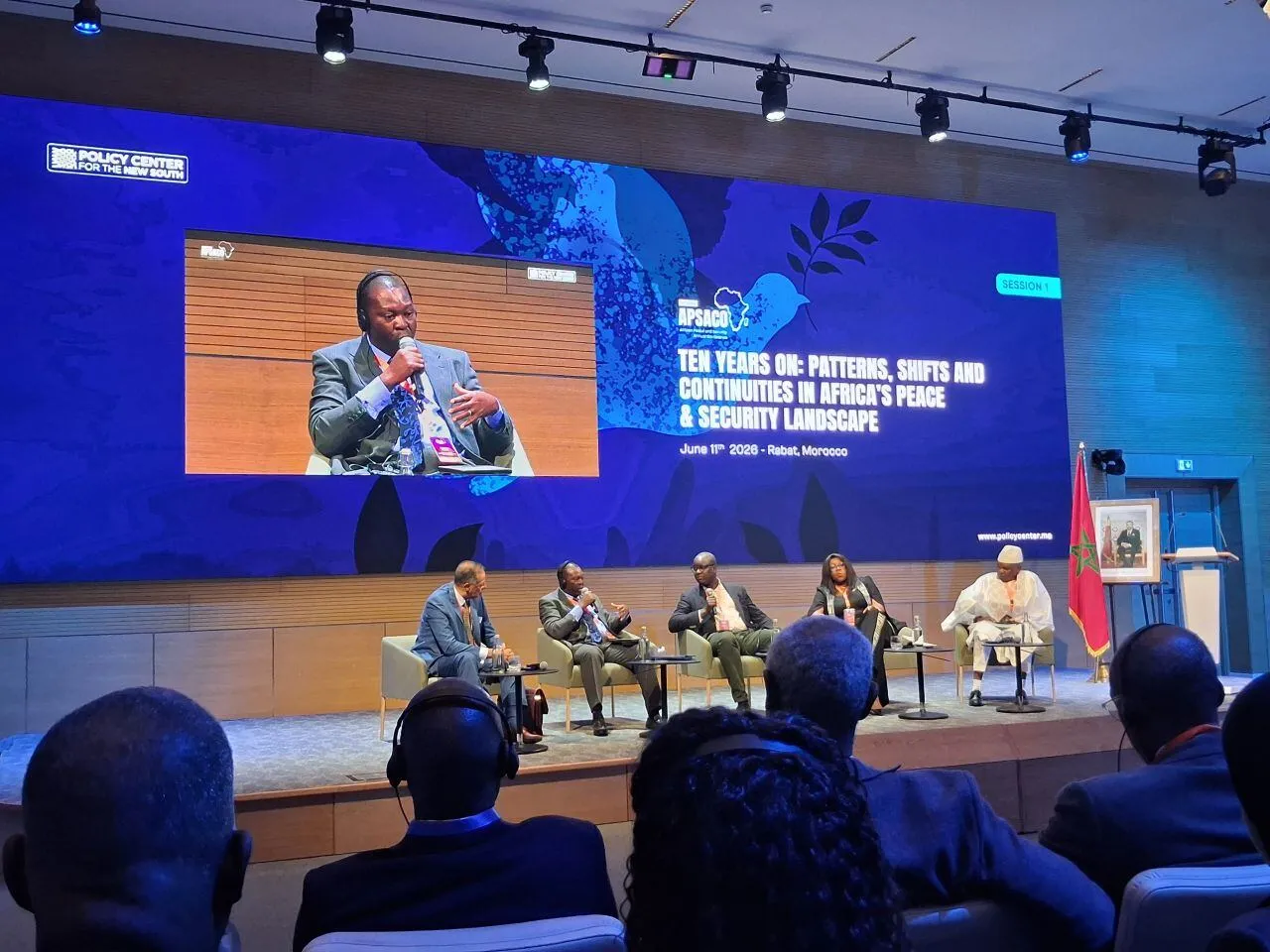
The first day of the 10th Annual Conference on Peace and Security in Africa (APSACO) could be encapsulated in a single image: a continent staring into a fractured mirror. Organized by the Policy Center for the New South, this anniversary edition, themed "A Decade in Review: The Evolution of the African Security Landscape," offered no comfort of celebration. Instead, it unveiled, with sometimes brutal honesty, the institutional fractures and political failures that are reshaping the influence map across West Africa. A stark divide emerged at the heart of the discussions, showcasing two conflicting visions of regional sovereignty: one championed by the countries of the Sahel States Alliance (AES), and another defended by coastal states striving to maintain the security architecture inherited from the Economic Community of West African States (ECOWAS).
The inaugural session immediately illuminated this rift. When asked about the most significant transformation of the past decade, Sampala Balima, Deputy Director General of the National Center for Strategic Studies of Burkina Faso, did not hesitate to point out the “institutional fracture resulting from the withdrawal of states from ECOWAS,” which she believes has reconfigured their security, institutional, and regional space into two blocks, which she hesitantly referred to as minilateral. This statement acted as an electric shock within the audience. For Balima and the regimes she indirectly represents, the emergence of the AES is not merely a diplomatic detail; it marks a crucial strategic rupture, the birth of a new security pole liberated from former tutelage.
However, this view faced immediate counterarguments from Garba Abdoul Azizou, former Special Advisor to the ousted President of Niger, Mohamed Bazoum, and an associate researcher at CECRI-UCL. Now living in Belgium since the coup, Azizou provided a profoundly opposing analysis, downplaying the structural significance of the AES: “Fundamentally, the birth of the AES has not changed the security situation that the states are currently experiencing. There is nothing original apart from the fact that three countries, facing the same terrorist threat, have come together.” For him, it is merely a patching of old frameworks like Liptako-Gourma or the G5 Sahel.
The danger, he emphasizes, lies in the illusion of small-group solutionism. In the face of threats that disregard borders, “a group of countries cannot resolve this phenomenon. We must move towards a broader context that includes ECOWAS countries and beyond, to the Gulf of Guinea states.” This confrontation between Ouagadougou and the pro-Bazoum Nigerien diaspora encapsulates the deadlock in West African security governance. On one side, there is a logic of blocs founded on distrust and a martial conception of sovereignty; on the other, a call for expanded multilateralism that, to date, has failed to establish credibility.
Professor Sharkdam Wapmuk from the Nigerian Defense Academy adds another layer of concern by observing not only an intensification of criminal networks but also a true web among actors of violence: “We see a situation where terrorists, gangs, and kidnappers are constructing stronger networks among themselves.” This symbiosis of crime and insurrection evolves more swiftly than the fragmented state structures meant to combat it.
Challenges of Peacekeeping Operations in Africa
If the first session revealed political fragmentation, the second, dedicated to a decade of peacekeeping operations, exposed its operational consequences. Jérôme Mellon, Political Affairs Officer at the UN, made notable confessions for a bureaucrat of the system. Discussing the experience of MINUSMA, the UN mission in Mali, he offered a candid diagnosis of the legitimacy crisis that has engulfed the mission. “The experience of MINUSMA in Mali is a very clear illustration of this loss of legitimacy. The mission was deployed in a contested political environment where consent was very fragile, expectations were unrealistic, and there was a polarization of political discourse.”
Mellon emphasized what is now seen as a truism in the air-conditioned corridors of capital cities, yet a heresy on the ground. “Peacekeeping cannot substitute for political will where it does not exist. Peacekeeping is a political instrument before it is a military or technical one,” he argues. It is precisely this absence of political will that hinders security architectures. The session highlighted a paradigm shift. Public opinion and host governments no longer judge the technical competence of Blue Helmets but their intrinsic legitimacy to operate. “The lesson is that legitimacy must be pursued and earned,” Mellon asserted, advocating for dialogue with communities rather than just with elites “in the air-conditioned offices of the capital.” This quest for legitimacy explains the thirst for “regional and national ownership” observed over the past decade, a trend praised by the UN but which, pushed to its extreme, produces isolationist monsters.
In this regard, the contrast presented by the presence of Commander Mame Rokhaya Lo, Senegal's first female pilot in the national gendarmerie, was striking. In a panel that also included General Sidiki Daniel Traoré, Military Advisor to the Chief of Staff of Burkina Faso, two models of security governance were silently observed. General Traoré, adhering to the prevailing doctrine in Central Sahel, theorized the fusion of military and political realms, justifying the intervention of armed forces in civilian matters. “It must be said, the military intervenes when there is a failure of politics. Therefore, to avoid this reservation, politics must genuinely respond to the expectations of the populations.” This represents the establishment of a military substitute for the failing civil state.
Conversely, Dakar quietly continues to embody the figure of a stable country that “has something to offer other African countries,” to quote moderator Ousmane Ndiaye. Commander Lo, drawing from her experience in MINUSCO, the UN mission in the DRC, symbolizes an army that remains under civilian control and projects itself into multilateral frameworks, in stark contrast to the sovereignist retreat observable in the Sahel. Senegal thus stands out as the anchor of an integrated security model, while Burkina Faso, Mali, and Niger embody the rupture.
Professor Sidi Mohamed Sidi, a Mauritanian jurist, reminded the audience that solutions do not solely lie in coercion or military alliances but in the resilience of state institutions. However, it is the terrorist threat that, in its movement, dictates the tempo. Professor Wapmuk linked this instability to structural factors such as “climate change, which has a significant connection to what is happening in terms of climate and migration.” For the coastal countries of the Gulf of Guinea, this observation serves as a warning: the porosity of borders transforms Sahelian fragilities into security challenges for Benin, Togo, or Côte d’Ivoire.
In conclusion, the first day of APSACO 2026 does not merely celebrate a decade of dialogue; it exposes its limits. The Moroccan think tank, by bringing together the rival factions of Sahelian geopolitics, offers a snapshot of an Africa that can no longer communicate with itself. On one hand, the AES, a bloc forged in urgency and anti-ECOWAS sentiment, attempts to impose its narrative of regained sovereignty. On the other, voices like that of Garba Abdoul Azizou warn that this institutional balkanization is a gift to armed groups. The painful truth may reside in the words of Jérôme Mellon: the Blue Helmets and sub-regional alliances will fail as long as they remain mere technical prosthetics on states lacking a legitimate political project.
The choice of Rabat as the setting for this dialogue is not insignificant. Morocco, which has bet on internal stability and discreet yet active security diplomacy, has positioned itself over the past decade as a facilitator among fractured sub-regions. By hosting this anniversary edition and previous ones, the Policy Center for the New South reaffirms the kingdom's desire to remain a platform for reflection and mediation at a time when West Africa is fracturing and former external partners are being contested. In this way, Rabat offers the neutral ground that is lacking on a continent in search of common reference points.
As reported by afrique.le360.ma.