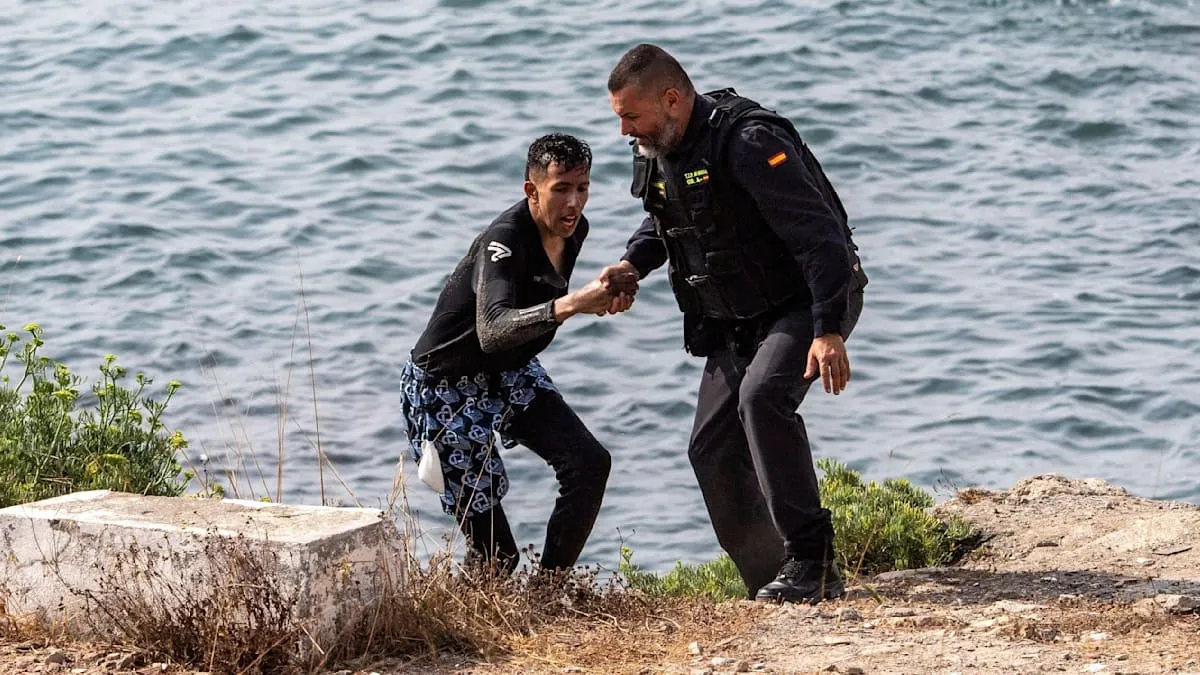
Massive Migration Attempt Highlights Ongoing Crisis
In a staggering display of desperation, over 800 migrants, primarily from Morocco and Algeria, made a perilous attempt to swim to Ceuta, a Spanish enclave located on the northern coast of Africa. This alarming migration event unfolded on a Wednesday, where many of these individuals were intercepted by Moroccan patrol boats before they could reach the Spanish shore. The Spanish Maritime Rescue Service played a crucial role, successfully rescuing more than 300 people from the treacherous waters, while tragically confirming the recovery of two bodies during the operation.
Context of the Migration Surge
The migrants launched their journey from Castillejos, a Moroccan coastal area closest to Ceuta, in hopes of reaching safety and better opportunities. Among those attempting the crossing were a significant number of young adults aged between 18 and 30, along with many minors, although exact figures have yet to be officially verified. Efforts by the Spanish Red Cross and the Civil Guard were instrumental in rescuing approximately 117 individuals from the sea, while the Civil Guard assisted around 200 more using patrol boats. Morocco responded to this migration emergency by deploying up to three maritime units to aid those who were still struggling in the water.
According to sources from the Maritime Rescue Service, the Salvamar Atria unit collaborated with the Civil Guard to manage the unfolding crisis effectively. During the exhausting rescue operations, the Civil Guard discovered two deceased migrants, suspected to have attempted the crossing in previous days. This sad discovery has contributed to a grim statistic, marking the total number of migrant fatalities along the Ceuta coastline in 2026 at 29, with 10 of those deaths occurring in July alone, six of which were linked to the current migration crisis that escalated over the weekend.
The ongoing crisis has led to significant overcrowding at the CETI, a temporary reception center in Ceuta. Local authorities report that over 1,500 individuals have entered the Spanish city illegally through swimming in just over a week, not including the most recent arrivals on Wednesday. This influx has overwhelmed the CETI, which has a maximum capacity of just 512 beds, already filled to capacity. Interestingly, while migrant arrivals in Spain overall have decreased in the first half of 2026 compared to the previous year, specific routes, particularly maritime paths to the Balearic Islands and land crossings to Ceuta and Melilla, have seen notable increases. For instance, land arrivals in Ceuta and Melilla surged by 140% from January 1 to July 15, 2026, reaching a total of 2,991, with Ceuta itself witnessing a staggering 149.4% increase in migrant landings compared to 2025.
As reported by efe.com.